Bohdan was located in Bialystok county. Bialystok county was administered by the USSR between 1939 and 1941. The Jewish population was decimated from almost 43,000 people in 1936 to 1,085 in 1945.
Archives
Bialobrzegi, Poland
Bialobrzegi is a town in Poland in the Masovian Province, about 60 kilometres south of Warsaw.
Before World War Two, Jewish trade in Bialobrzegi flourished. In 1931, Jewish merchants owned 59 grocery stores, 10 shops, 7 restaurants and bakeries out of a total of 112 shops in general.
In 1937, there were 1,677 Jewish residents of Bialobrzegi, half of whom were Orthodox.
In the first months of 1941, the Germans formed a ghetto in Bialobrzegi. The ghetto eventually had a total of 2,865 residents. The final liquidation of the ghetto was carried out in late 1942, the residents were taken on a death march to Dobieszyn. Those who reached their destination were loaded onto freight wagons, which transported them to the Nazi german extermination camp in Treblinka, where they were killed in gas chambers.
Belchatow, Poland
The town of Belchatow was occupied by the Germans during the first week of the war in 1939, during the High Holy Days. There was no formal ghetto, but some streets were earmarked as the Jewish district. The liquidation of the Jewish community of Belchatow occurred in August 1942 when close to 1,000 Jews were sent to the Lodz ghetto and 5,000 were deported to the extermination camp in Chelmno. No Jewish community was re-established in Belchatow after the war.
Bekescsaba, Hungary
In 1940, many Jews were sent to do forced labour in "labour battalions". After the Germans occupied Hungary in March 1944, the remaining Jews of Bekescsaba were deported to the Auschwitz-Birkenau concentration and extermination camp in occupied Poland, which they reached on 29 June 1944. After the war, 60 survivors from Auschwitz and some 240 from forced labour camps returned to the town.
Starachowice / Wierzbnik, Poland
Strachowice was home to eight of the Boys but many more were held as slave labourers in the city. The story of the labour camp is unusual and contributed to their survival.
PRE-WAR STARACHOWICE
Jews settled in Starachowice and Wierzbnik in the 18th century. The two towns merged in 1939. The population of 24,500 residents consisted of 13,880 Jews. Polish-Jewish relations were good-neighbourly and local Poles did not take part in the boycott of Jewish businesses in the late 1930s.
The Jewish community was active in civic and commercial life. Surrounded by forests Starachowice was a major timber centre. Plywood factories and saw mills were owned by Jewish families. The Starachowice iron ore works was founded by a Jewish family in the early 20th century but was nationalised when the town became part of the newly created state of Poland after the First World War. The factory was an important part of the local armaments industry.
After the arrival of a number of Jews from Russia after the Bolshevik revolution interest in Zionism began to grow in Starachowice. The town was also a Hassidic centre and there was support for Agudat Israel.
Jewish children attended a Hebrew school
LIFE IN THE GHETTO
The German army occupied Starachowice on 5 September 1939 and persecution of the Jews began immediately.
Many refugees from Lodz arrived in Starachowice swelling the Jewish population, as Lodz was part of Polish territory incorporated into the Third Reich.
A ghetto was set up in Starachowice in 1940. Those fit to work were taken as forced labour to the iron ore works, which was now a key part of the Nazi war effort and later became the Herman Goering Werke. Among them were those who later became members of the Boys.
The camp had an unusually high survival rate because the SS used a Jewish council to run the camp.
A number of other members of the Boys were also in the camp, including Simon Kalmowitz from nearby Kielce, Salek Benedict from Lodz and Schmul Laskier from Warsaw.
The Starachowice ghetto was liquidated on 27 October 1942. Those who were not taken into slave labour were taken to the Treblinka extermination camp. About 1500 became slave labourers and 5000 were murdered.
The labour camp was closed in July 1944 and the workforce, which included a number of the Boys, was deported to the Auschwitz-Birkenau concentration and extermination camp.
When the train arrived, there was no selection at the ramp as the workforce was already considered useful to the German war effort. As a result survival levels were considerably increased.
Some survivors who returned to Starachowice were murdered after the liberation and the vast majority of the survivors left Poland. Most of them settled in Israel.
PRESENT DAY STARACHOWICE
The synagogue is no longer standing but the city does have a very well preserved Jewish cemetery.
Sosnowiec, Poland
Sosnowiec is an industrial city in southern Poland, in the Silesian Voivodeship not far from the mining town of Katowice. The first Jews settled in the city in the 19th century.
It was home to six of the Boys but many more of them passed through the ghetto and labour camps.
PRE-WAR SOSNOWIEC
In 1939, about 30,000 Jews lived in Sosnowiec, 20% of the town’s population.
As it was an industrial city, Jews were active in trade unions. They played an important role in the 1905 Russian Revolution, as the city was then part of the Russian empire.
Jews were represented in all social classes and active in civic and commercial life as well as in the professions.
There was a lively cultural and religious life in Sosnowiec. There was a strong Zionist movement and Hebrew cultural life. In 1926, Jewish merchants created the Merchant Bank, which supported Zionist organizations.
WARTIME
Sosnowiec which was close to the Polish-German border was occupied within days of the German invasion in September 1939. The Great synagogue was burned down a week later.
A ghetto was established in March 1943. Many Jews from the surrounding area were brought into the ghetto which was linked to the ghetto in neighbouring Bedzin. As an industrial city Sosnowiec played an important part in the German war effort and the Jews in the ghetto were used as forced labourers.
The vast majority of the Jews held in the ghetto, approximately 35,000 people were deported to the Auschwitz-Birkenau concentration and extermination camp in the summer of 1943. Jews from Sosnowiec had been victims of murder at Auschwitz from its inception in 1940.
Among those who were deported to Auschwitz in 1943 was Motek Grzmot, who was selected to work when the train arrived in Birkenau.
Although there had been considerable antisemitism before the war and a bomb at been placed in the Jewish owned Hotel Bristol, some local Poles notably offered assistance to Jewish families and among those hidden was Rosa Turek, who came to the UK as part of the first group of the Boys.
As the ghetto was being liquidated the Jewish underground staged an uprising with the Jews in nearby Bedzin ghetto. Most of the 400 Jewish fighters perished.
The ghetto uprising is remembered in Sosnowiec where a street is named after the fighters.
PRESENT DAY SOSNOWIEC
After the war about 700 of the city’s Jews returned but were met with considerable antisemitism. Many survivors from further east settled after the war in the parts of Silesia that had been incorporated into the new Polish state, as there were empty properties that had belonged to the expelled German community.
As Zionist youth movements had played a major role in pre-war Jewish politics and most survivors were young people, it is not surprising that Sosnowiec became a centre where young survivors gathered before leaving Poland to travel illegally to the British controlled Palestine Mandate.
Place of Birth:
Associated Boys:
Radom, Poland
Radom is in south central Poland in an area which was the heart of the armaments industry under the Russian empire and after the First World War in the new Polish state.
Seven of the Boys who were born in Radom survived the war and it is believed that they all worked as slave labourers in German factories, which were integrated into the German economy and played a major role in the Nazi war effort.
It is likely that other members of the Boys spent time in Radom as slave labourers.
PRE-WAR RADOM
Jews settled in the city in the 16th century but the community only began to flourish in the late 19th century. Jews worked mostly in the tanning and metal business.
In 1938, the Jewish population of 29,745 was 29% of the total residents living in Radom.
The community was involved in local politics and embraced a wide variety of different allegiances from the religious Agudat Israel, Zionist organisations and the secular socialist Bund.
There was a lively Jewish cultural environment in the city with a theatre, literary society and over twenty educational institutions.
Ethnic relations were largely nonviolent prior to the German invasion of Poland but right wing Polish organisations organised boycotts of Jewish business.
WARTIME
The German army arrived in Radom on 8 September 1939 and the city and environs became part of Generalgouvernement.
With forced resettlements, the city’s Jewish population increased dramatically, reaching about 33,000 by 1942.
In April 1941, the Germans established two ghettos in Radom. Despite the extreme hardship and persecution, the Jews organized a network of self-help organizations and a civilian resistance movement that included clandestine schools and a theatre.
The Germans quickly rebuilt the Polish armaments factory that had been damaged in the attack and Jews were forced to work in the factory, among them Berek Wurzel and his sister Bluma Wurzel. Their father, a wealthy businessman used diamonds to secure their employment hoping that by becoming skilled labourers their survival might be insured.
In the summer of 1942, the Germans liquidated the ghetto. Most of Radom’s Jews, approximately 32,000 people, were murdered at the Treblinka extermination camp. Those who were working as slave labourers were not deported. There are only 67 known survivors of Treblinka where there was no selection made on arrival and prisoners were sent directly to the gas chamber.
About 3,000 remained in Radom as slave labourers. In the summer of 1944, the surviving Jews were deported to the Auschwitz-Birkenau concentration and extermination camp. Deportation to Auschwitz did not immediately condemn a prisoner to death, as a selection was made on arrival and offered a chance to be chosen for slave labour. The majority of those selected were between 15 and 30 years old.
LIBERATION
After the war those Jews who returned to Radom met at the Europejski Hotel. In the summer they numbered 1,198 and had formed a Jewish committee, set up a shelter and a prayer house.
Those survivors who returned to Radom, however, found themselves not welcome and Polish historians have recorded the murder of at least one of those who returned from camps.
Radom is not far from Kielce, a city that witnessed a pogrom in July 1946 in which 42 Jewish survivors were brutally murdered and 80 seriously wounded. It prompted a mass exodus of Jews from Poland.
The surviving Jews of Radom followed and in 1947 only 99 Jews remained in the city. By 1948 that number had shrunk to 30. Nearly all of them left but only after they had erected a monument to the ghetto on the site of the former synagogue.
Until the 1960s, a few Jews remained in the city, hiding their Jewish identity, but there are no Jews known to live in Radom today.
PRESENT DAY RADOM
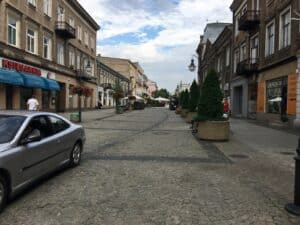
Radom has a pretty pedestrianized main street but is well off the tourist trail.
In 2017, the local council funded the publication in Polish of a Jewish memorial book, The Book of Radom. A small exhibition about the city’s Jewish past accompanied the book launch and a concert was held to commemorate the destruction of the ghetto.
The Jewish cemetery has been restored and can be visited on appointment.
Poles know surprisingly little about the country’s Jewish history but many young people are keen to discover and commemorate Poland’s lost Jewish communities.
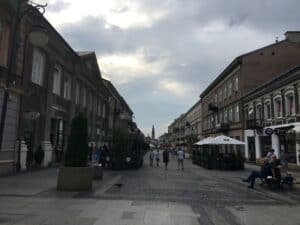
Gorlice, Poland
Gorlice is in southern Poland, close to the Slovak border.
Jews first settled in Gorlice in the 18th century and made a living trading timber, corn and wine. The community grew substantially in the late 19th century after oil was found in the area and Jews owned the local oil refinery.
Gorlice was home to eight of the Boys, who were born in the town, and at least two more of them grew up there. Zisha Swimmer grew up in the nearby village of Struzowska.
Slave labour played an important part in their survival.
PRE-WAR GORLICE
Jews played a major role in the commercial and civic life of Gorlice. They owned 90% of shops and 30% of craft workshops. There was a rich cultural and religious Jewish life and Gorlice had two synagogues.
In 1939, the Jewish population of Gorlice was 5,000, about half of the total. Many Jews fled eastwards after the German invasion of Poland in September 1939.
WARTIME
A ghetto was established in Gorlice in 1940. It was liquidated in September 1942, and the vast majority of the Jews in the ghetto were taken to the Belzec extermination camp.
When the ghetto was liquidated in 1942, some Jews were selected for slave labour. Some including Hersch Balsam, David Hirschfeld and his brother Moniek Hirschfeld and SzjayaPopiel were sent to the Krakow-Plaszowlabour camp.
From there the members of the Boys were transferred to work in the munitions camp of Skarzysko-Kamienna where many of the Boys worked as slave labourers. It was here that the group first began to come together. They were then deported via Czestochowa to the Buchenwald concentration camp in Germany.
PRESENT DAY GORLICE
After the liberation about 30 Jewish families returned. They found their property had been looted and the cemetery destroyed. Antisemitism made them seek a new future elsewhere.
Place of Birth:
Associated Boys:
Demblin-Irena, Poland
Demblin was home to eight of the Boys. The town, in the Lublin region of Poland, also played a part in the lives of a number of other members of the Boys who were in the Demblin labour camp, among them Jacob Fajngcesycht from the nearby village of Ryki and David Denderowicz, who was born in the small village Leopoldow.
Slave labour played a key part in the Boys survival.
PRE-WAR DEMBLIN
Jews settled in the area around Demblin in the 18th century. Until the partition of Poland in 1795, when the town became part of the Russian empire, Demblin was called Modrzyce and was home to the rabbinical Taub family.
Demblin has always been an important military town and in 1926 the biggest airport in Poland was built there. It was a centre for the training of fighter pilots. Demblin was also an important railway junction.
There were several Jewish bakeries in the town and Jews owned the soda factory, a brewery and the timber mill. A Jewish weekly newspaper was published in Demblin from 1929 to the outbreak of the Second World War.
Although Jews were not drafted into the Polish air force, or allowed to work for the state railway, Demblin’s Jews made a living supplying both.
Antisemitism grew in Demblin in the interwar period and there was a boycott of Jewish shops in the late 1930s.
WARTIME
During the German invasion of Poland in September 1939, Demblin was badly bombed, as was nearby Ryki. The raids killed 680 Jews.
The synagogue in Demblin was burnt down in October 1939 and persecution of the Jews began in earnest. Twelve Jews were burned alive in the synagogue.
All Jews from adjacent villages were placed in the ghetto of Demblin. Conditions in the ghetto were cramped and insanitary. Poles were allowed to enter the ghetto in 1941, so many of the Jews were able to survive by trading material goods for food.
In May 1942, 2,500 Jews were deported to the Sobibor extermination camp where they were murdered. A further 3,250 Jews were deported to the Treblinka extermination camp in September where they were gassed.
No Jews remained in Demblin by October 1942.
Demblin had five labour camps and the town was an important military base prior to the German invasion of the Societ Union in the summer of 1941. The Boys worked in these camps, notably the one at Demblin airfield.
One of the last Jewish labor camps in the Lublin District, it enabled hundreds of Jews to survive the Holocaust. The camp was closed in July 1944 and the workers moved to the HASAG labour camps in Czestochowa.
PRESENT DAY DEMBLIN
After the end of hostilities, 82 Jews returned to Demblin-Irena, nine of whom were murdered by Poles. All the surviving Jews left Demblin during the summer 1945.
Today, no Jews live in Demblin.
Częstochowa, Poland
The industrial city of Częstochowa in southwest Poland is famous for the Catholic icon the Black Madonna but, before the Holocaust, it was also home to a lively Jewish community and to six of the Boys.
Częstochowa played a role in many of the Boys lives as a large number passed through the HASAG labour camp and from there were deported to the Buchenwald concentration camp in Germany. It illustrates the importance of slave labour in their survival but is also significant as it was through this period that many close friendships among the Boys were formed.
PRE-WAR CZESTOCHOWA
When World War II broke out, 28,500 Jews lived in Częstochowa. They played an active part in industry, banking, civic and commercial life. The city was also a centre for doll manufacturing and many of the toy companies belonged to Jewish families.
Częstochowa was also an important centre of Hasidism and Zionist movements. A Jewish agricultural training farm and a trade school operated in Częstochowa during the interwar years. There was also a network of religious and secular Jewish schools, as in most large Jewish communities in Poland.
LIFE IN THE GHETTO
The Germans entered Częstochowa on Sunday, 3 September 1939 and persecution of the city’s Jews began immediately.
A ghetto was established on 9 April 1941. Some twenty thousand Jews from other cities (Krakow, Lodz and Plock) and nearby villages were also imprisoned in the Częstochowa Ghetto.
The German company HASAG ran a series of labour camps in the city, in which many of the Boys worked as slave labourers prior to deportation to the Buchenwald and Ravensbruck concentration camps in Germany.
During the Second World War, HASAG became a Nazi arms-manufacturing conglomerate with dozens of factories across German occupied Europe using slave labour on a massive scale. HASAG employed women as well as men.
The ghetto eventually held more than 40,000 people, of which approximately 39,000 were murdered at the Treblinka extermination camp. Elderly people in the home for the aged and the children in the orphanage were killed on the spot.
There was a little known underground resistance movement in the ghetto that maintained close contact with the Jewish Fighting Organisation in the Warsaw ghetto. The group fought back against the Germans during the deportations and liquidation of the ghetto.
LIBERATION
When the Red Army liberated Częstochowa, 5,000 Jews were still living in the area.
In June 1946, 2,167 Jews were living in Częstochowa. Training farms prepared Jewish youth for life in Palestine until 1948. After the establishment of the state of Israel, many Jews left Częstochowa and, after the Polish Communist Party’s antisemitic campaigns of the 1960s, nearly all the remaining Jews left the city.
Today, the main synagogue is a concert hall. The city has a Jewish museum and there is a memorial at the site of the HASAG labour camp.