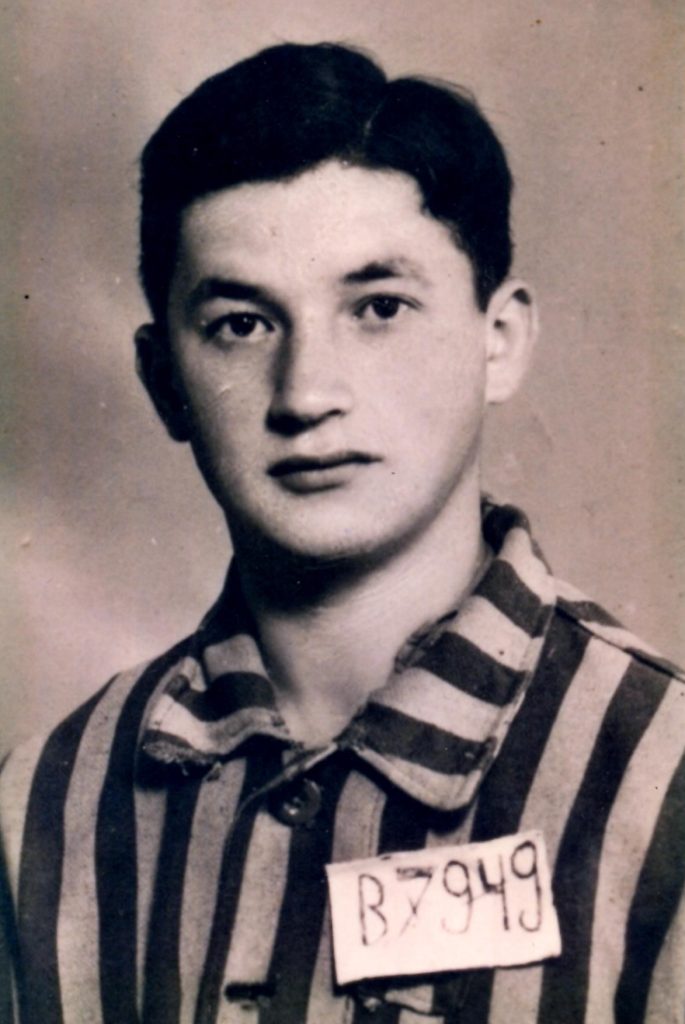
Members of the Boys were born in Nelipeno, now Nelipyno, Ukraine
The Boys were teenage and child-Holocaust survivors, who were brought to the UK after the war for rest and rehabilitation.
Members of the Boys were held in Nazi labour and concentration camps and used as slave labourers. They had also survived World War II in hiding or as lone children.
The Carpathian Mountains in the 1930s.
Nelipyno is a village is western Ukraine, near the border with Hungary and Slovakia, about 27km east of Mukachevo, on the banks of the Latorica river.
Until the end of World War I, Nelipyno was part of the Austro-Hungary. During the period between the two world wars it was incorporated in the state of Czechoslovakia. In the course of World War II it was occupied by Hungary. At the end of the war it became part of the Soviet Union.
Pre-war
Jews probably settled in Nelipyno in the first half of the 18th century. By 1880, the Jewish population was 209, out of a total population of 795. In 1921, under Czechoslovakian rule, the Jewish population rose to 496. Jewish families in Nelipyno earned a living from commerce and agriculture.
By 1941, the Jewish population had reached 672, out of a total population of 2,765.
Occupation
In 1938, Nelipyno and the surrounding area were annexed by Hungary and then incorporated into Hungary in 1939. The town became known as Harsfalva in Hungarian.
Jews were subjected to discrimination and antisemitic attacks. Men were sent into forced labour battalions and drafted for service on the eastern front, where most died.
In August 1941, those who could not produce Hungarian citizenship were deported and murdered in mass shootings.
Deportation
The Germans occupied Hungary in March 1944.
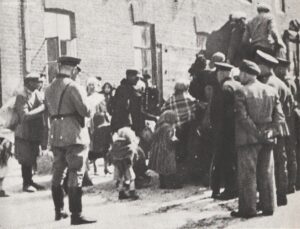
In April 1944, the Jews in Harsfalva were rounded up and placed in the Munkács Ghetto before, in May 1944, they were deported to the Auschwitz II-Birkenau concentration and extermination camp.
Liberation
After World War II, Transcarpathia was annexed by the Soviet Union. Harsfalva became part of the USSR and was renamed Nelipyno. Many Jews felt there was no future for them under Stalinism and either did not return to their homes or decided to flee westwards.
Former synagogue in Nelipyno
Present-day
No Jews live in Nelipyno today.
Visiting Nelipyno
>
Getting there Nelipyno is accessible by car or by train to Mukachevo or Volovets, followed by a local taxi or bus.
Note that the UK Foreign Office advises against travel to Ukraine because of the ongoing Russian invasion.
There is little to see of the town’s rich Jewish heritage.
The Jewish Cemetery (By the railway on Zelena ul.) The cemetery is well maintained and contains original tombstones.
Members of the Boys were born in Iršava in Czechoslovakia, now Irshava, Ukraine.
The Boys were teenage and child-Holocaust survivors, who were brought to the UK after the war for rest and rehabilitation.
Members of the Boys were held in Nazi labour and concentration camps and used as slave labourers. They had also survived World War II in hiding or as lone children.
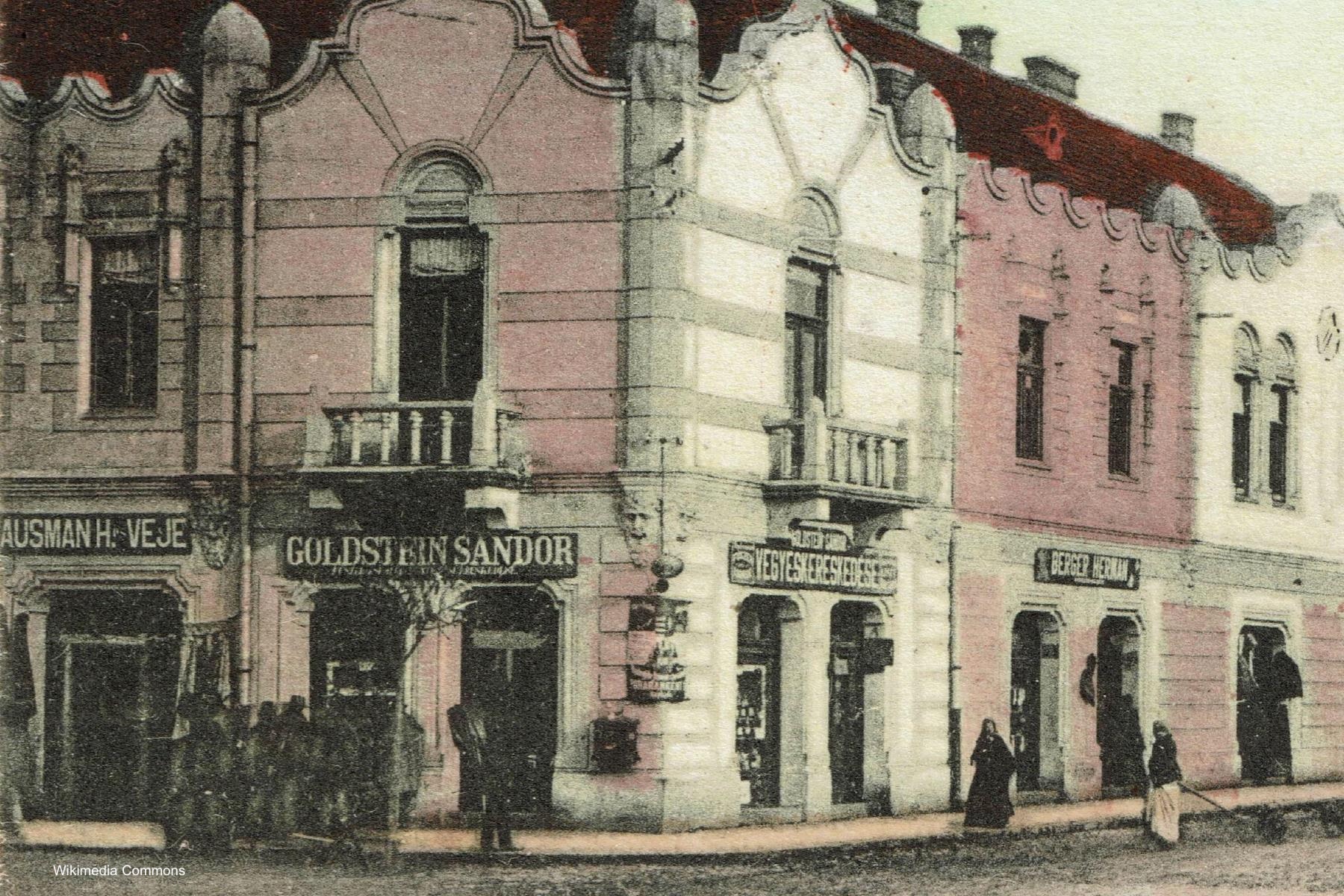
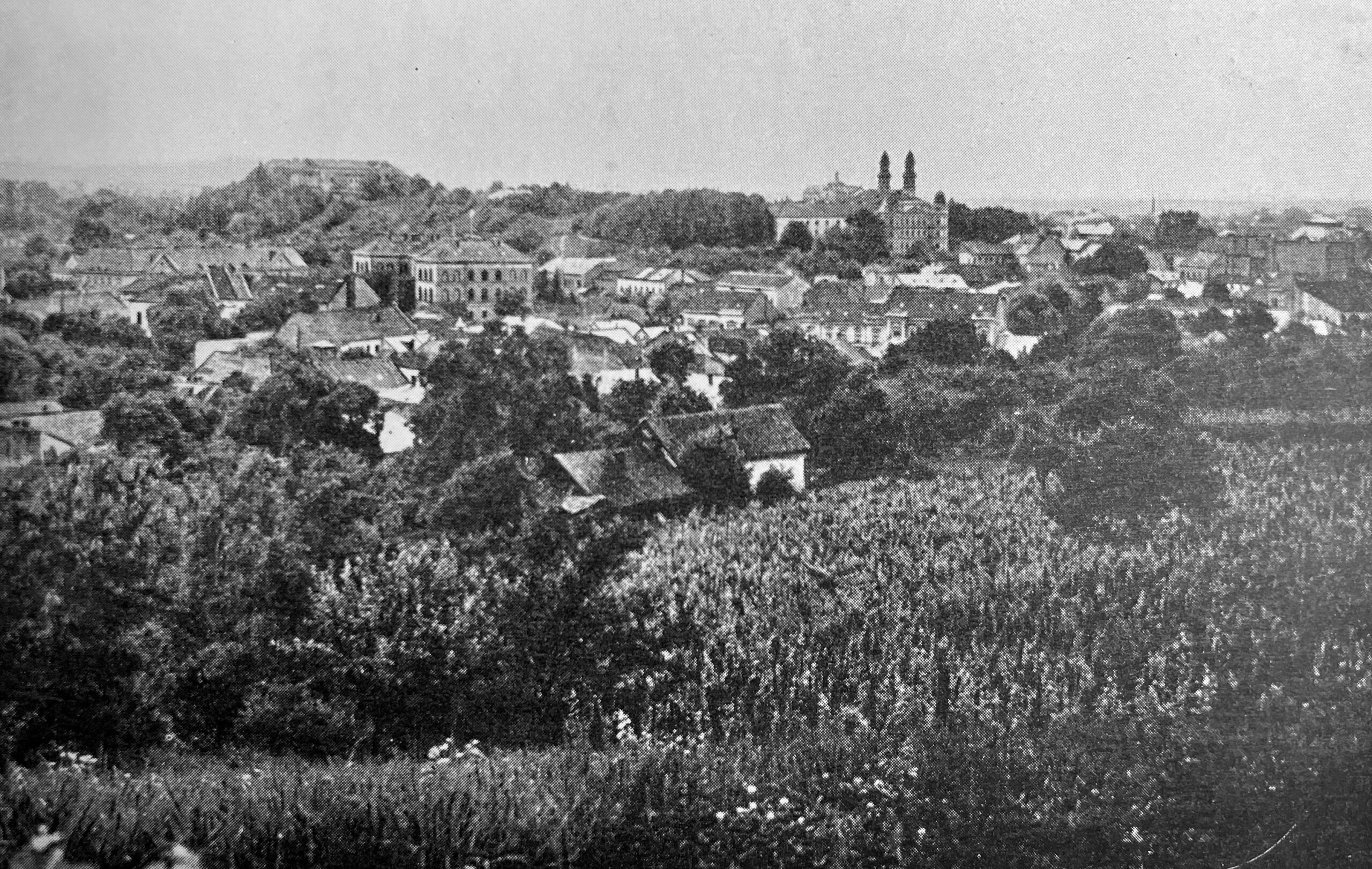
Old postcard of Irshava.
Irshava is situated in the region known historically as Transcarpathia, now western Ukraine. It is about 30km southeast of Mukachevo.
Until the end of World War I, Irshava was part of the Austro-Hungary. During the period between the two World Wars it was incorporated in the state of Czechoslovakia. In the course of World War II it was occupied by Hungary. At the end of the war it became part of the Soviet Union.
Pre-war
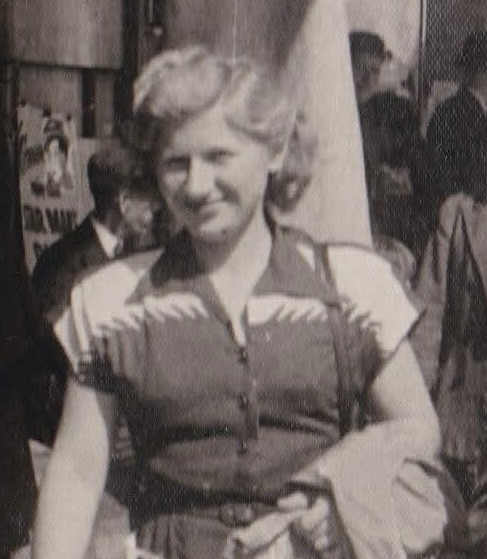
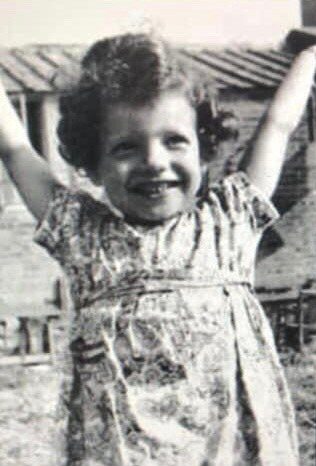
Irene Mermelstein, one of the Boys from Isrhava, in Brighton, 1947.
It is not known when the Jewish community of Irshava was established. The oldest tombstone of the Jewish cemetery is from the end of the 19th century.
Irshava’s yeshiva was established by Rabbi Yoel Teitelbaum, who had come to the town from Satmar before World War I. After the war, many Jews came to live near him and rabbis and heads of communities were among his disciples.
The Jews of the region were among the poorest in Europe, many living in rural areas and working in agriculture. Jewish families earned their livelihoods from trade and crafts. They worked mainly as traders and craftsmen, particularly as carpenters, blacksmiths, tailors, cobblers and painters.
At the beginning of the 20th century, two sawmills were built in order to establish a local furniture industry, as well as a chemical factory for wood, alcohol, acetone, and glue, employing Jewish workers.
The Jews of Irshava lived close to the main road which crossed the town. It was called “the Jewish road” in Yiddish. Most of the Jews had their own houses, with a flower garden in front and a vegetable garden and fruit trees at the back. Daily prayer services were held at the central synagogue.
In 1941, 1,393 Jews were living in Irshava. Most of its citizens were Ruthenians. The principal language was Ruthenian, but Hungarian, Russian and Czech were also spoken. The majority of the Jews spoke Yiddish among themselves.
Occupation
Following the Munich Agreement in 1938, Czechoslovakia was divided up and Irshava and the surrounding area were annexed by Hungary. The town became known as Ilosva in Hungarian.
In March 1939, the Hungarians occupied the region and imposed laws restricting Jewish access to education, trade, and the professions. Many Jews were persecuted and pushed out of their occupations. Jewish businesses were taken over by Hungarians but many remained closed.
In 1940, 150 Jews from Ilosva were drafted into forced labour battalions and others were drafted for service on the eastern front, where most died.
In August, 1941, a number of Jewish families, who could not prove their Hungarian citizenship, were expelled to Kamianets-Podilskyi in German occupied Polish territory, where they were murdered in mass shootings. A number of Jewish families of Ilsova managed to secure false documents with the help of a school official, and so evaded expulsion.
Deportation
The Germans occupied Hungary in March 1944. At the beginning of April of that year all the Jews in Hungary were ordered to wear the yellow badge on their clothes.
In April 1944, just after Passover, the Jews of Ilosva were forced into a ghetto with Jews from surrounding localities. Local Hungarian police confiscated all jewellery and watches.
On 22 May 1944, the ghetto was emptied and all its inhabitants were deported to the Auschwitz II-Birkenau concentration and extermination camp in occupied Poland. To find out more about the camp click here.
The number of Ilsova Jews who survived the war is not known.
Liberation
Ilsova was liberated by the Red Army in the autumn of 1944.
After World War II, the region was annexed by the Soviet Union in 1945. Ilsova became part of the Ukrainian Soviet Socialist Republic and was renamed Irshava.
A handful of survivors returned to Irshava. Most of the survivors found that their home’s occupied by strangers. Irshava’s Jews were either very religious and or Zionists. It was not possible to practice religious observance under Stalinism and Zionist politics could lead to arrest. As a result, most survivors chose to leave.
Present-day
In 2016, Irshava had about 9,000 inhabitants. It is thought that no Jews live there today, although the town hosted Jewish refugees from further east in 2022 after the Russian invasion of Ukraine.
Visiting Irshava
>
Getting there
The nearest airport to Irshava is Satu Mare in Romania. There are bus connections from Rzeszow in Poland to Irshava via Lviv abd Mukachevо.
Note that the Foreign and Commonwealth Office advses against travel to Ukraine because of the ongoing Russian invasion.
The former synagogue (11 Gargarian Street) is a private youth hostel.
Jewish Cemetery (Bld Zarichna) Some headstones remain.
Members of the Boys were born in Bratislava in Czechoslovakia, now the capital of Slovakia.
The Boys were teenage and child-Holocaust survivors, who were brought to the UK after the war for rest and rehabilitation.
Members of the Boys were held in Nazi labour and concentration camps and used as slave labourers. They had also survived World War II in hiding or as lone children.
Jews first arrived in Bratislava in the 10th century but a community only began to develop in the 17th century. The city was known by it German name of Pressburg for much of its history.
Pre-war
In 1930, approximately 15,000 Jews lived in Bratislava, which had a total population of 120,000. On the eve of the Holocaust the Jewish community was the largest in Slovakia.
Jews were active in local politics and cultural life. The city was a Jewish religious and political centre and home to the renowned Pressburg Yeshiva, as well as the Zionist Organisation of Slovakia.
Paul Loewner and his sister Hanna Tanner, both members of the Boys, were born in Bratislava.
In March 1938, following the annexation of Austria to Germany, hundreds of Jewish refugees arrived in the city.
Antisemitism was an issue in the inter-war period, as after the city’s inclusion in Czechoslovakia, the local Slovak population identified the Jews with the city’s former German and Hungarian elites. There were serious anti-Jewish riots in 1938 and 1939. As a result many Jews left Bratislava.
Wartime
After the creation of the Slovak state in March 1939, a Nazi ally, persecution of the Jews began immediately. Between March and October 1942, the Hlinka Guard (the paramilitary wing of the Slovak People’s Party), alongside Slovak police and military personnel, concentrated 58,000 Jews in labour camps, mainly in Novaky, Sered and Vyhne. There were no ghettos in the wartime Slovakian state.
By March 1942, when the deportations began, nearly half of the city’s Jews had been evicted, and dispersed in smaller towns across the country.
German forces occupied Bratislava in September 1944 and approximately 2,000 of the remaining Jews were sent to the Auschwitz II-Birkenau concentration and extermination camp in occupied Poland.
The vast majority of Bratislava’s Jews were murdered in the Holocaust.
Liberation
Of the over 15,000 Jews living in Bratislava in 1940 only about 3,500 survived. Jews returning to Bratislava from the war met with indifference and sometimes even hostility.
Rachel Levy was one of the Boys who spent time in Bratislava after the liberation.
Immediately after the war, Bratislava became the centre of Slovak Jewry due to the fact that many Slovak Jewish survivors preferred to settle in the relative safety of Bratislava as opposed to their former hometowns in the country. A number of the Boys spent time in the city.
Restitution issues and high levels of antisemitism led most survivors to believe that there was no future for the Jewish community in Slovakia. There were anti-Jewish riots in 1946 and 1948.
Despite this, Bratislava was a major transit point in the Jewish exodus out of eastern Europe in the years after the Holocaust, as Jews headed for the American occupied zone of Austria.
Rabbi Solomon Schonfeld
From 1945 until February 1949, more than 150,000 Jewish migrants passed through Bratislava, most of them walking across the bridge at nearby Devinska Nova Ves.
Rabbi Solomon Schonfeld, who brought the Fifth Group of the Boys to UK spent time in Bratislava after the liberation looking for orphaned Jewish children.
Aftermath
About 2,000 Jews remained in Bratislava in 1949, when the communist government took control of the country. Under communism Jewish religious and cultural life was gradually restricted and the property of Jewish organisations was nationalised.
In the 1960s, restrictions on Jewish life were eased and some Jews allowed to leave for Israel. Many more Jews left the city after the fall of communism.
Present-day
It is estimated that about 800 Jews now live in Bratislava.
Visiting Bratislava
>
Bratislava is a good place to start a trip to Slovakia, and it is in easy reach of Vienna.
Sadly much of the old Jewish Quarter was demolished in the 1960s during a communist-era development programme and is now covered by the bus station.
Getting there
Bratislava airport is the largest in Slovakia. There is also a bus service from Vienna airport to Bratislava 40km away.
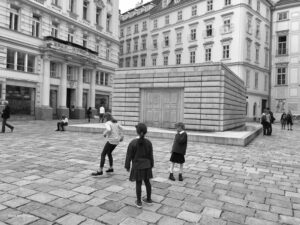
Holocaust Memorial in Bratislava, Slovakia.
Getting around
Bratislava is easily explored on foot. You will need a car to explore the rest of Slovakia but it is possible to visit Sered, Košice and other principle towns by train.
Museum of Jewish Culture (Múseum Židovskej Kultúry; Židovská 297; entry fee) The museum has 7,000 objects in its collection and focuses on everyday life and Jewish festivals. It is located in the Zsigray mansion, one of the surviving buildings from the original Jewish quarter.
Holocaust Memorial (Rybné Square) The memorial erected in 1996, stands on the site of the former Neolog Synagogue, which was demolished in 1969.
Synagogue (Heydukova 11–13) Bratislava has one functioning synagogue built in the 1920s in a Cubist design.
Further afield
>
Devínska Nová Ves
Bratislava sits on the border with Austria. As a result, it was an important stopping point for Jewish refugees from eastern Europe in the immediate aftermath of the Holocaust. Once the survivors arrived in Bratislava, many of them were taken to Devínska Nová Ves, 14km northwest of the city. The town is separated from Austria by the pretty Morava River, and in 1946 thousands of Jews were among the 100,000 who walked across the border here.
Today, there is a cycle route, the Cyklomost Slobody, the Freedom Bridge which leads into Austria. It was built in 2012 to celebrate the newfound liberty of the post-Soviet world. Sadly, though, you will find no mention of the Jewish refugees who passed this way after the war. They have been forgotten.
Sered
Slovakia has only one Holocaust museum, in Sered, 67km northeast of Bratislava, at the site of the former Sered concentration camp. To find out more click here.
Members of the Boys were born in Berehove in Czechoslovakia, now in Ukraine.
The Boys were teenage and child-Holocaust survivors, who were brought to the UK after the war for rest and rehabilitation.
Members of the Boys were held in Nazi labour and concentration camps and used as slave labourers. They had also survived World War II in hiding or as lone children.
The Carpathian Mountains in the 1930s.
Berehove is situated in the region known historically as Subcarpathian Ruthenia, now partly in western Ukraine.
Until the end of World War I, Berehove was part of Austro-Hungary. During the period between the two World Wars it was incorporated into Czechoslovakia. In 1938, the region was occupied by Hungary. At the end of the war the area became part of the Soviet Union.
Pre-war
The first Jews arrived in Berehove from Poland during the 18th century. By 1830 there were 200 Jews living in the city. By 1838 the Jews in Berehove had established an organised community. The majority spoke Hungarian, while many also spoke Yiddish and German.
The city had a Jewish school as well as a number of small yeshivas. During the 1930s a Hebrew school was founded.
On the eve of the Holocaust in 1941, Berehove was home to almost 6,000 Jews out of a population of 19,000. Some worked in agriculture, trade and crafts. Others owned factories, flour mills and banks, worked in agriculture and were doctors, lawyers, engineers, pharmacists or public officials.
Occupation Following the Munich Agreement in 1938, Czechoslovakia was divided up and Hungary annexed Berehove and the surrounding region. The town was then known by it Hungarian name of Beregszasz.
The Hungarians imposed laws restricting Jewish access to education, trade, and the professions. The Jews in Beregszasz had their business licenses confiscated, and five hundred men were conscripted into the Hungarian labour battalions. Many perished on the eastern front.
In August 1941, many Jewish families, who could not prove their Hungarian citizenship, were expelled to Kamianets-Podilskyi in German occupied modern-day Ukraine, where they were murdered.
Hugo Gryn after the liberation.
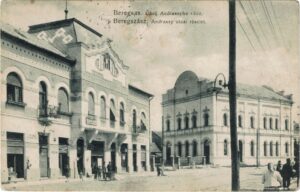
“In centre of the town there was a huge courtyard with the Great Synagogue, its elegant long windows facing the main square of the town. This was the synagogue where my father had his own seat …
Beyond the synagogue, on the town’s Main Street, there was a row of shops which belonged to the congregation, as did two arcades built in the modernistic style where kosher meat and poultry, as well as fish and Passover supplies were sold.
The last communal building facing Main Street was built in 1911 and housed the communal mikveh. Inside there was a long row of cubicles, each of which contained a bath-tub followed by a few steps that led to two large ritual pools.”
Hugo Gryn was born Hugo Gruen in Berehove in 1930.
The Gruen family lived on Rozsoskert 72. To find out more about Hugo Gryn’s life click here.
Deportation
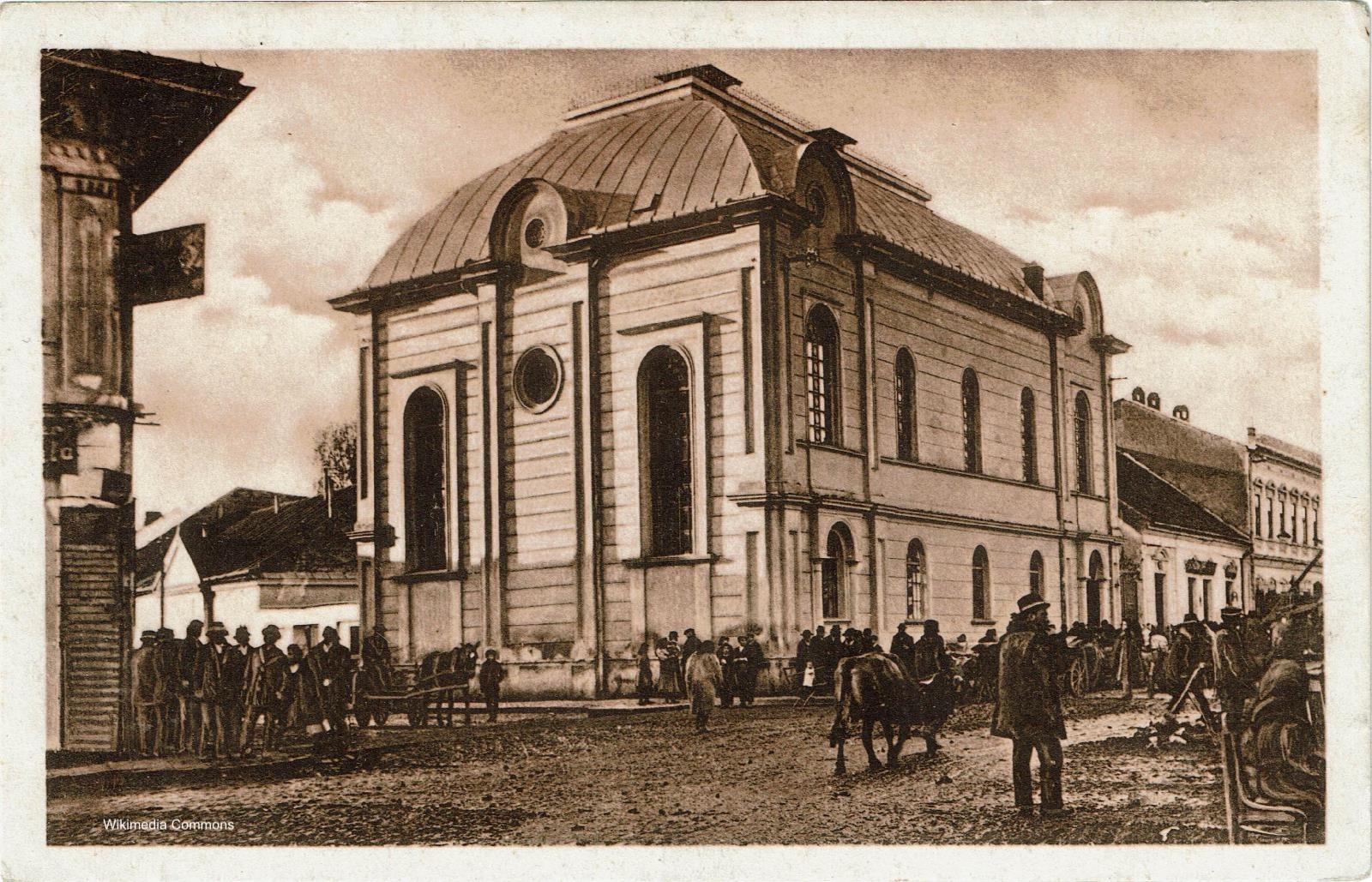
The synagogue in Berehove, then Czechoslovakia.
In 1944, the Germans invaded Hungary. In May 1944, around 3,600 Jews from Beregszasz as well as others from the surrounding area were placed in a ghetto and then deported to Auschwitz II-Birkenau concentration and extermination camp. To find out more about the Beregszasz Ghetto click here.
When the trains arrived in Birkenau, a selection was made on the ramp. It offered healthy young men and women a chance of survival as they were often selected for slave labour.
An estimated 85% of the Jews from Subcarpathian Ruthenia perished in the Holocaust.
Liberation
In the autumn of 1944, the Soviet Red Army entered the town.
The region was annexed by the Soviet Union in 1945. Beregszasz became part of the Ukrainian Soviet Socialist Republic.
After the war, survivors attempted to restore the community. However, they met with a hostile reception from the city’s inhabitants. When they returned home, most of the survivors found that their home’s were occupied by strangers.
Most of Berehove’s Jews were either very religious and or Zionists. It was not possible to practice religious observance under Stalinism and Zionist politics could lead to arrest. This prompted Jewish survivors to leave.
Present-day
A small community of Jews, numbering about 50 people live in Berehove.
Visiting Berehove
>
Berehove, Ukraine
Getting there The town of Berehove is located near the Ukrainian border with Hungary. There are train there are connections to Chop and from there to Košice in Slovakia. Berehove is also acessible by bus and car.
Note that the Foreign & Commonwealth Office advises against all travel to parts of Ukraine because of the ongoing Russian invasion.
What to See
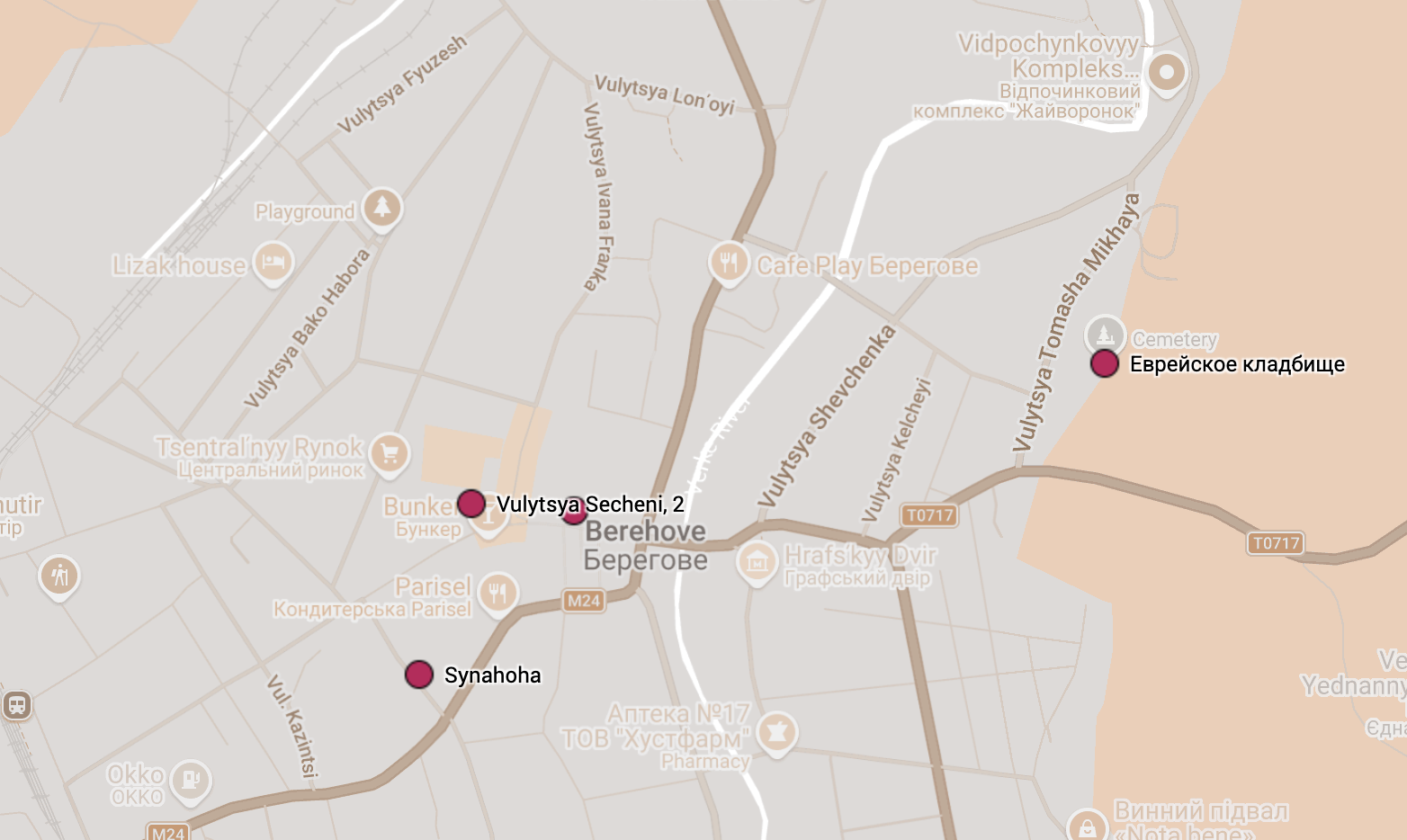
The Grand Synagogue (Kozsut Square, near the Ferenc Rakoczi II Transcarpathian Hungarian College of Higher Education) In the heart of the city centre, the building was used as a synagogue until 1959 when it was transformed into a cultural centre and surrounded by a concrete “shell.” A restoration project, supported by Hungary, aimed to restore its original façade, with plans to include a museum, theatre, and potential new wing were announced in 2022 just before the Russian invasion of Ukraine.
Former Mikveh (Secheni 2) The former Jewish ritual bathhouse is now used as a bank.
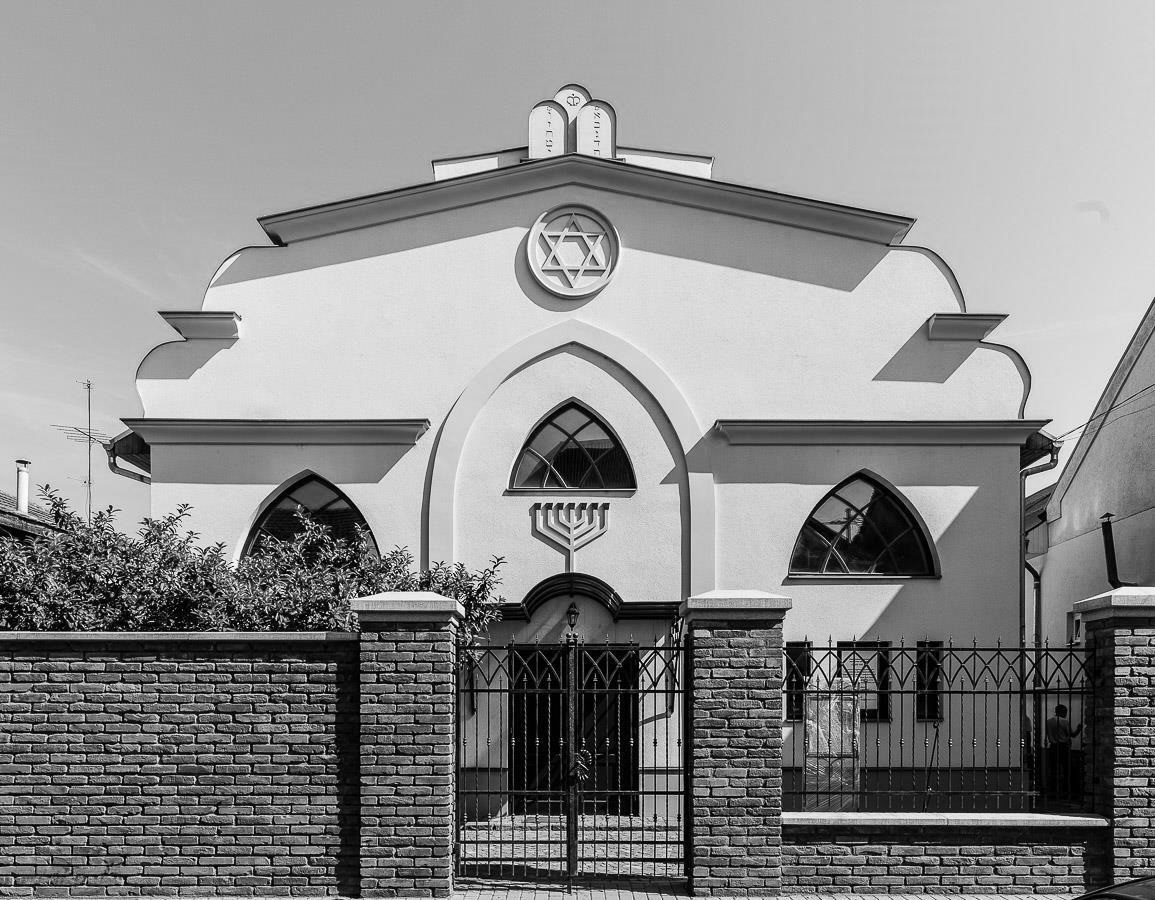
The Small Synagogue (8 Zrinyi) There were once six synagogues in Berehove, including the Great Synagogue. Built in the 1920s this is the only functioning Jewish religious building in the city. There is a memorial plaque to victims of the Holocaust and a small museum. The synagogue has no rabbi, and is sustained through donations.
The Jewish Cemetery (Еврейское кладбище behind houses 28 and 30 on Tomasha Mikhaya) has been restored and retains numerous original tombstones, the oldest dating from the 18th century.
Jewish Community
Shalom Foundation of Berehove (4 Mukachivska; e shalom.beregszasz@gmail.com)
What to read
>
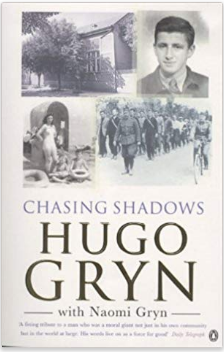
Chasing Shadows: Memories of a Vanished World by Hugo Gryn with Naomi Gryn (Viking, 2000) Gryn was a member of the Boys. To find out more about the book click here.
Members of the Boys were born in Warsaw in Poland.
The Boys were teenage and child-Holocaust survivors, who were brought to the UK after the war for rest and rehabilitation.
Members of the Boys were held in Nazi labour and concentration camps and used as slave labourers. They had also survived World War II in hiding or as lone children.
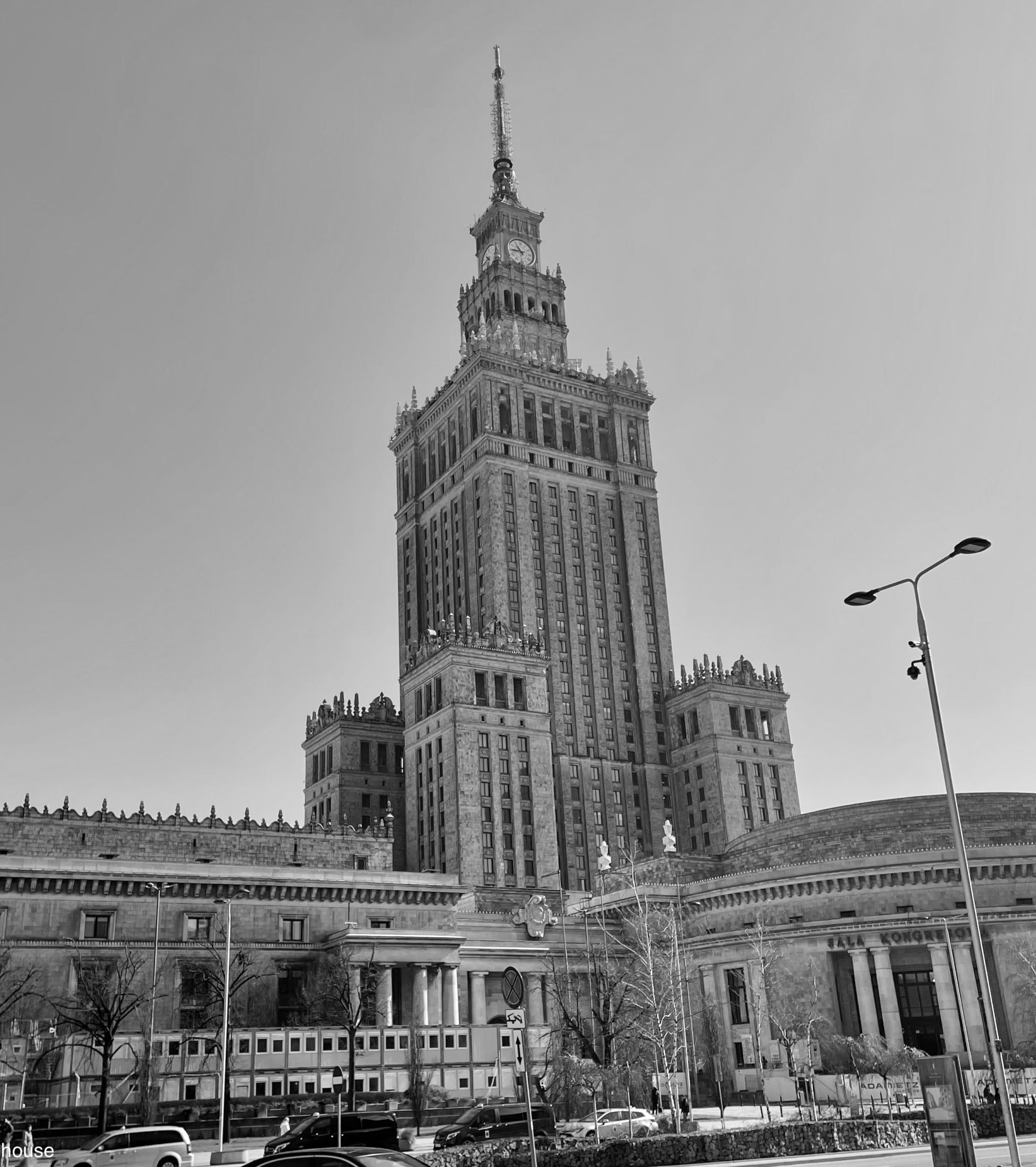
Palace of Culture and Science in Warsaw, Poland.
Before World War II, Warsaw was one of the world’s most important Jewish cities. It also played an important part in the story of many of the Boys’ families.
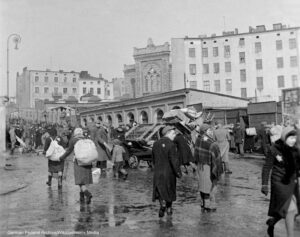
It was home to 26 of the members of the Boys, who were born in the city, but far more members of the Boys found themselves in the Warsaw Ghetto. Jews, who lived in the surrounding villages, were forcibly moved into the ghetto and many families fled to the capital during the German invasion. Many of the Boys’ families were also in the Warsaw Ghetto.
Pre-war
Jews first lived in Warsaw in the 14th century but were forbidden to live in the city from 1527 to 1768. After the third partition of Poland in 1795, Warsaw was part of the Russian empire and Jews from further east flooded into the city.
The Polish capital was an important centre for both Jewish religious and secular life. All social classes and political persuasions were represented in the community.
As the war approached, however, life became increasingly difficult for the city’s Jews as Jewish shops were boycotted and antisemitic legislation was introduced.
The Germans invaded Poland on 1 September 1939 and laid siege to Warsaw, which finally capitulated on 29 September. Persecution of the Jews began immediately.
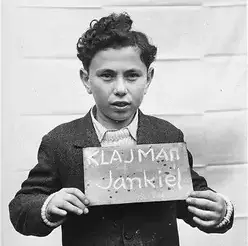
Abram RubinsteinSam LaskierJankiel Klajman
Three of the Boys for whom Warsaw was home. These photographs were all taken after World War II.
The Ghetto
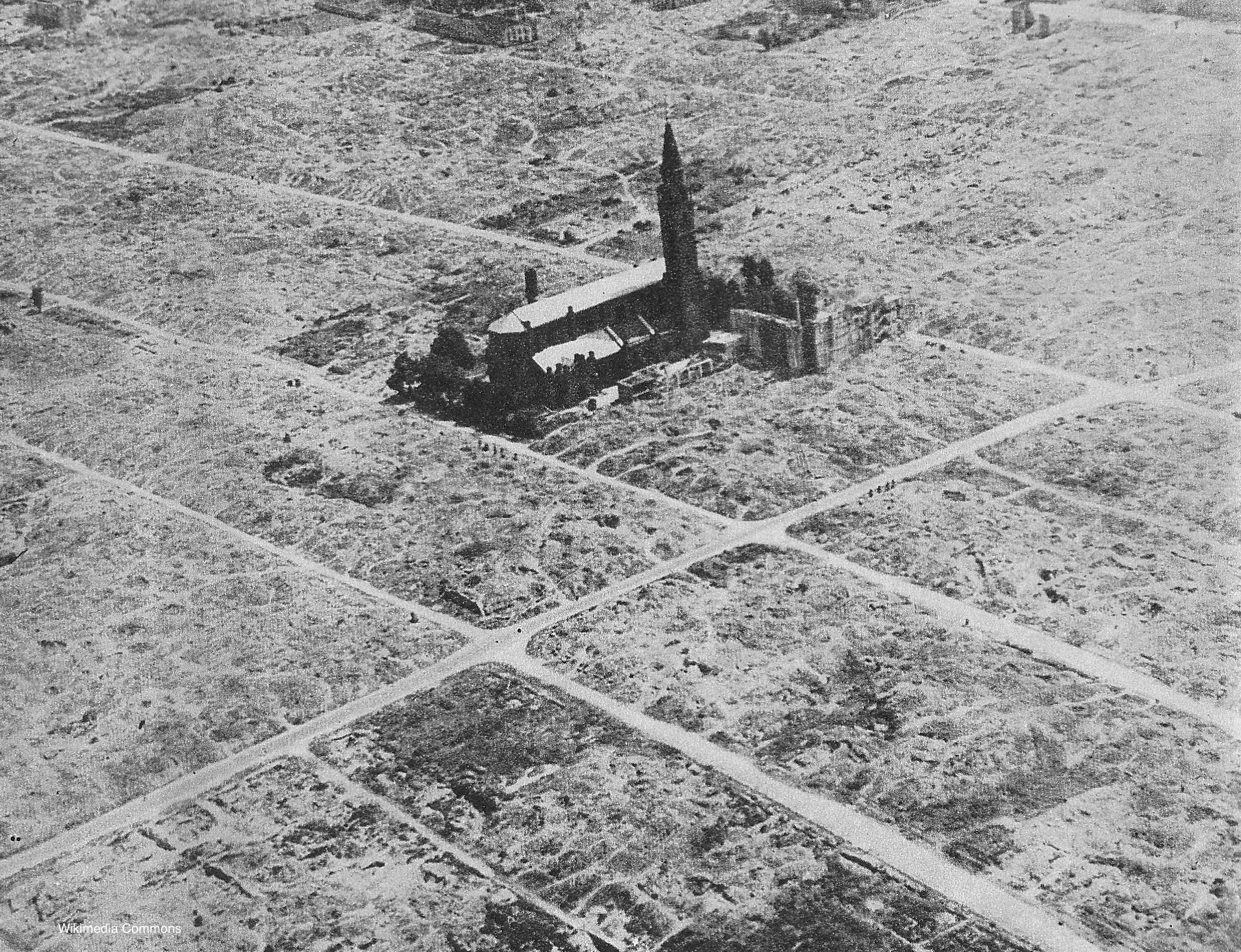
In November 1940, the Germans established a ghetto in Warsaw in the district of Muranow. It was the largest ghetto in occupied Poland and at its height 460,000 Jews were imprisoned there. To find out more about the ghetto click here.
The Uprising
Warsaw Ghetto Uprising 1943
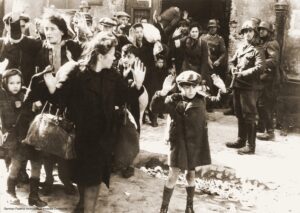
When the liquidation of the ghetto began on 19 April 1943, the Germans encountered a massive and unexpected resistance. It was the first large scale act of resistance by any civilian population in occupied Europe.
The ghetto was completely demolished in May 1943 and a number of the members of the Boys were brought to Warsaw from labour camps to sort through and level the ruins.
The Uprising is regarded as the symbol of Jewish resistance and is often mistakenly cited as an exception. Jewish resistance was far more common than is widely believed. Members of the Boys took part in the Uprising.
Liberation
About 2,000 Jews were liberated in Warsaw and by the end of 1945, 5,000 Jews settled in the city. The population doubled when Jews who survived the war in Russia returned to the capital. The city became the seat of the Central Committee of Polish Jews and a number of Jewish cultural institutions were opened in 1949.
The community immediately set about raising money to build a monument to commemorate the uprising which had already been designed by Nathan Rapoport while in exile in the Soviet Union. It was unveiled in 1948.
Antisemitism and communist persecution drove many Jewish survivors out of Poland in the post-war period, others left in the late 1950s and after the anti-Zionist campaign of the 1960s.
Present-day
About 2,000 Jews live in Warsaw today, although the figure is probably far higher as many of the Jews who live in the city are secular and come from families that hid their Jewish identity under communism.
The Boys’ Story: Three Lives
The Artist
The Nurse
The Scientist
Visiting Warsaw
>
Getting there & around
Warsaw is a hub for air and rail travel and easily reached. Most of the sites in Warsaw in both the area of the former Small Ghetto and around the POLIN Museum can be reached on foot. Buses link the two areas.
Good to Know The Jewish Historical Institute (ul. Tłomackie 5) publishes two useful maps of the ghetto and sites related to the Ringelblum archive. It is worth stopping by the institute to pick them up before setting off to explore the former ghetto.
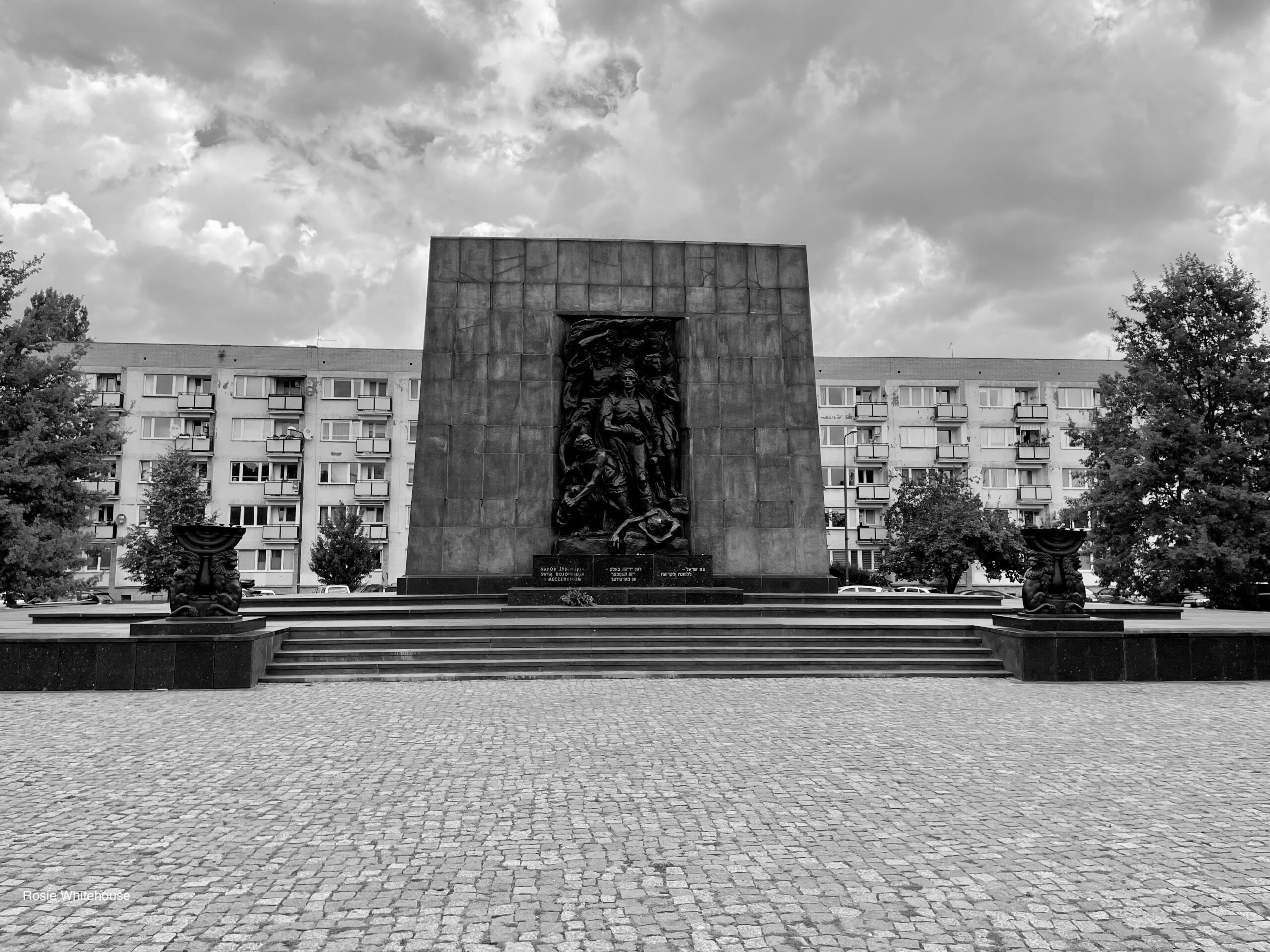
Monument to the Ghetto Heroes
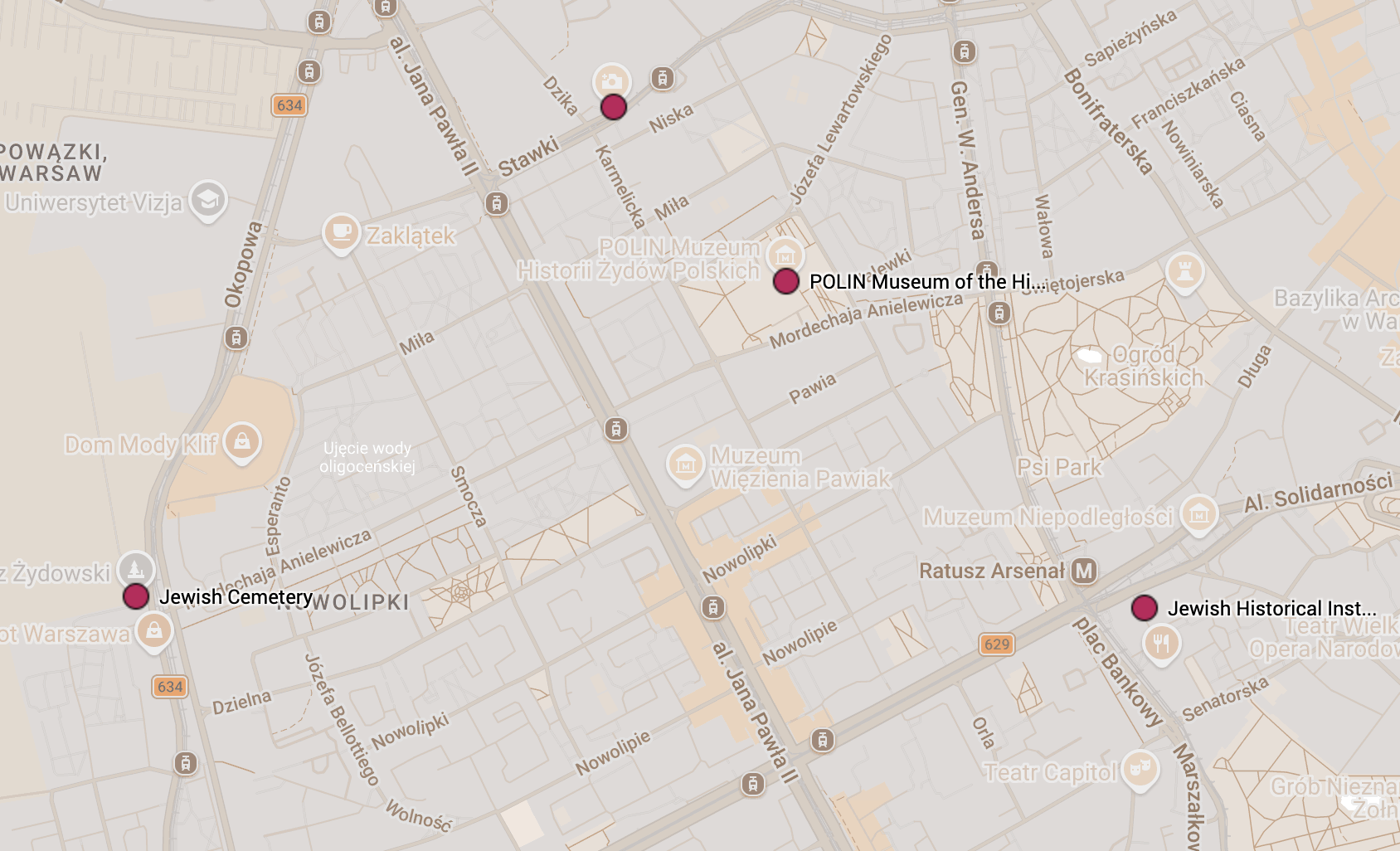
The Great Ghetto Area
The heart of the Warsaw Ghetto was the Murańow district, 1km east of the Old Town.
Great Ghetto Area, Warsaw
POLIN Museum of the History of Polish Jews (Mordechaja Anielewicza 6; entry fee) The museum tells the story of the Jewish community from their arrival in the country in the Middle Ages. Polin is the Hebrew name for Poland. Outside the museum on a bench is a statue of Jan Karski, who was a leading member of the Polish resistance.
Monument of the Ghetto Heroes (Opposite the entrance to the POLIN museum) The Memorial Route of Jewish Martyrdom and Struggle that begins here is marked by 16 granite blocks. They include:
The Anielewicz Mound (Mila 18, located in a small park) The bunker was the headquarters of the operations of the Jewish Combat Organisation led by 24-year-old Zionist Mordechai Anielewicz. When the bunker was discovered by the Germans on 8 May 1943, Anielewicz and 120 other fighters committed suicide by blowing up themselves up, while the others surrendered.
Umschlagplatz (Stawki 10) Before the war the station here had been used as a freight terminal. The Germans gathered up to 300,000 Jewish people here prior to deportation to the extermination camps. A memorial, in the form of a 4m-long wall with a black stripe on the front, was unveiled in 1988.
The vast Jewish Cemetery is located at the end of ul. Niska on Okopowa. The mass grave of those who died of hunger, disease and exhaustion is in the southeastern corner. This is where members of the Boys sneaked out of the ghetto to search for food for their families.
Warsaw Concentration Camp Memorial Plaque (ul. Anielewicz 34 by the Jewish Cemetery) The Germans opened a concentration camp in Warsaw in 1943. They brought 4,000 foreign Jews among them members of the Boys to sort through the rubble after the Ghetto Uprising. To find out more click here.
The Memory Bridge (ul. Chłodna) Marks the site of the wooden bridge across Chłodna built by the Germans to link the two areas of the ghetto. i
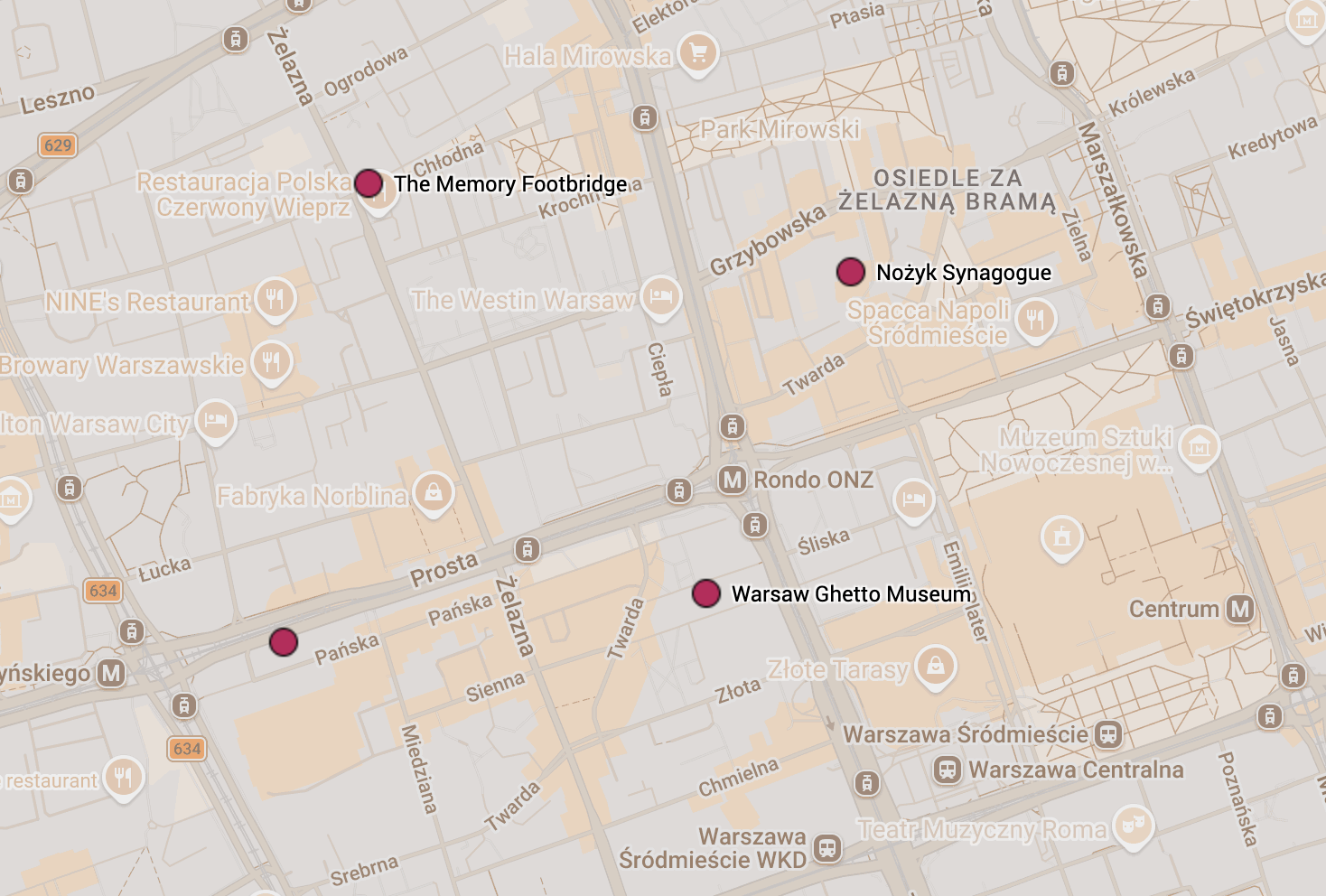
The Small Ghetto Area
Small Ghetto Area, Warsaw
Plac Grzybowski was the site of the Judenrat office (pl. Grzybowski 26/28).
Monument to the Evacuation of the Warsaw Ghetto Fighters (Prosta 51) marks the spot where some dozen ghetto fighters emerged from the sewers on the night of 8–9 May 1943 with the help of the Polish underground. One of the Boys Yossi Gerstein remembers encountering them as a feral child living on the streets of Warsaw.
Warsaw Ghetto Museum (ul. Śliska 51) The museum is housed in the former children’s hospital built in the 1870s. Most of its patients met their deaths in Treblinka. It was one of the few buildings to survive the war and was used as a children’s hospital until 2014.
Synagogue
Nosyk Synagogue (ul. Twarda 6), built in 1898–1902, was closed during the German occupation but reopened in 1945. It was restored in 1977–83 and holds regular services. The annual Singer Warsaw Jewish Cultural Festival (w shalom. org.pl) is held on nearby ul. Prozna, where tenement buildings that survived the destruction of the ghetto still stand.
The Ringelblum Archive
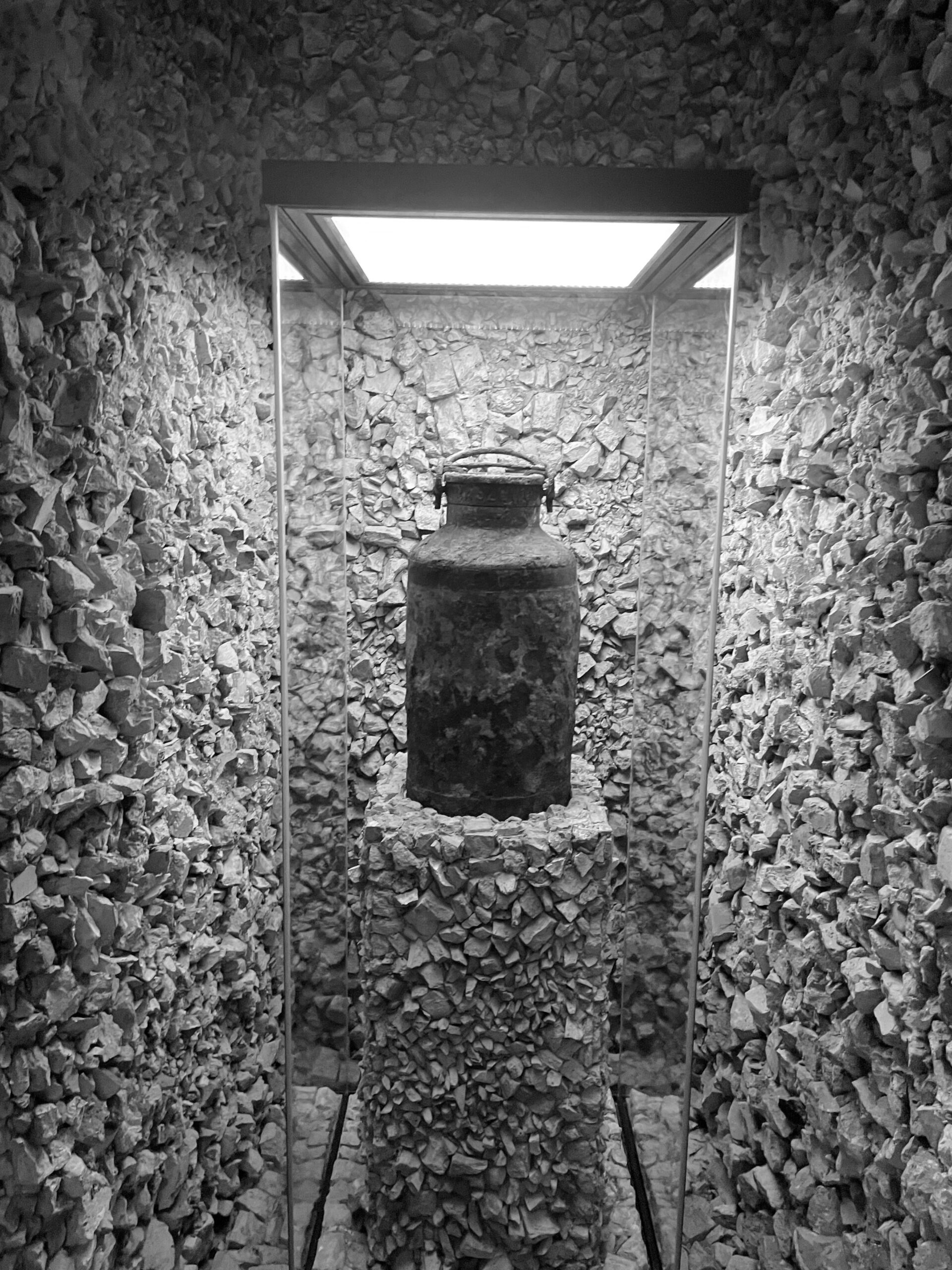
The milk churn that once held the Ringelblum archive.
One of the most important items to survive the Warsaw Ghetto is a milk churn. In it was hidden one of the most significant collections of documents relating to the destruction of Poland’s Jewish community.
The churn is on display at the Jewish Historical Institute (ul. Tłomackie 5; entry fee) which was founded by survivors in 1947. The building dating to 1936 is original and was formerly the Main Judaistic Library, which had a collection of more than 30,000 volumes until it was plundered and the contents taken to Germany. It was included in the ghetto and housed the offices of a German-approved Jewish relief organisation, Aleynhilf (Self-Help).
One of its leaders was the social worker and historian Emanuel Ringelblum (1900–44), who believed that the Jewish people should tell their own story for themselves. In an act of intellectual resistance, Ringelblum and his colleagues created a secret group, calling themselves Oyneg Shabbat (Yiddish for ‘Joy of the Sabbath’) as they met at the institute on the Sabbath.
When in July 1942 it became clear that the ghetto was about to be liquidated, part of the archive was buried in ten metal boxes in the basement of the Ber Borochov school at ul. Nowolipki 28/30. Two large metal milk cans with more documents were also hidden here in February 1943. In 1946, two surviving members of the group retrieved the first part of the archive but the second part was only discovered by accident during construction work in 1950. A third cache of documents buried under the Brushmakers’ Workshop, now the Embassy of the People’s Republic of China at ul. Świętojerska 34, has never been found. Most of the members of Oyneg Shabbat, including Ringelblum, did not live to see the end of the war.
Visiting Treblinka
>
Treblinka
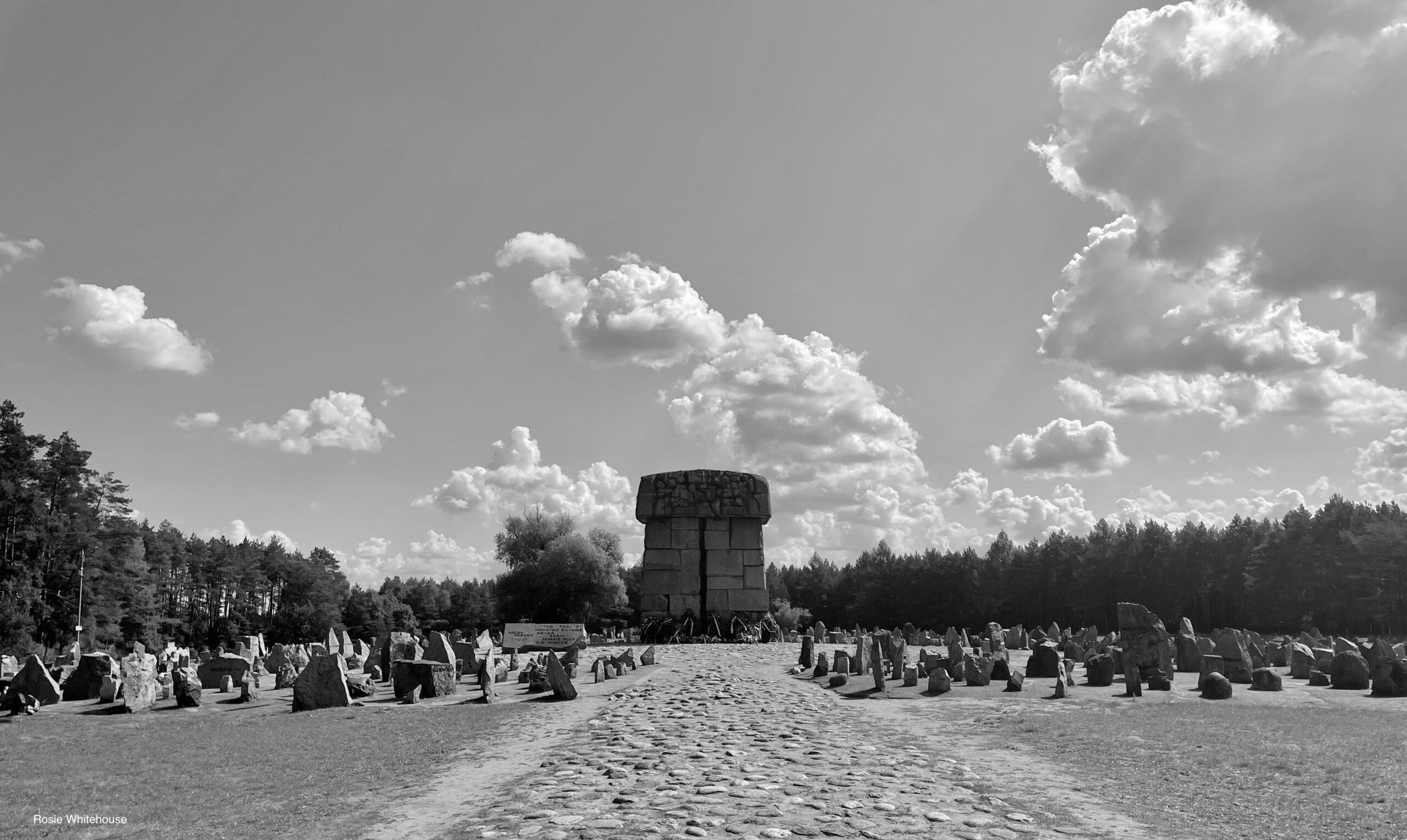
Treblinka was the site of one the Germans’ deadliest extermination camps, and some 800,000-920,000 Jews from ten different countries were murdered here between 1942 and 1943.
Close to the Bug River in remote countryside, Treblinka was chosen for the site of the camp as it was close to the main Warsaw–Białystok railway line. Today, it is a quiet, lonely place which gets few visitors.
Good to know It is much cheaper to visit Treblinka on your own steam. If you do not have a car take a taxi from the station in Małkinia Górna (7km away) and ask the driver to wait. Trains run from the main Central Station in Warsaw. Be sure to arrange the price first. It takes under an hour to see the site. Be aware that the route follows that taken by the trains to Treblinka.
What to see
The site at Treblinka is over 2km long. The main area which was once the extermination camp, Treblinka II, is a short walk from the car park. The labour camp, Treblinka I, is at the other end of the forest complex from the museum and main memorial. It is possible to drive there, where there is a second car park.
There is no need to book in advance to visit Treblinka, access is 24 hours and free.
The Treblinka Museum (open daily; free) is next to the main car park.
Nothing remains of the camp, which is now covered by 17,000 stones, 216 of which are marked with the names of communities destroyed by the mass murder in Treblinka. They stand on the site of the mass graves and buried ashes.
The path from the car park takes you past the memorial. The railway line is marked by stone slabs that lead to the ramp. The path continues behind the main monuments and curves back to the car park and visitors’ centre.
Members of the Boys were born in Mukačevo in Czechoslovakia.
The Boys were teenage and child-Holocaust survivors, who were brought to the UK after the war for rest and rehabilitation.
Members of the Boys were held in Nazi labour and concentration camps and used as slave labourers. They had also survived World War II in hiding or as lone children.
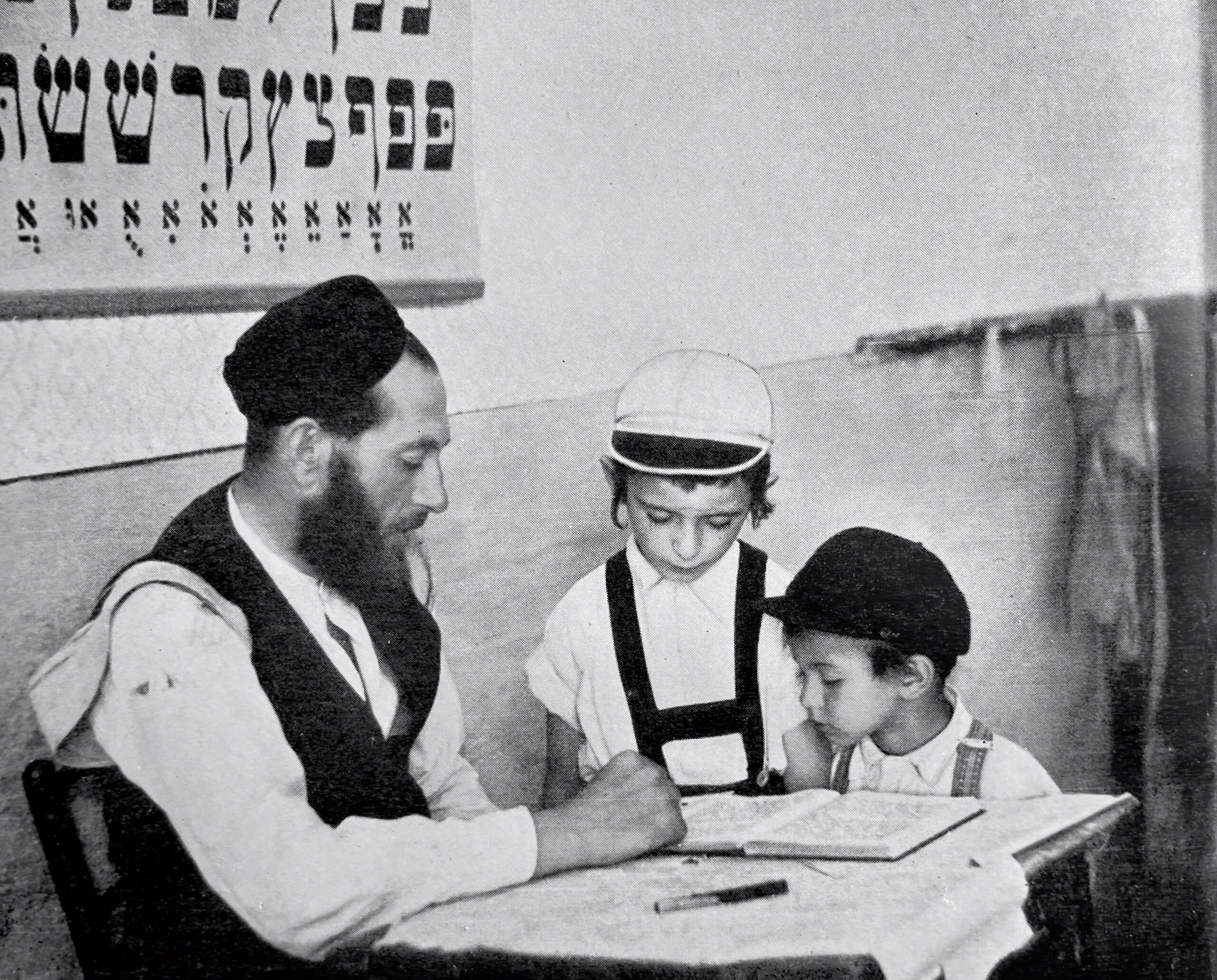
Jewish boys studying in pre-war Mukačevo.
Pre-war
Jews lived in Mukačevo and the surrounding villages as early as the second half of the 17th century. By 1851, Mukačevo was home to a large yeshiva.
The Jews of the region were among the poorest in Europe, many living in rural areas and working in agriculture.
Mukačevo had a large Hasidic community. On the eve of the Holocaust, there were nearly 30 synagogues in town, many of which were shtieblech – small Hasidic synagogues. Much of the town was closed on Shabbat, and the first cinema in the town, established by a Hasidic Jew, also closed on Shabbat and Jewish holidays.
The Chief Rabbi of Mukačevo, Rabbi Chaim Elazar Spira, led the community from 1913 until his death in 1937, and was the most outspoken voice of religious anti-Zionism.
In 1920, the first Hebrew-speaking school in Czechoslovakia was established in Mukačevo, followed by the Hebrew Gymnasium in 1925, which soon became the most prestigious Hebrew high school east of Warsaw. Many of the Boys attended this school but not all.
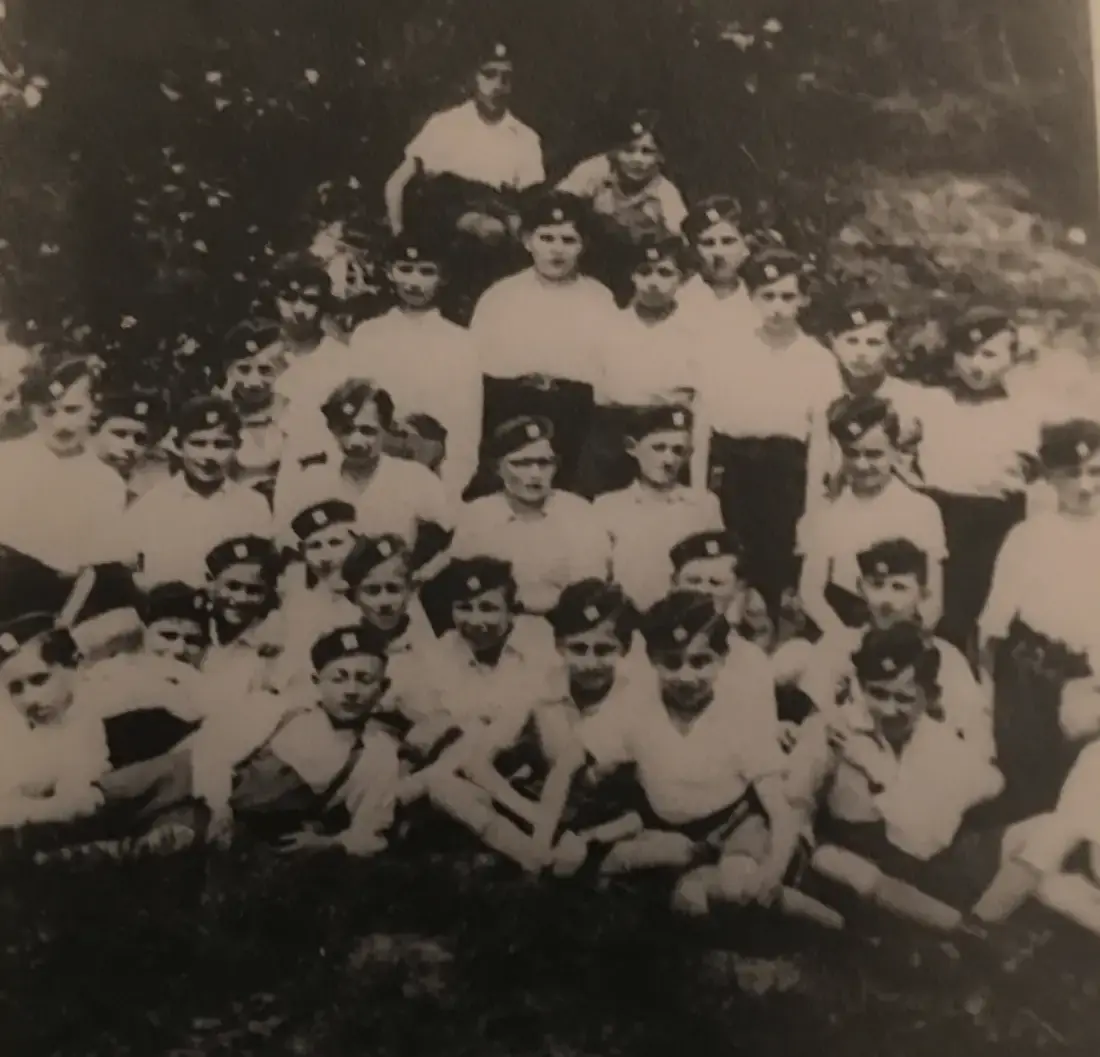
Mukačevo Hebrew Gymnasium 1938. Note the caps with the Ten Commandments on. Meir Stern, one of the Boys, is in the picture.
In the interwar period, the Jews of Mukačevo constituted almost half of the town’s population, and about 10% the Jewish population of Subcarpathian Rus. On the eve of the Holocaust, Mukačevo was the largest and most prominent Jewish community in eastern Czechoslovakia. According to the 1941 census, 42.7% of the town’s population were Jewish.
The Boys’ Story: The Stern Family
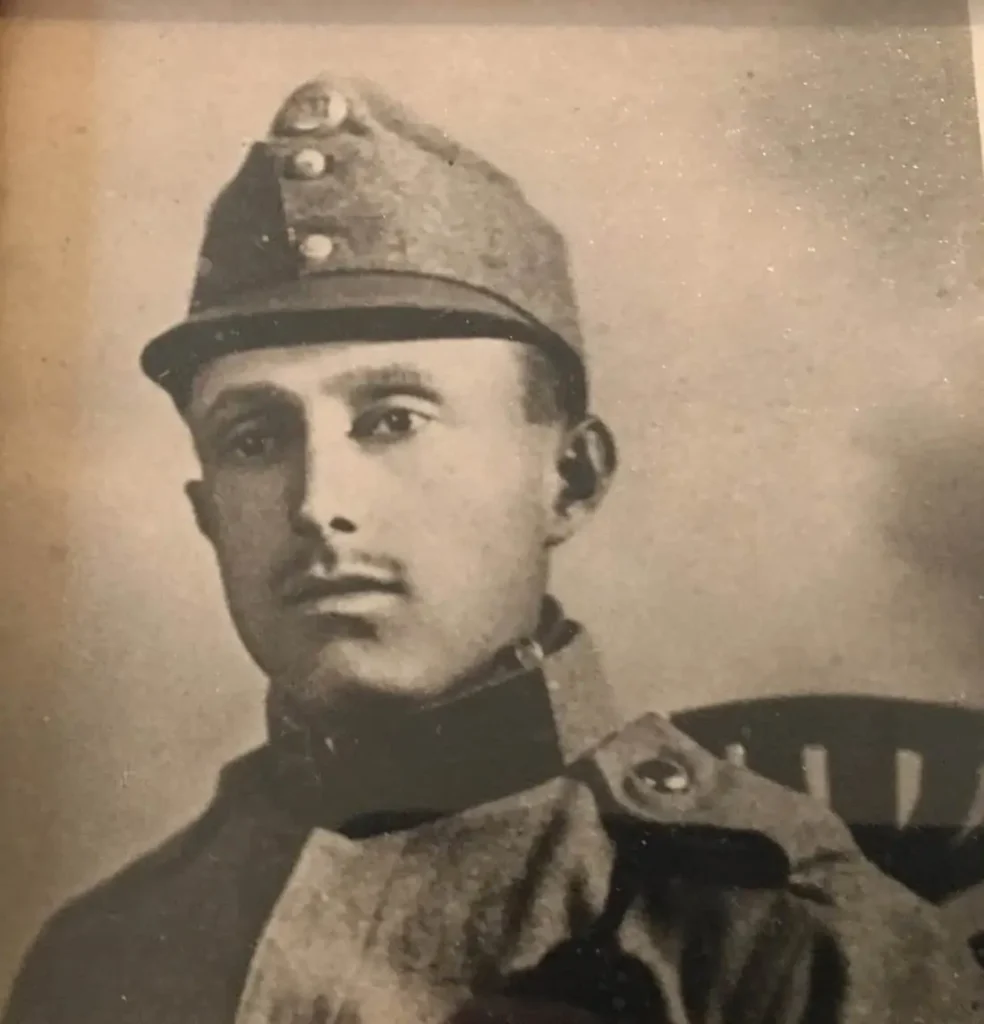
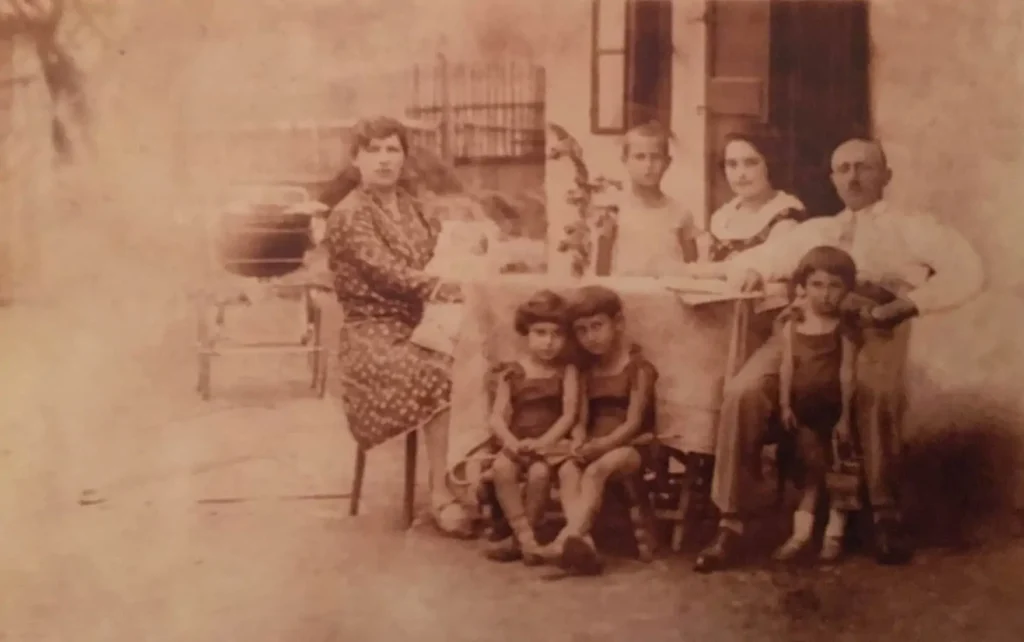
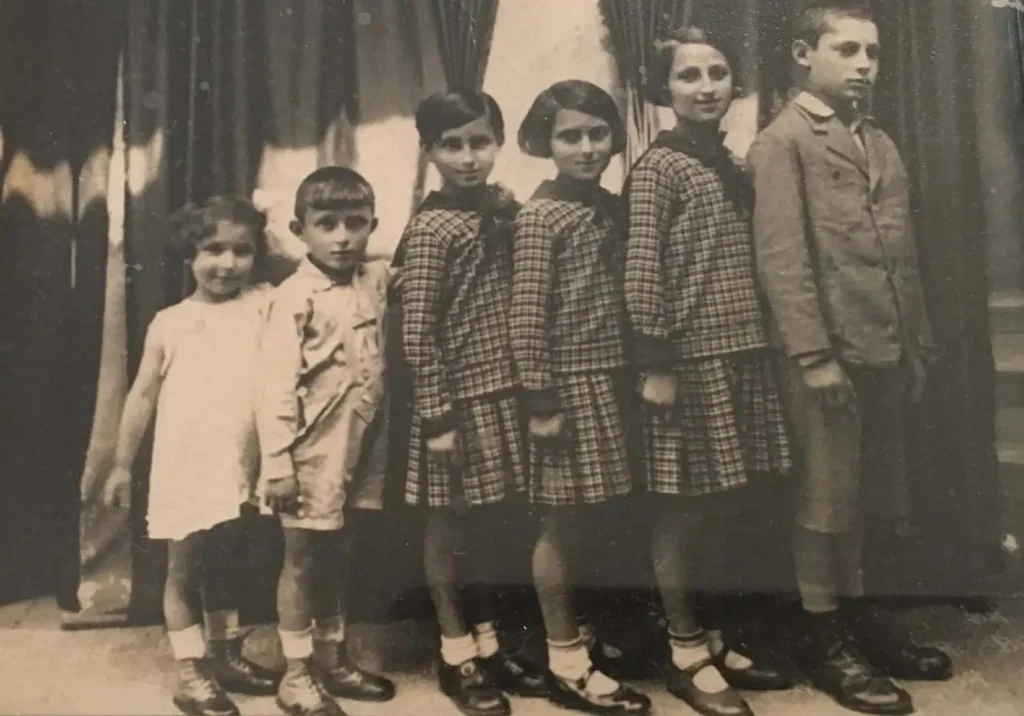
Meir Stern’s father in the Austro-Hungarian ArmyThe Stern family.The Stern Siblings.
The Stern siblings Zolly, Manci, Alice, Dvora, Meir and Eliska lived in Mukachevo. The children’s father had been an officer in the Austro-Hungarian army. The children attended the Hebrew Gymnasium but sadly Dvora died before the outbreak of World War II.
When war broke out their father was called up to a labour battalion, where he worked in the kitchen. He survived and returned home before Germany invaded Hungary in March 1944.
Their cousins were deported as they were not able to prove that they were previously Czech citizens. Their family was massacred in a mass shooting in Kamianets-Podilskyi but two of their cousins escaped and returned home. Nobody believed them when they told the community what had happened to their parents.
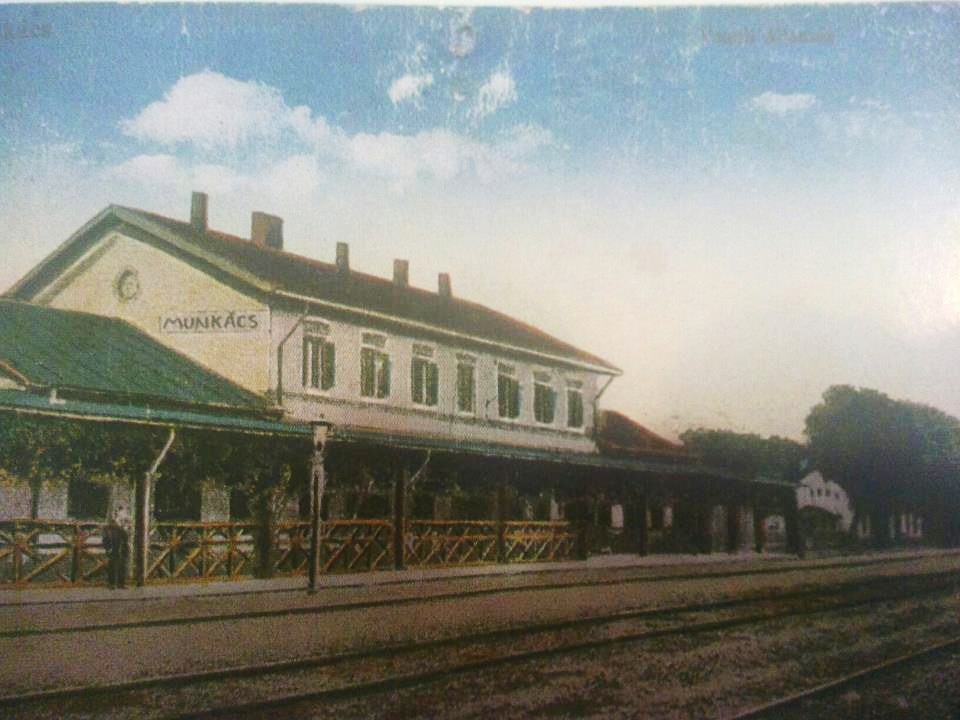
In the spring of 1944, the Stern family were imprisoned in the ghetto in Munkács, before they were deported to the Auschwitz II-Birkenau concentration and extermination camp, where the children’s father died.
Meir was a slave labourer in Neu-Dachs-Jaworzno, a subcamp 40km north of Auschwitz that was centred around slave labour in a coal mine. He escaped while on a death march. His sisters Manci, Alice and Eliska also survived
The children were reunited with their mother in Prague. They were then given accommodation that had previously belonged to a German family who had ben expelled.
Eliska and Meir’s mother signed them up for the transport of children that was leaving for the UK in May 1946. Stern’s mother was in favour of Stern going to England as he says, he was a “trouble-maker”. He did not want to study and “They thought they would make something out of me in England and I think she was right,” Stern says. To find out more about the life of Meir Stern click here.
Zolly, who was living in Budapest in 1944, was saved by the Swedish diplomat, Roaul Wallenberg and went to Israel in 1949. Alice and Manci went to Israel in 1949. Elsika, also one of the Boys, later lived in the United States. To find out more about her life click here.
Occupation
Following the Munich Agreement in 1938, Czechoslovakia was divided up and Hungary annexed Mukačevo and the surrounding region. It now became known by its Hungarian name of Munkács.
There was widespread antisemitism and life became difficult for the Jewish community. Polish and Russian Jewish residents, as well as native Jews who could not prove their citizenship, were deported over the Ukrainian border into the hands of the German commando. Many men were conscripted into the Hungarian army.
Deportation
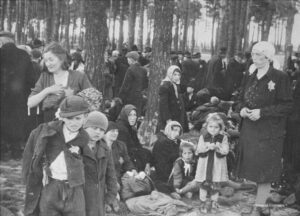
Jews from Subcarpathian Rus selected for death at Auschwitz-Birkenau, wait in a clearing near a grove of trees before being led to the gas chambers. Pictured on the bottom row from left to right: Reuven and Gershon Fogel, their mother Laja Mermelstein Fogel, Tauba Mermelstein, Tauba’s daughter and her granddaughters one of whom was named Gerti. The Mermelsteins were from Mukachevo.
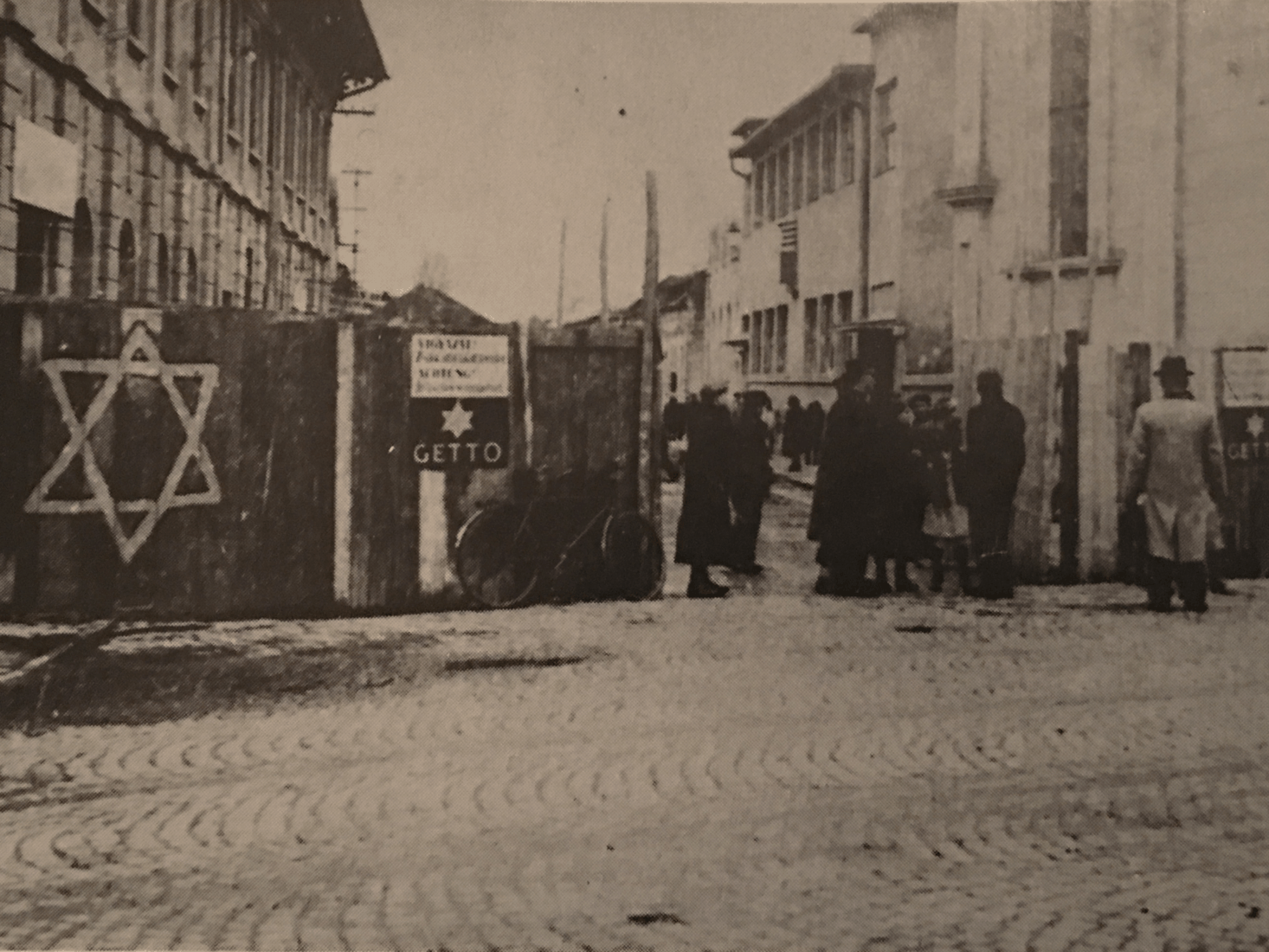
In March 1944, the Germans invaded Hungary. A ghetto was set up in city. To find out more click here.
After a week, under the supervision of Adolf Eichmann, the architect of the ‘Final Solution’, the Jews in the ghetto were put into freight wagons and deported to Auschwitz II-Birkenau concentration and extermination camp.
On 30 May 1944, Munkács was officially declared Judenrein, free of Jews. Over 27,000 Jews from Munkács and surrounding villages had been deported to Auschwitz.
Liberation
An estimated 2,000 Jews from Munkács survived the Holocaust.
In 1945, around 1,000 of these returned, searching for family members among them members of the Boys.
After the war, the region was annexed by the Soviet Republic of Ukraine. Following the annexation, many Jews left. In the late 1960’s.
After 1969, the Jewish community of the city was reduced to about 300 elderly people, only a handful of whom had been born there before World War II and survived the Holocaust.
Present-day
There is a small community of approximately 100 Jews. There is a modest revival including a kosher kitchen, mikveh, and daily prayer services. A number of Ukrainian Jews from further east have settled in western Ukraine since the Russian invasion.
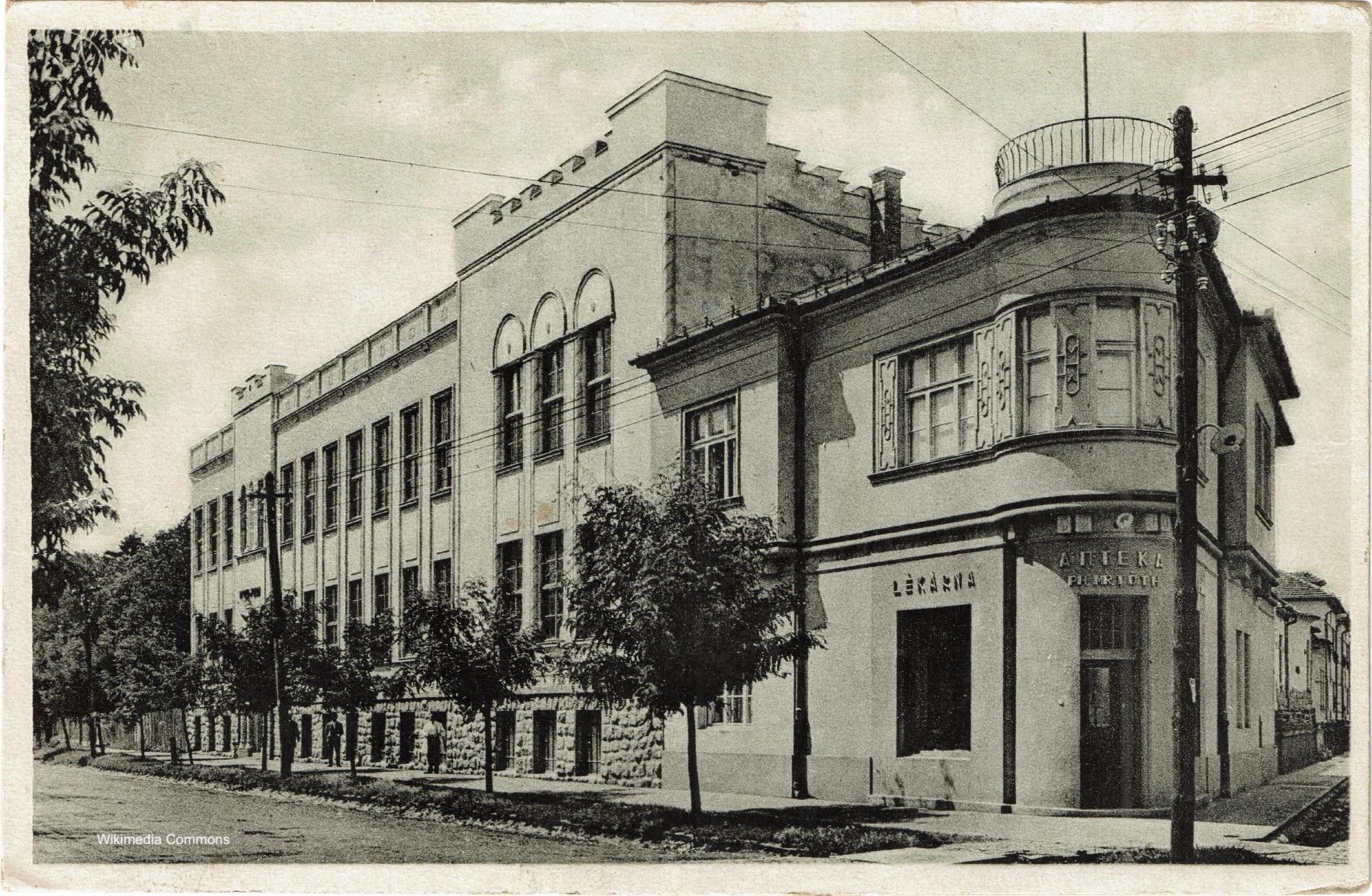
Pre-1944
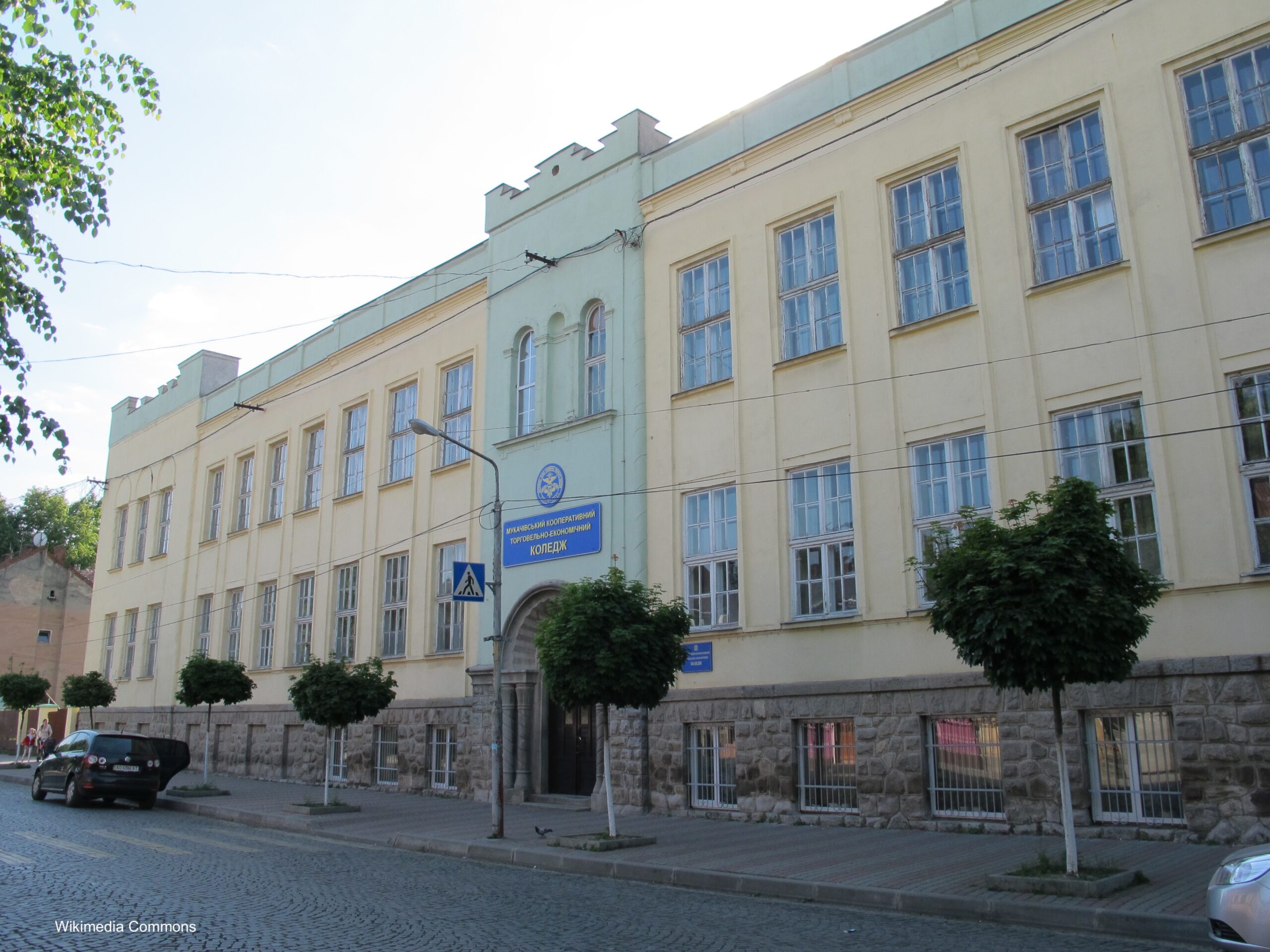
Present-day
Lost Places
Visiting Mukachevo
>
Getting there
Mukachevo is best reached by train from Košice via Chop.
Note the UK Foreign and Commonwealth Office advises against travel to Ukraine because of the ongoing Russian invasion.
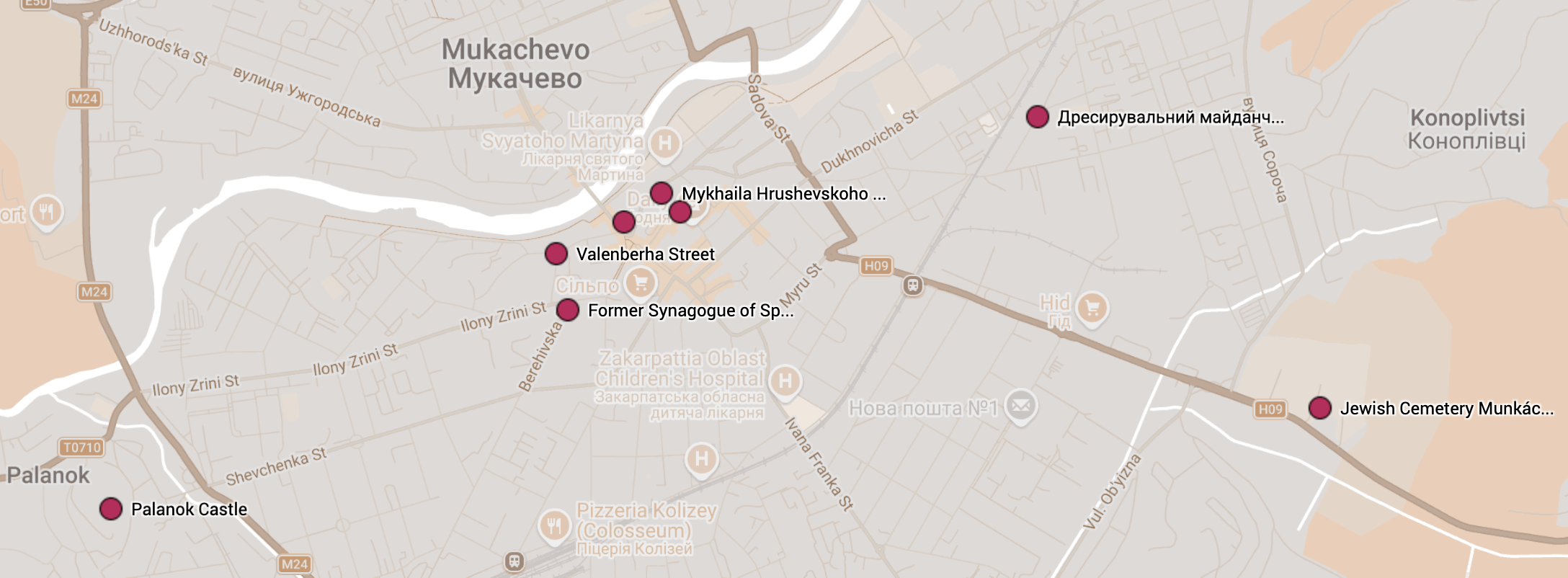
Map of central Mukachevo
What to see
In 1920, the first Hebrew-speaking school in Czechoslovakia was established in Mukachevo, followed by the Hebrew Gymnasium in 1925, which soon became one of the most prestigious Hebrew high schools in eastern Europe. The building still stand on the main street.
Memorials
Holocaust Memorial Plaque (Bld Valenberha) marks the site where deportations to Auschwitz began in May 1944.
Next door to it is a 2013 plaque that commemorates the Swedish diplomat Raoul Wallenberg, who saved Jews in Budapest – though he had no direction connection to Mukachevo, he did save Jews from the city.
A plaque at Zankovetskoi Street 6 marks the house of Traian Popovici, the Romanian-appointed mayor in 1941–42. He compiled a list of some 20,000 Jews eligible for exemptions for deportation to Transnistria or to enable those who had already been sent to return. He was sacked in spring 1942. In 1969 he was recognised as a Righteous Among Nations.
Cemetery
The Old Jewish Cemetery (ul. Myra and Akademik Pavlova) was destroyed in the communist-era and turned into a car park. Now it is full of lines of symbolic tombstones and has a Holocaust memorial topped with a menorah at its centre. There is also a newer memorial inscribed in Ukrainian.
New Jewish cemetery is 2km east at Tomas Masaryk Street 21.
Ghetto Location (Valenberha (Wallenberg) Street) The Holocaust memorial marks the ghetto entrance at the corner of the street.
Hoif Complex of the Munkacser Rebbes (20 Hrushevskoho) The former residential and community complex of the Munkacser Hasidic dynasty.
Former Synagogue of Belz (17 Vozyednannya) This historic building belonged to the Belz Hasidic community.
Synagogue & Jewish Community
Bais Medrash Hagadol (7 Hrushevskoho) A new synagogue was dedicated in 2006 on the site of a pre-war Hasidic prayer house, which serves as a central point for the current community
Museum
Palanok Castle (History Museum) The castle features a dedicated exhibition, “From the Jewish Community History,” providing context on the city’s multicultural past.
What to read
>
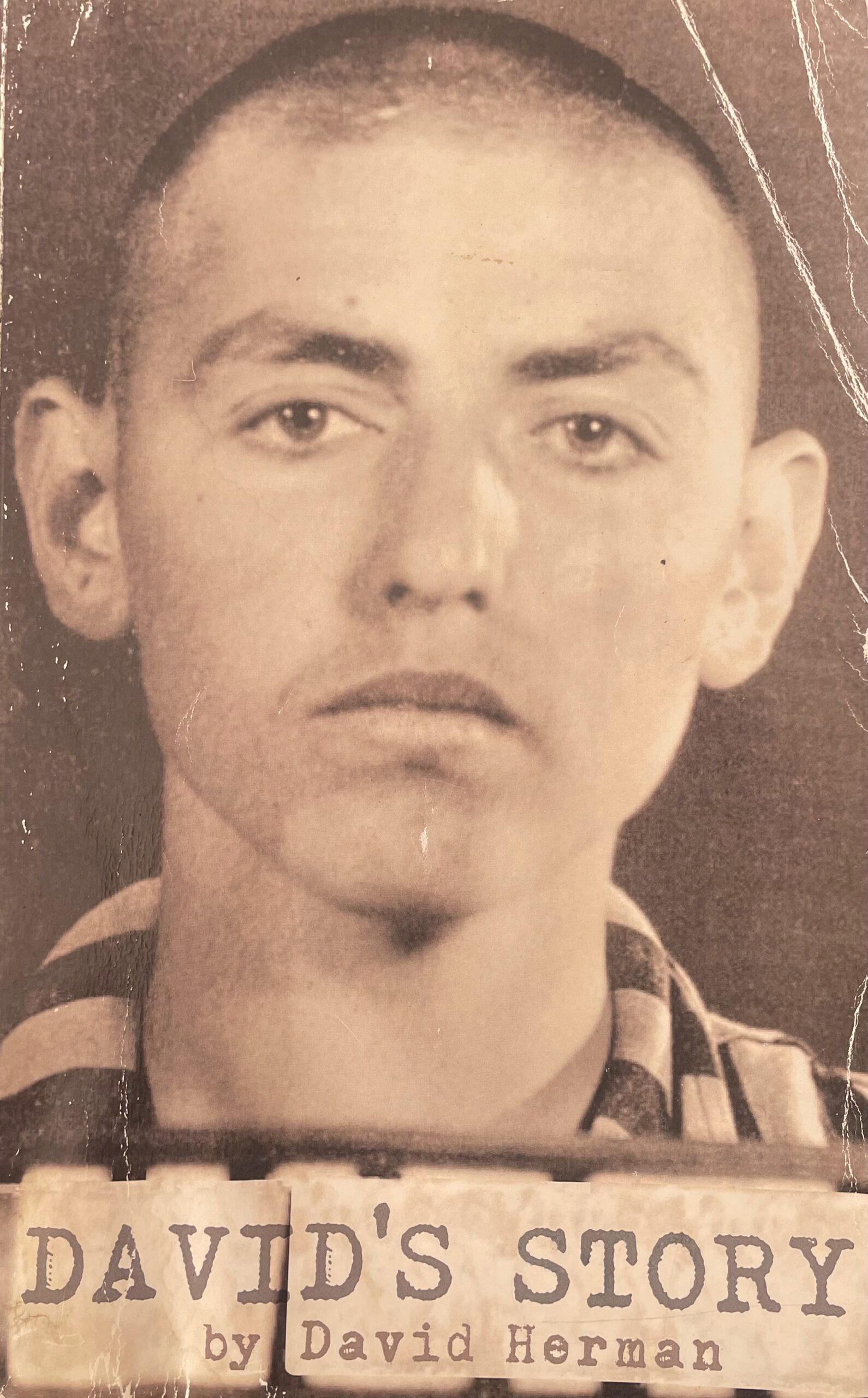
David’s Story (Herman Press, 2016) David Herman. Herman was one of the Boys who grew up in Mukachevo. To find out more click here.
Members of the Boys were born in Vienna in Austria.
The Boys were teenage and child-Holocaust survivors, who were brought to the UK after the war for rest and rehabilitation.
Members of the Boys were held in Nazi labour and concentration camps and used as slave labourers. They had also survived World War II in hiding or as lone children.
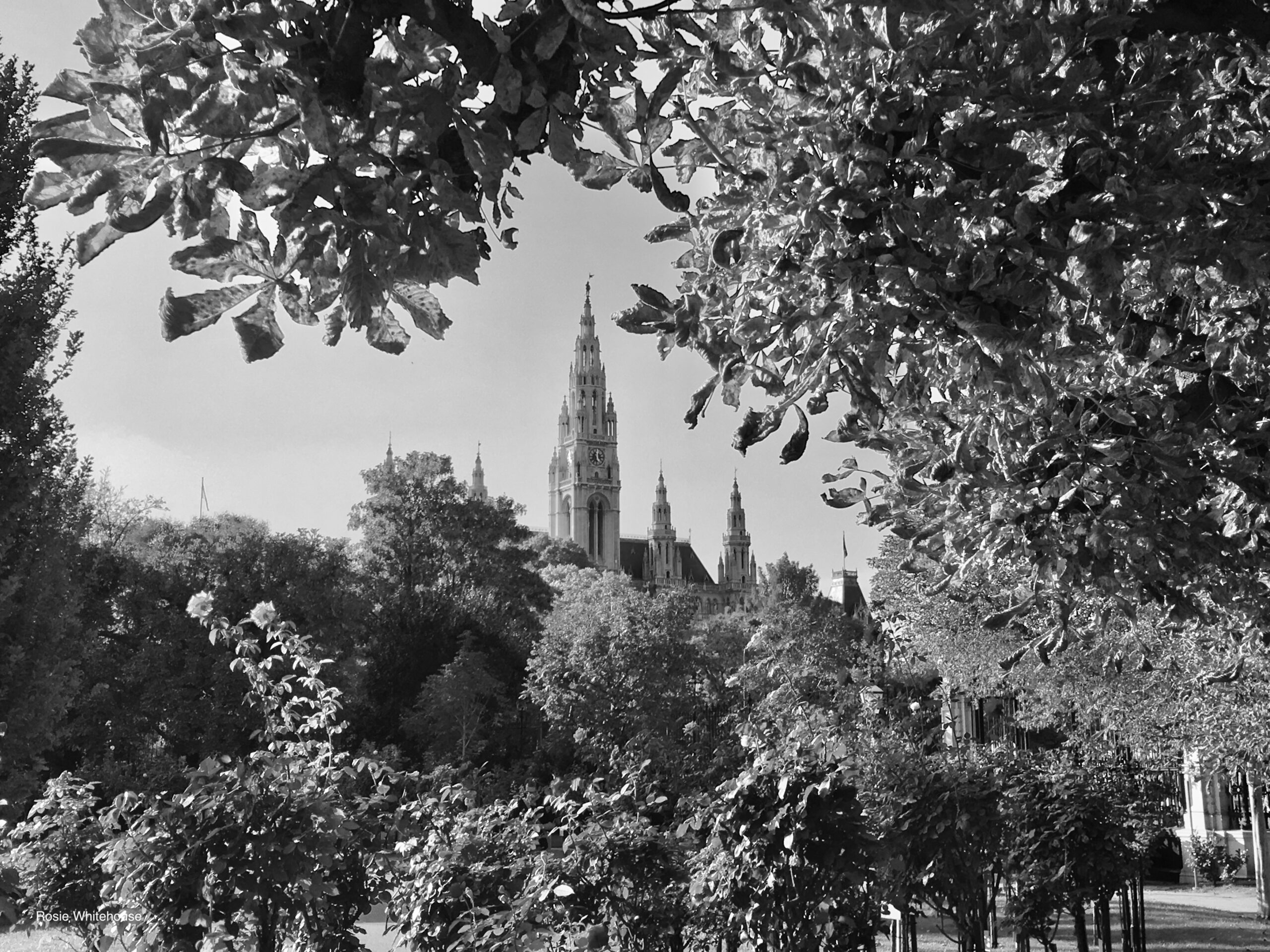
Vienna City Hall.
Jews have lived in the Austrian capital, Vienna, since the 12th century. At the dawn of the 20th century Vienna was one of the most prominent centres of Jewish culture in Europe.
Vienna has an important place in the story of the Boys. It was home to 13 of the children brought to the UK between 1945 and 1946, who were some of the youngest members of the Boys. Austria also played a key role in the Boys experiences during the Holocaust. Many of the Boys were held in the Mauthausen concentration camp and its subcamps.
Vienna was also the home of child psychologist Anna Freud, who played an important role in caring for the younger members of the Boys after their arrival in Britain.
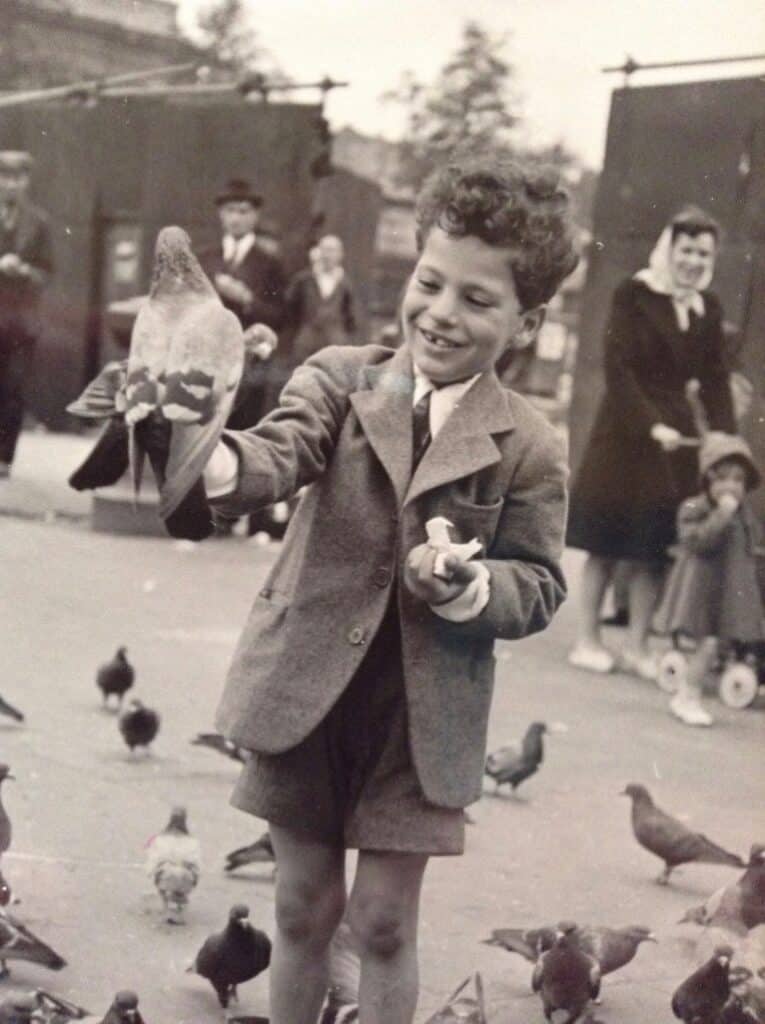
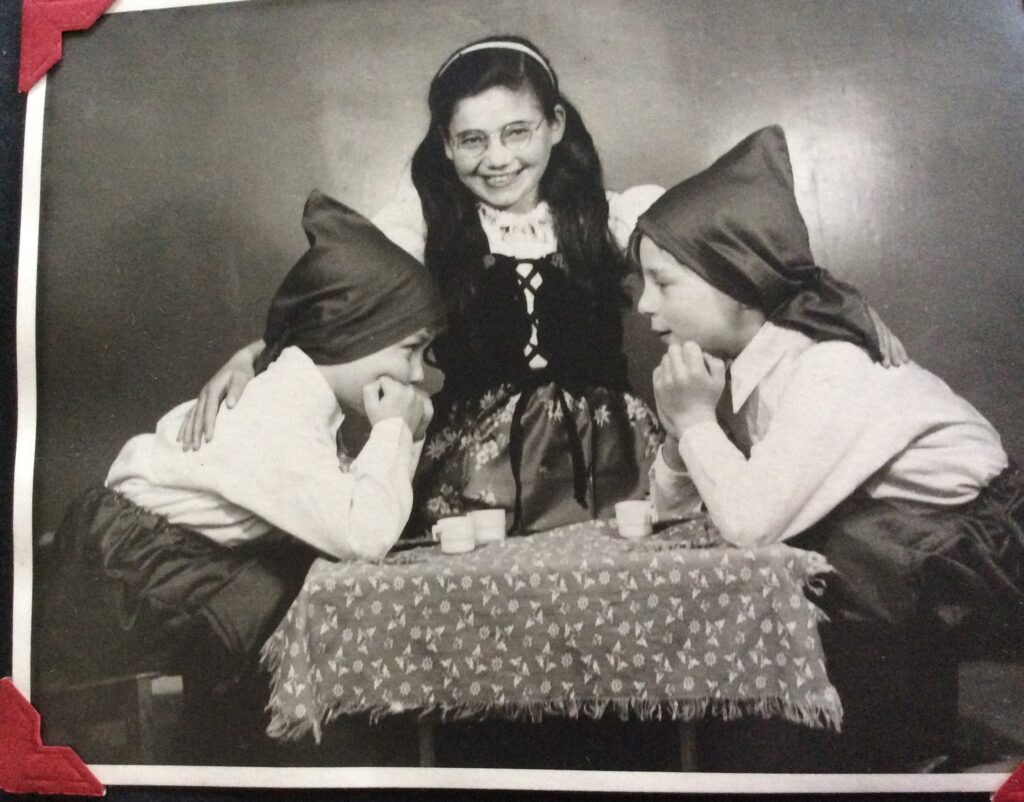
Jackie Young Sylvia GruenerJudith Singer
Vienna was home to some of the youngest members of the Boys. These photographs were all taken after World War II.
Interwar Years
In 1934, 174,034 Jews lived in Vienna making up 9% of the city’s population. The community represented all social classes and consisted of highly assimilated Jews as well as Orthodox. All political persuasions were also represented. The overwhelming majority of the country’s Jews lived in the capital Vienna but antisemitic political rhetoric was so widespread that you could be antisemitic without ever having met a Jew.
After Germany annexed Austria in the 1938 Anschluss, Adolf Eichmann was appointed the head of the Central Office for Jewish Emigration in Vienna. Persecution and humiliation of the Jews began immediately with the intention of driving Austria’s Jews to flee the country. In the months that followed 120,000 Jews left Austria.
It was extremely difficult to leave the Third Reich and a substantial departure tax had to be paid. It was also hard to obtain a visa to enter another country. Many of the children who left after the Anschluss were helped by the Central British Fund, who brought the Boys to the UK after World War II.
Film Footage
In the summer of 1938 by the American physician and amateur filmmaker Dr. Lafayette P. Monson set out on a round-the-world-trip. Among the images he caught were some historic shots of Nazi persecution of Jews in Vienna.
First scene shows a billboard with stereotype caricature of a Jew and the text “Judentum ist Verbrechertum. Lest die Stürmer-Sondernummer” (Jewry is Criminality. Read the Stürmer special issue) in front of the Vienna Opera. Following parts showcase antisemitic graffiti on a Jewish café and Jewish shops at Nestroyplatz in Vienna’s 2nd district (the former Jewish quarter).
Wikimedia Commons: Prelinger Archives Public Domain
Deportation
When the decision was taken at the Wannsee Conference in January 1942 to annihilate the Jewish population, the Jews who had remained in Vienna became victims of the Holocaust.
Of the more than 65,000 Viennese Jews who were deported to concentration camps, only about 2,000 survived.
Judenplatz Holocaust Memorial, Vienna, Austria.
Liberation
In 1946, only 4,000 Jews remained in Vienna but the population swelled as Jews fled from antisemitism and communism in eastern Europe in the post war years.
After the liberation Austria housed approximately 300,000 refugees in displaced persons’ camps across the country.
Vienna was a centre for the Jewish underground who helped Jews leave Europe on route to the British controlled Palestine Mandate. Severe restrictions on Jewish immigration led many Jews to try to reach the territory illegally.
Present-day
Around 7,000 Jews live in Vienna today, the vast majority of them from the former Soviet Union.
Visiting Vienna
>
Getting there Vienna has excellent international air, rail and road connections.
Getting around Much of Vienna is accessible on foot. To drive on Austrian motorways, you will need to buy a vignette at the border.
The former Mauthausen concentration camp can be reached by public transport, as can the subcamps of Ebensee, Gusen and Melk, where members of the Boys were held. For Mauthausen, take a train from Vienna to Linz, which is 22km from the memorial. Then from Linz, take bus 360. If returning by public transport, be aware that the last bus leaves well before the site closes. To see the Gunskirchen memorial, it helps to have a car.
Beacon of Light Memorial for Kristallnacht, Vienna
Memorials
JudenplatzHolocaust Memorial Designed by British artist Rachel Whiteread, the monument, an inside-out locked library, is also known as the Nameless Library. The spines of the books face inwards symbolising the untold stories of the victims.
Shoah Wall of Names Memorial (Otto-Wagner-Platz) A large 200m elliptical loop of standalone walls are engraved with the names of 65,000 Jewish adults and children from Austria murdered between 1938 and 1945. Among them are members of the Boys families. The monument is particularly moving at night. It is opposite the Austrian National Bank but more significantly stands next to Vienna University. In 1938, some 2,700 Jewish teachers and students were expelled from the university, which before the Anschluss was a hotbed of antisemitism.
The Keys of Remembrance Memorial created in 2008, it shows 462 keys with name tags of local Jews deported in the Holocaust set beneath a glass panel lowered in the pavement on the corner of Servitengasse and Grünentorgasse.
Aspangbahnhof Deportation Memorial (Leon-Zelman-Park, Rubin-Bittmann-Promenade 7) Between 1941-1942, 47,035 Jewish men, women and children were deported from Aspangbahnhof to camps, ghettos and killing fields of Nazi-occupied eastern Europe.
Leopoldstadt Synagogue Memorial (Tempelgasse 5) The largest synagogue in Vienna was set on fire in an arson attack in October 1938. The four tall white pillars which today mark the site give a sense of the synagogue’s enormity and grandeur. The buildings adjacent to the synagogue were left standing and the left annex, which still survives, was home to a children’s orphanage from 1942-1945 where members of the Boys were cared for. The complex served as a centre for survivors after the war.
Kleine Sperlgasse 2a A plaque marks the spot where Jews were gathered before deportation. From February-March 1941 and from October 1941 to the end of October 1942, the school at this site served as a transit camp, where tens of thousands of deportees were held. Many people committed suicide here.
Monument against War and Fascism (Albertinaplatz) Designed by Austrian sculptor Alfred Hrdlicka in 1988, the memorial is made up of four statues and stands on a bomb site where hundreds of people who had taken shelter in the cellars in March 1945 were killed. The Gate of Violence is made of granite quarried by prisoners in the Mauthausen concentration camp.
Museums
Jewish Museum (Dorotheergasse 11; entry fee) The main site of the Jewish Museum of Vienna has an exhibition that covers the Holocaust and its aftermath.
Vienna Wiesenthal Institute for Holocaust Studies (Rabensteig 3; free) dedicated to the Nazi hunter Simon Wiesenthal. Wiesenthal, who had been a prisoner in Mauthausen, made it his mission to bring the architects of the Holocaust to justice.
Sigmund Freud Museum (Berggasse 19; entry fee) The Freud family lived here from 1891 until they fled to the UK in 1938. The Freud family were among 110,000 Austrian Jews who managed to escape. In London Freud’s daughter, the child psychologist Anna Freud, played a key role in the rehabilitation of the Boys.
From 1939 onwards Jews were ordered into crowded designated buildings as their apartments were confiscated. Freud’s apartment was eventually confiscated in 1942. The newly renovated museum commemorates Freud’s neighbours and the 76 Jews detained in the building between the autumn of 1939 and spring 1942. Their names are recorded in the stairwell.
Viktor Frankl Museum Wien (Mariannengasse 1; entry fee) This museum remembers Viktor Frankl (1905–97), another great Viennese therapist and the founder of logotherapy and existential analysis. Frankl was a Holocaust survivor who spent three years in four camps: Theresienstadt, Auschwitz, Kaufering III and Türkheim. After his return from the camps, he wrote Man’s Search for Meaning (Rider, 2004) in just nine days. The book was published in German in 1946.
Synagogue
Stadttempel (Seitenstettengasse 4; w jewishinfopoint), Vienna’s main synagogue and the only one of the 93 synagogues and prayer houses in city in 1938 to survive the Nazis. Its interior was, however, badly damaged during Kristallnacht. Its proximity to people’s houses saved it from an arson attack. In the anteroom there is a Holocaust memorial, designed by architect Thomas Feiger, inaugurated in 2002.
Visiting Mauthausen & its subcamps
>
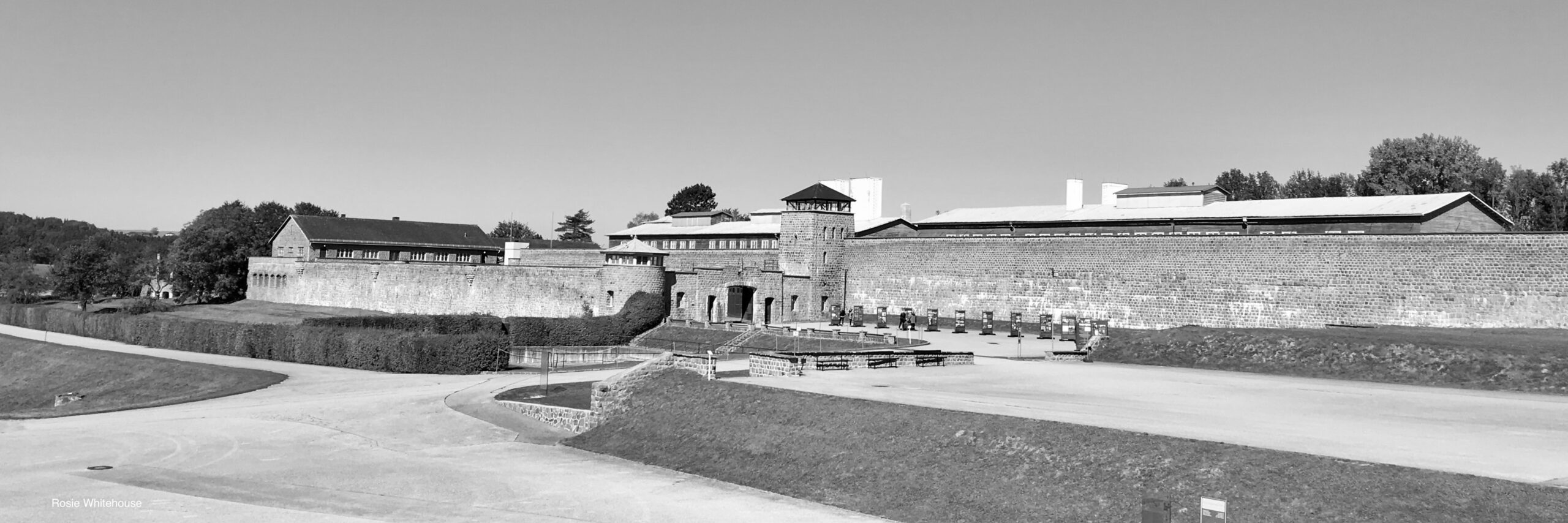
Mauthausen Memorial
Many members of the Boys survived Mauthausen and its subcamps click here to find out more.
Mauthausen Memorial complex (Erinnerungsstrasse 1; w mauthausen-memorial.org; free) The memorial includes a fascinating museum with full explanations in English. There are copies of the lists of those who arrived here on the death marches, and a detailed part of the exhibition is dedicated to the aftermath of the Holocaust.
Good to Know Unlike Auschwitz, Mauthausen is not inundated with tourists, so there is no need to book in advance. You need at least 2 hours to see the whole site. It is worth browsing the website before you go as it contains extensive information about the camp, including testimonies and a virtual tour with an audio guide.
The subcamps There are interesting memorials at some of Mauthausen’s subcamps where the Boys were held.
Gusen
Much of the modern village near the main camp is built on the footprint of the camp destroyed in 1945. Several original buildings survive, but today are used as private residences. While it is difficult to comprehend this, it is far from unusual. There is a small visitors’ centre and memorial (Georgestrasse 7, Langenstein; w gusen.org; free).
The gate of the former Ebensee concentration camp.
Ebensee
Ebensee Contemporary History Museum (Kirchengasse 5; entry fee) has an excellent exhibition which traces the rise of the Austrian Nazi Party and the local history of the Ebensee camp. The museum is 3 minutes’ walk from the station, which is also the easiest place to park. The site of the actual camp and tunnels is in Ebensee-am-Traunsee a 40-minute walk from the museum. Alternatively take bus 505/555 and walk the last 15 minutes. The camp itself was demolished in 1949 and is now a suburban housing estate entered through the original camp gateway. It is a peaceful place with kids on bikes and neatly kept gardens. It is possible to visit the vast tunnels dug into the foot of the Seeberg Mountain and there is a memorial in the cemetery.
Melk
Melk Memorial (Schießstattweg 2; present a valid photo ID at the entrance of the Melk barracks (Freiherr Karl von Birago Pionierkaserne, Prinzlstrasse 22) to get the key)
Gunskirchen Memorial
There are two memorials to the camp where many of the Boys were liberated after death marches. One is on Route 1 from Wels to Lambach opposite the turning for Saag. The other is off the road leading to Saag, on the left in a tiny glade.
Members of the Boys were born in Užhorod in Czechoslovakia.
The Boys were teenage and child-Holocaust survivors, who were brought to the UK after the war for rest and rehabilitation.
Members of the Boys were held in Nazi labour and concentration camps and used as slave labourers. They had also survived World War II in hiding or as lone children.
Užhorod, Czechoslovakia in the 1930s.
Užhorod in the Carpathian Mountains was home to 22 members of the Boys.
Pre-war
Jews have lived in Užhorod since the 16th century.
Until 1920, Užhorod was part of Austro-Hungary. In 1920, Užhorod became the capital of Carpathian Ruthenia, the most easterly corner of the newly created state of Czechoslovakia. In the inter-war period the Jewish community flourished.
In 1930, 7,357 Jews, a third of the population lived in Užhorod.
Modern-day Uzhhorod, Ukraine.
The city had a number of Jewish schools, a yeshiva, a Jewish hospital and an old aged people’s home. Užhorod was an important Hasid and Orthodox religious centre. Many books were printed in the city in Hebrew and Yiddish.
Jews played an important role in the economy and were active in local politics. The vast majority of the Jewish population of Užhorod were tradesmen and shopkeepers, although there were also wealthy families who owned large factories that still exist. The Weiser family were owners of the flour mills on Mukacsevskaja Street, which still produces bread and baked goods.
Occupation
Under the 1938 Munich Agreement, Hungary occupied the area. In March 1939, the Hungarians officially annexed the region and imposed laws restricting Jewish access to education, trade, and the professions. The city was now known by its Hungarian name of Ungvár.
Many Jewish men were drafted into labour battalions sending them east for forced labour on the eastern front. Jews who could not prove that they had Hungarian citizenship were deported to Poland and many were murdered there by the SS.
Deportation
In March 1944, Germany invaded Hungary.
On 21 April 1944, two ghettos were established outside the town. One in the ghettos was in a brick factory, which belonged to the Jewish Moschkowich family and the other in a timber warehouse, owned by the Gluck family, who were also Jewish. Jews from the surrounding area were brought into the ghettos and approximately 25,000 people were held there. Other member of the Boys from neighbouring towns and villages were also taken to the ghetto. To find out more click here.
In June 1944, the majority of the ghetto’s inhabitants were sent to Auschwitz II-Birkenau concentration and extermination camp.
Liberation
On 27 October 1944, the city was liberated by the Soviet Red Army. About 2,000 Jews from Užhorod survived the Holocaust. Many of those who returned home were not made welcome and found strangers living in the homes.
Transcarpathia was annexed to the Soviet Union in 1945. As a result most survivors chose to leave.
Present-day
Uzhhorod has a small Jewish community, a synagogue, community centre and a day school. It oversees the remaining Jews in the nearby towns of Khust, Mukachevo, Rachiv and Vinogradov.
Visiting Uzhhorod
>
Getting there
Trains run from Košice in Slovakia to Uzhhorod and Mukachevo via Chop. If you are going to Uzhhorod this way, get out in Chop and take a taxi from in front of the station. To explore the Carpathian Mountains, it pays to have your own transport.
Note that the UK Foreign Office advises against travel to Ukraine because of the ongoing Russian invasion.
What to see
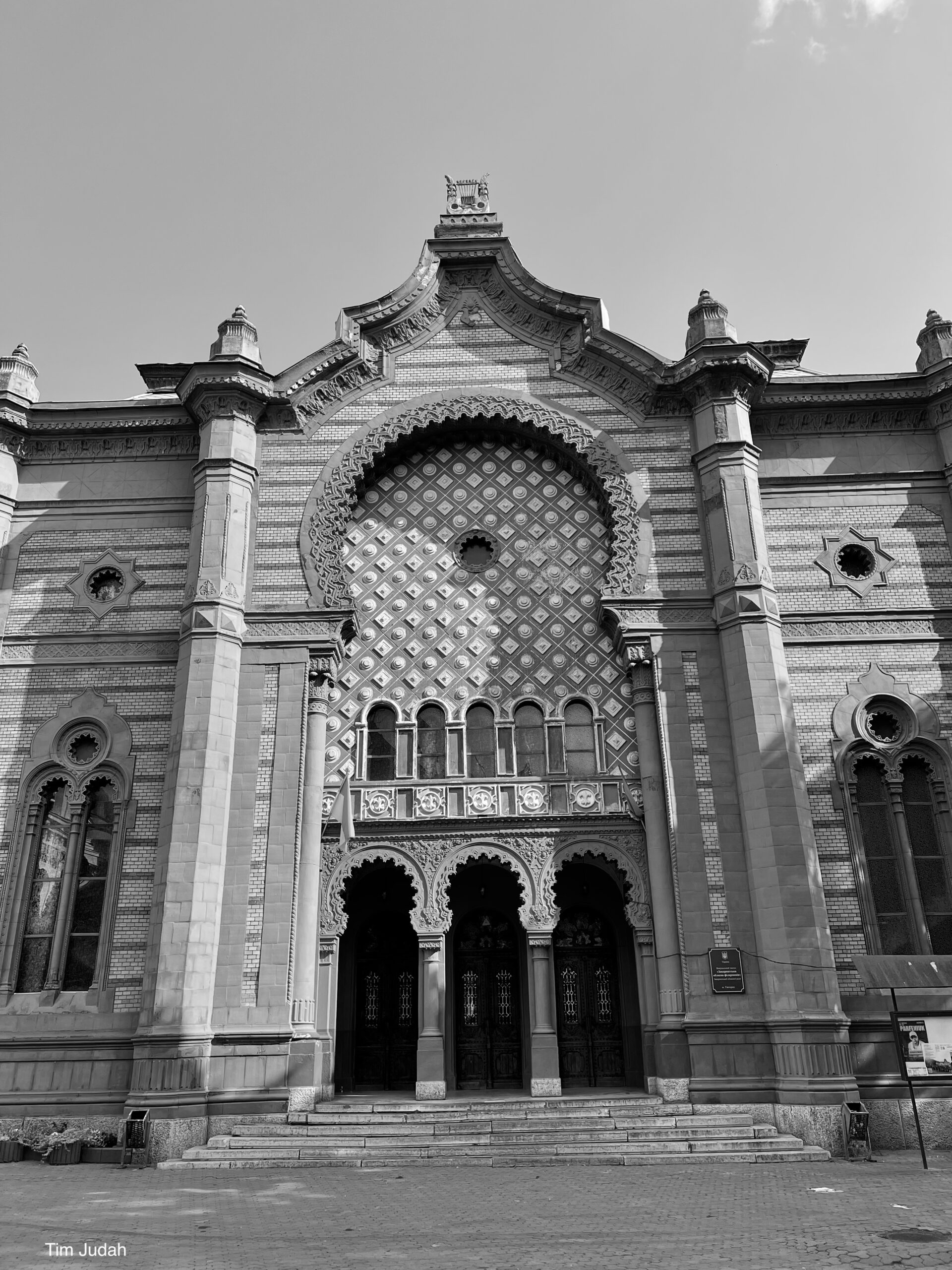
Uzhhorod Choral Synagogue (10, Pasazh Ln) Completed in 1904, this landmark building is famous for its Neo-Moorish and Byzantine Revival architecture. Since 1947, it has functioned as the Transcarpathian Regional Philharmonic. While most Jewish symbols were removed during the Soviet era, a plaque on the facade commemorates the 85,000 Jews from the region murdered in the Holocaust.
Active Synagogue (47 Mukachevska Street) This 1920s-era synagogue currently serves the local community of approximately 300 people.
Jewish Cemeteries The city’s Jewish cemeteries are considered significant pilgrimage sites, particularly the grave of Rabbi Solomon Ganzfried (1804–1886), the author of the Kitzur Shulchan Aruch.
The Old Jewish Cemetery (Kotlyarevs’koho St) This is the city’s largest and most historically significant Jewish burial ground, containing over 1,000 gravestones and the Ohel of Rabbi Shlomo Ganzfried: The author of the Kitzur Shulchan Aruch (1804–1886).
Radvanka Jewish Cemetery (5, Stefanyka Street) Established around 1855, it currently contains approximately 70 gravestones.
Jewish Community of Uzhhorod (36, Rus’ka St) The centre offers support and information for visitors exploring local heritage.
Museum
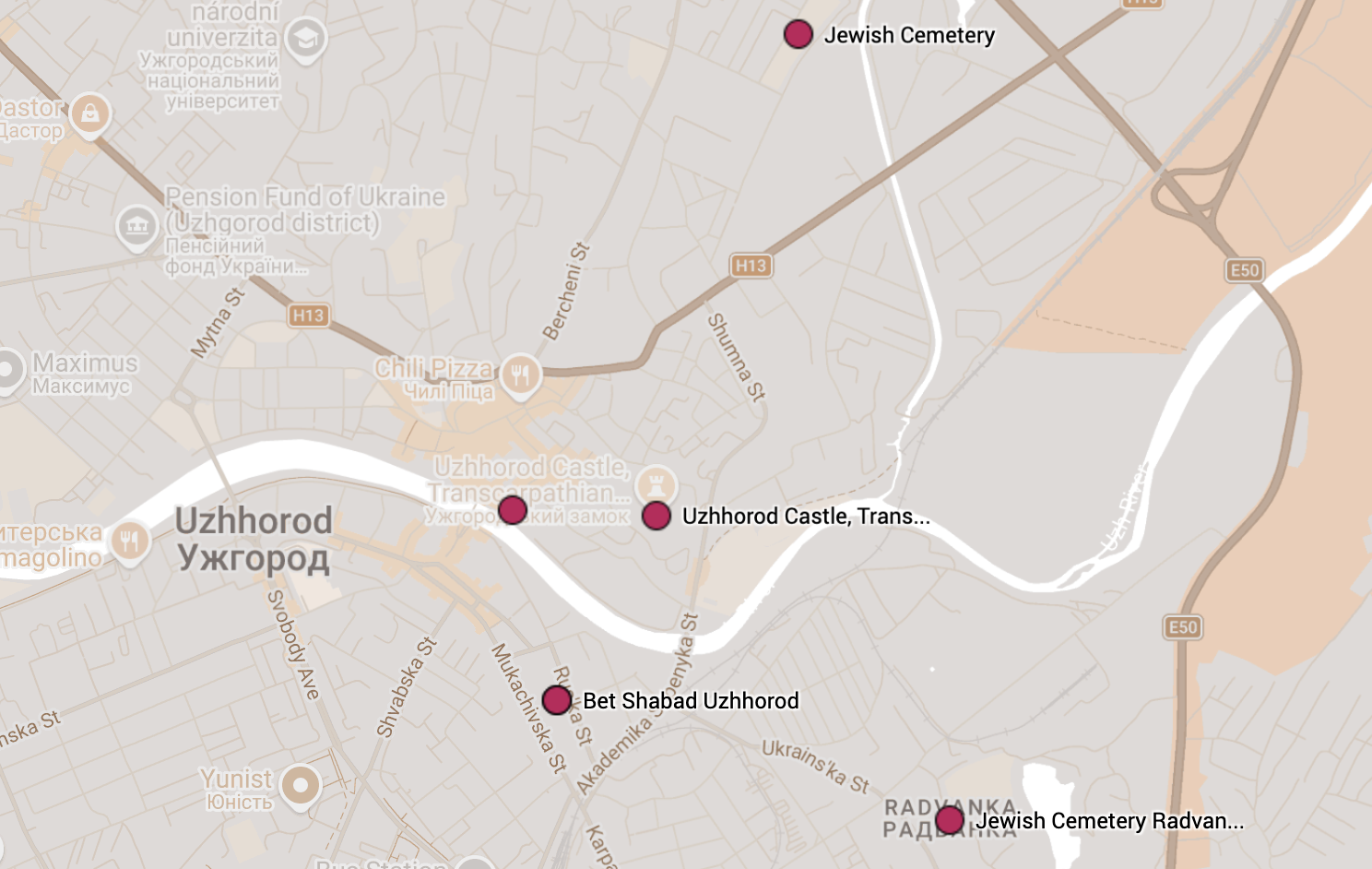
Transcarpathian Museum of Folk Architecture (Kapitul’na St, 33а) As of late 2025, a rare wooden synagogue from Velyki Komiaty was slated for transfer to this open-air museum to be preserved and used for religious purposes.
Members of the Boys were born in Piotrków-Trybunalski in Poland.
The Boys were teenage and child-Holocaust survivors, who were brought to the UK after the war for rest and rehabilitation.
Members of the Boys were held in Nazi labour and concentration camps and used as slave labourers. They had also survived World War II in hiding or as lone children.
The former synagogue in Piotrków, Poland.
Poitrków played a significant part in the story of the Boys, despite the fact that Jewish life in the city was totally destroyed during the Holocaust.
Over 30 of the Boys were born in Piotrków and many more were interned in the ghetto after the German invasion of Poland in September 1939.
Piotrków is situated in an industrial area of Poland in the Łódź Voivodeship. Many of the Boys who came from this area survived because the factories, mills and brickyards were vital to the German war effort. They were run by German companies, who used forced and slave labour.
Ben Helfgott 1946.
“Piotrków was a progressive town, in fact it was a socialist town. There were still many Jews who were Orthodox and wore kaftans and peaked hats, but that was declining very fast. I spoke Polish at home, though my parents between them still spoke Yiddish to each other, my grandparents spoke Yiddish.”
The vast majority of the Boys worked as slave labourers, and thus evaded deportation to the extermination camps, where many of their relatives were murdered. This shared experience bonded the group together.
The Boys from Piotrków and the Creation of the Boys
It was two of the older brothers of the Boys, who were born in Piotrków and arrived in the Theresienstadt Ghetto in the final weeks of World War II, who brought the young teenage orphans into one unit that would be cared for together. They became part of the first group of the Boys. To find out more click here.
Pre-war
Jews had lived in Piotrków, one of Poland’s oldest cities, since the early 16th century. In 1939, Jews, numbering about 15,000 people, made up 27% of Piotrków’s population.
Gary WinogrodskiKrulik WilderMoishe Malenicky.Moniek BukiHarry Spiro Henry Brown
Six of the Boys from Piotrków. These photographs were all taken after the liberation.
As Piotrków industrialised in the 19th century, it was Jewish families who established the city’s first factories and most of the city’s shops. Piotrków was at this point part of the Russian empire. The city became part of Poland after World War I.
Piotrków was a centre for timber, textiles and glass manufacturing. In 1928, 65% of the registered traders and craftsmen were Jewish. Commercial life in Piotrków was badly affected by the 1930s depression and many Jewish families lived in extreme poverty
Piotrków was a major hub of the Jewish printing industry, which produced a wide range of publications that included Yiddish newspapers, secular and rabbinic literature.
Mala Tribich remembers her childhood in Piotrków:
The city was a centre for Talmudic study and produced many notable rabbis but the Jewish community was diverse and included Orthodox families as well as assimilated secular Jews.
During the interwar period Piotrków was home to branches of all the Jewish political parties represented in Poland: the religious Agudas Yisrael, the various Zionist factions, and the socialist Bund.
In the late 1930s antisemitic attacks became frequent.
Harry Spiro described the first weeks of the German occupation in 1939 at a Chabad meeting in Oxford in 2019:
The Ghetto
The Germans army arrived in Piotrków on 5 September 1939. Persecution of the Jews began immediately. A month later a ghetto was established, the first in occupied Poland.
The ghetto had a population of around 10,000 people but the numbers soon began to swell as Jews from the surrounding area were brought to Piotrków. Eventually, almost 25,000 people were confined to the ghetto. To find out more about the ghetto click here.
Mala Tribich describes the murder of her mother and sister in 1942 after the family had been in hiding:
Deportation
As news of deportations and mass killings began to reach the city, the Judenrat learned that the Germans planned to keep slave labourers in the city and set out to increase the number of workshops.
On 14 October 1942, the ghetto was surrounded by SS and Ukrainian militia and in the days that followed approximately 22,000 people were deported to the Treblinka extermination camp, where they were murdered. There are only 67 known survivors of Treblinka, where there was no selection made on arrival and prisoners were sent directly to the gas chamber.
Some of the Boys witnessed the selection in the market square but others heard the departure of the trains while at work in the factories.
In November 1942, those Jews who had hidden in the ghetto and did not have work permits were rounded up and held in the synagogue. Among them were a number of the Boys.
When the manager of the Hostensia glass factory discovered that this was the reason some of his work force had not arrived for work the Boys were immediately released as key workers.
The Jews remained in the synagogue for some days before they were shot in a nearby forest. Among them were the families of the Boys.
Slave Labour
The 2,400 Jews who remained alive were now all confined in forced labour camps, among them many members of the Boys.
South central Poland had been a centre of the armaments industry since the area had been part of the Russian empire. Many of the Boys from Piotrków were taken to munitions camps, notably one at Skarżysko-Kamienna, which was run by the German company HASAG.
There the members of the Boys became highly skilled workers and although they were treated with abject cruelty, they played an important part of the German war machine. One thousand five hundred other Jews were deported to the forced labour camps at Bilzyń, Pionki and Starachowice.
Those Jews who remained in Piotrków worked in Hortensia glass factory, which produced jars and bottles, the Kara factory that produced glass plate, and the Bugaj timber yards.
In November 1944, the Jewish workers at the glass factories and a smaller part from the Bugaj were sent to the HASAG factories in Częstochowa. The larger part of those from the Bugaj, including about 50 people from the glassworks, were sent to Buchenwald concentration camp in Germany, among them were many members of the Boys.
The women and small children from both factories were also sent to Germany to the Ravensbrück concentration camp and those who survived were liberated in the Bergen Belsen concentration camp. Among them was Mala Helfgott, also one of the Boys.
Liberation
Piotrków was liberated by the Red Army on 16 January 1945. Less than 2,000 of the Jews who had been in the ghetto survived.
Some returned to Piotrków, among them Ben Helfgott, Mala’s brother. He was arrested and Polish policeman threatened to shoot him before letting him go.
Only about half of the Jews that left Piotrków in November 1944, survived the atrocious conditions in various German concentration camps and on the death marches.
Most of the surviving Jews of Piotrków chose to leave Poland.
Present-day
Today, there are no known Jews in the city.
Visiting Piotrków
>
Getting there
The nearest airport is Łódź. There are direct trains and buses from Warsaw and Kraków.
What to see
Former Synagogues
The traces of the Jewish community of Piotrków-Trybunalski include two preserved synagogue buildings:
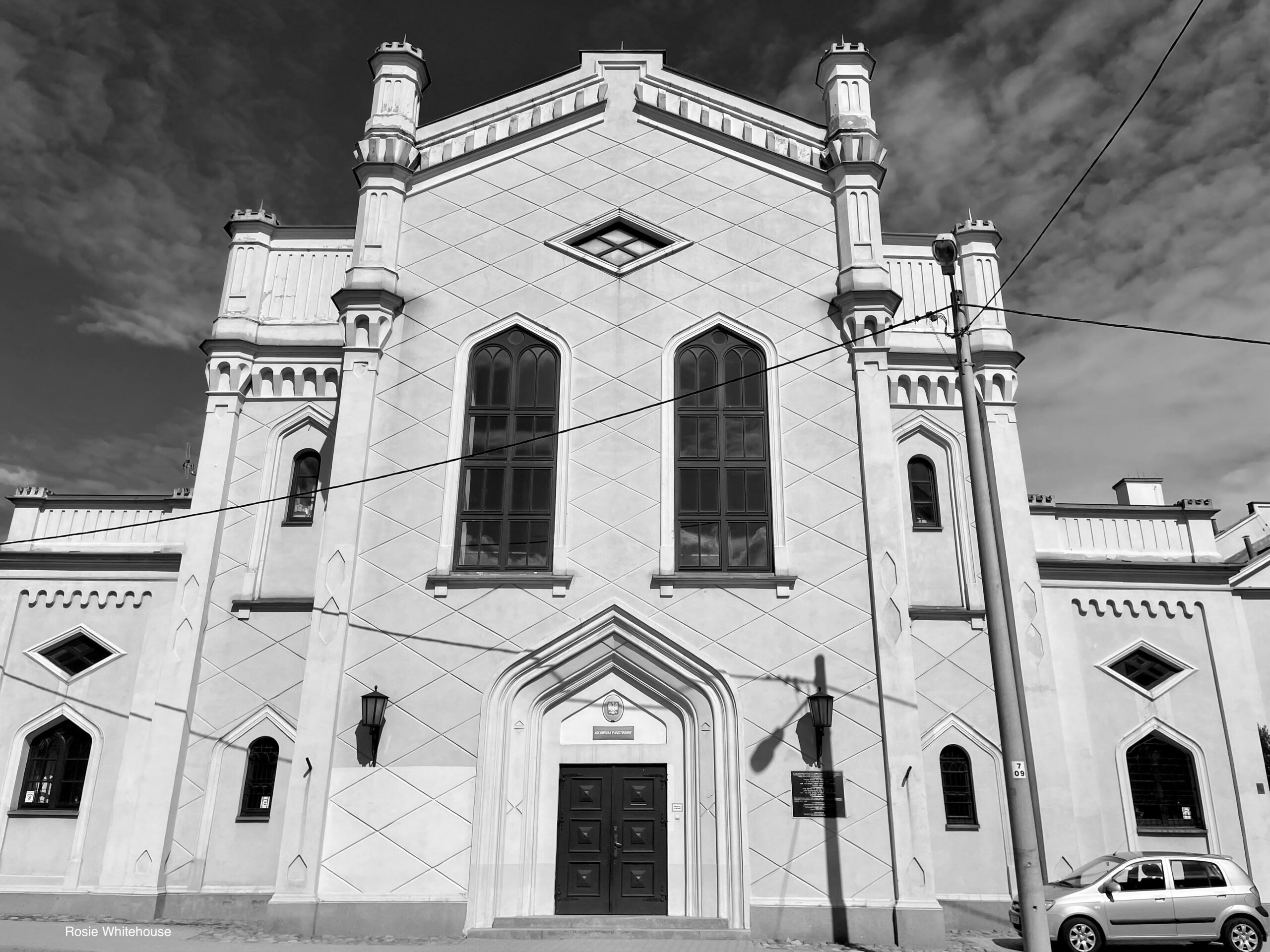
The Great Synagogue (Jerozolimska 29) Built at the end of the 18th century, it is one of the best preserved synagogues in the region. It is now home to the town library.
The Small Synagogue (Jerozolimska 25) Also dating back to the 18th century, is the children’s library.
Memorial to the Jews killed in Piotrków.
Ghetto Location
A walk through the old town, specifically along Staro-Warszawska and Jerozolimska streets, traces the boundaries of the 1939 ghetto.
Deportations took place in the main square.
Bugaj Slave Labour Camp Site During WWII, the Dietrich-Fischer wood factory (Holzwerke) at the lake was used as a slave labour camp, where many of the Boys were held.
Hortensia Glassworks Labour Camp Site (21 Maja Street) Located on the outskirts, this was the site of a forced labor camp (Arbeitslager) where Jewish prisoners, including members of the Boys, were forced to work under brutal conditions. The original Hortensja factory did not survive the economic changes of the late 1990s.
Memorial
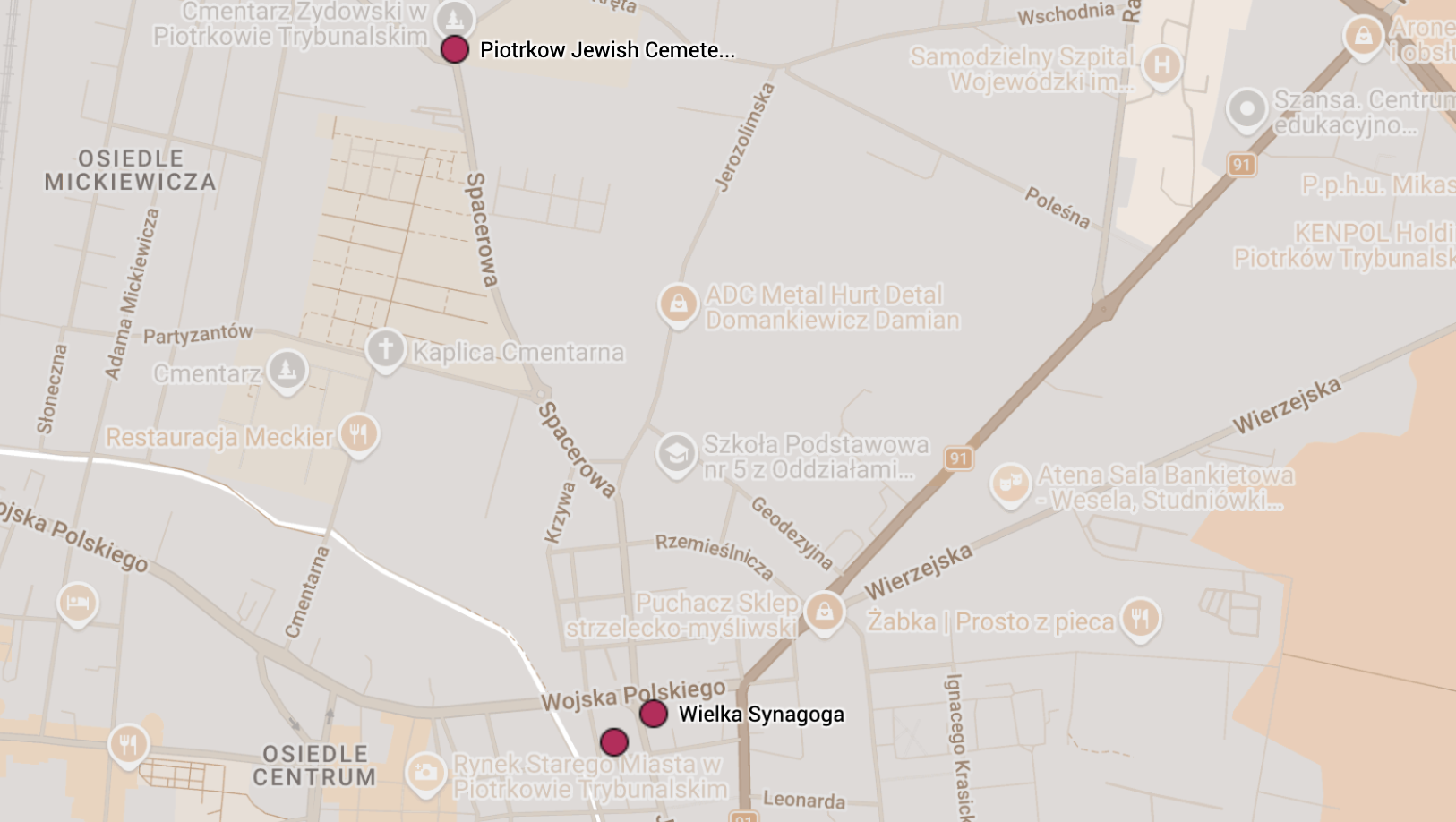
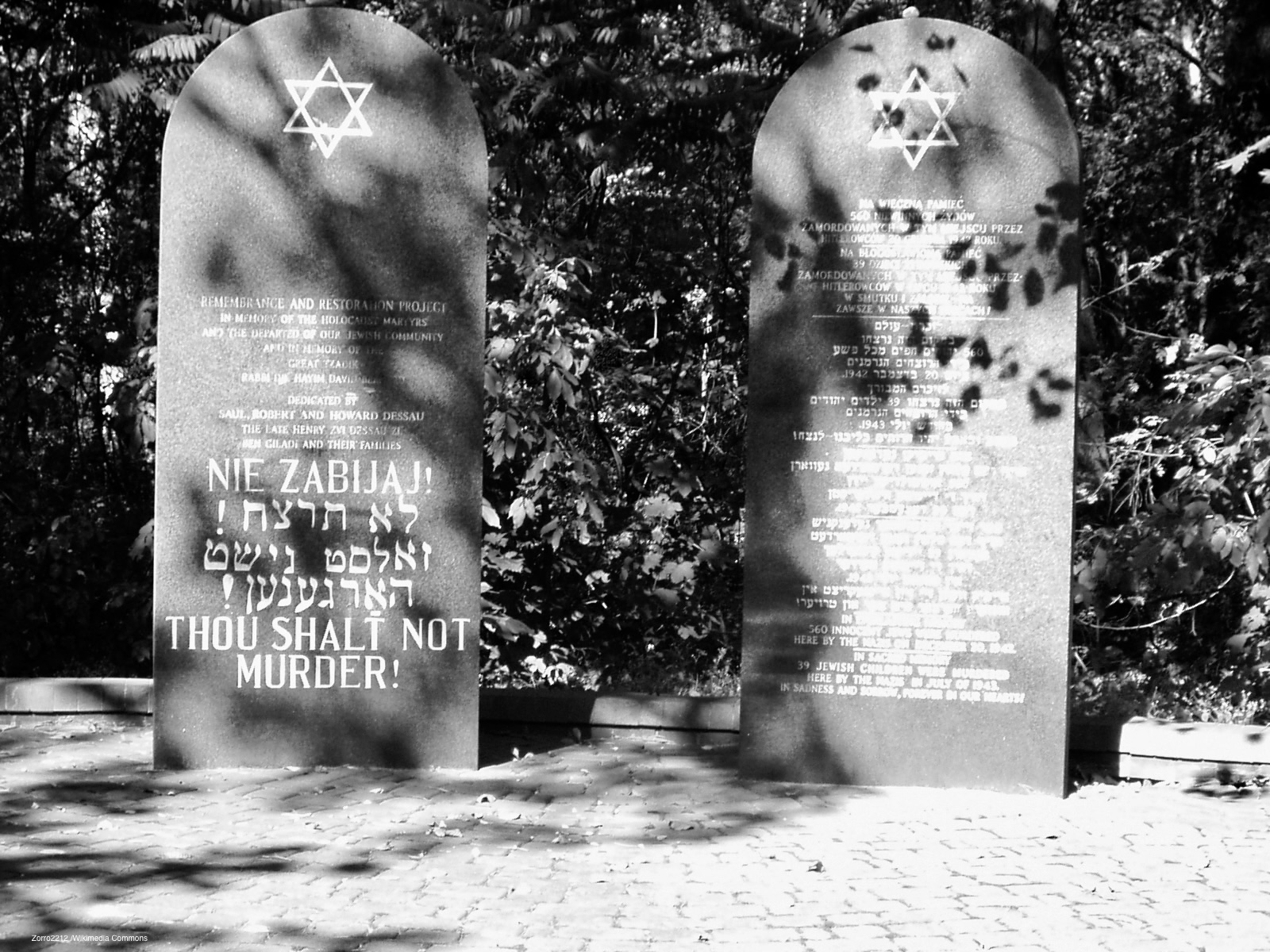
Commemorative Plaques Five plaques exist, funded by survivors Saul and Robert Dessau and Ben Giladi, located at the Great Synagogue, Plac Czarniecki, the Old Cemetery site, the New Cemetery, and near the Rakow forest (3km northwest of Piotrków Trybunalski).
Museum
Piotrków Trybunalski Museum (plac Zamkowy 4, located in the Royal Castle) Provides broader historical context for the city, including its Jewish history.
Cemetery
New Jewish Cemetery (Kręta 20) This is one of the largest and best-preserved Jewish cemeteries in the region, with over 1,700–3,000 surviving matzevot (tombstones). It includes mass graves of Holocaust victims and the ohel of the famous tzaddik Chaim David Bernhard. (The cemetery is usually locked; keys are held by a family living in the former gravedigger’s house on-site.)
Old Jewish Cemetery Site Located in the park area directly behind the synagogues, this site no longer has visible tombstones but is commemorated by a memorial plaque installed in 1997.
What to read
>
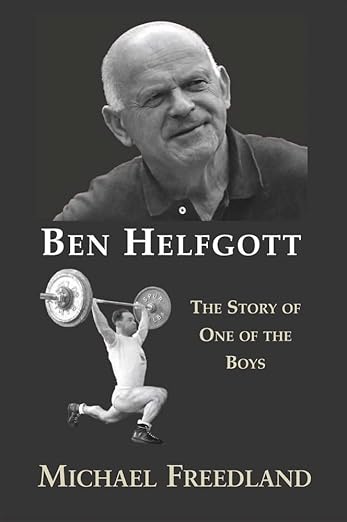
Ben Helfgott, The Story of One of Our Boys (Valentine Mitchell, 2018) Michael Freeland. Ben Helfgott was one of the Boys from Piotrków. To find out more click here.
The Boys were teenage and child-Holocaust survivors, who were brought to the UK after the war for rest and rehabilitation.
Members of the Boys were held in Nazi labour and concentration camps and used as slave labourers. They had also survived World War II in hiding or as lone children.
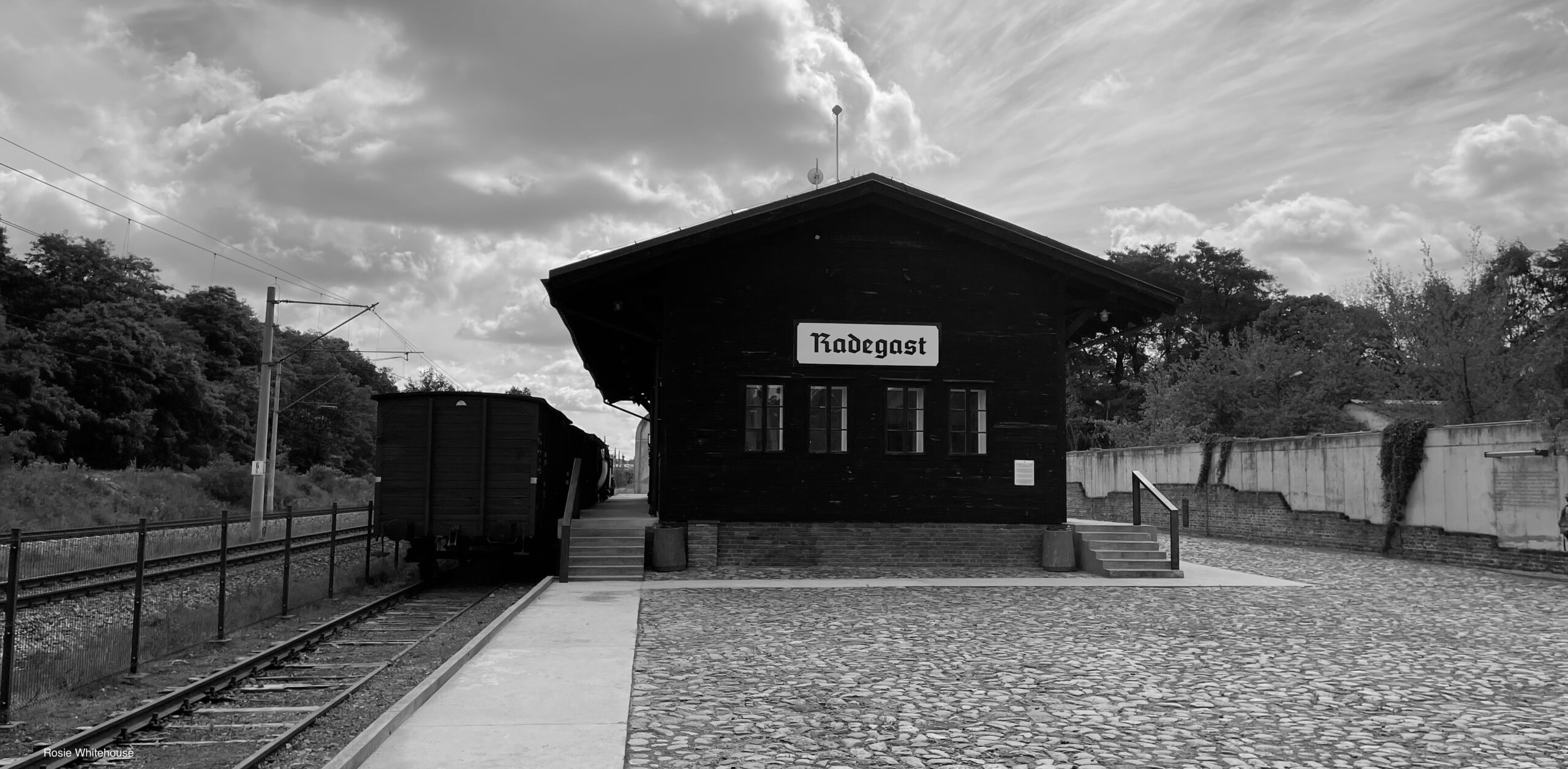
Former Radegast Station, Łódź, Poland.
Łódź was Poland’s second largest city in the inter-war period and was home to a number of the Boys.
Many of those Boys were incarcerated in the Łódź Ghetto, as were many more of the Boys, who were born elsewhere in the region and in Germany. The ghetto was a significant factor in their survival as it was the longest lasting of all the ghettos established in occupied Poland.
Pre-war
Łódź was a major manufacturing centre and it grew exponentially in the late 19th century. Jews made up a third of the population, numbering some 223,000 on the eve of World War II.
It was a diverse community which included all social classes, political views and religious orientation. Łódź was a centre of Jewish literary, theatrical, and artistic activity.
A centre for textile manufacturing, Jews dominated retail trade and by the eve of World War I, Jewish entrepreneurs operated more than half of the city’s factories. Jewish skilled workers dominated tailoring, shoemaking, meat-cutting, printing, and paper workshops and factories. Jewish merchants controlled wholesale and retail commerce, marketing most of the textile production and operating thousands of small grocery stores and market stalls. Jews also owned many of the city’s apartment houses.
Nevertheless, interwar Łódź was a multi-ethnic society with interlocking interests and frictions, where anti-Jewish violence was an occasional, but not predominant phenomenon.
The Story of the Boys’ Families: The Kestenberg Family
The Kestenberg Family.
Isaac Kestenberg was a textile manufacturer. He and his wife Sarah had four children. Samuel (b. 1922), Szyja ‘Charlie’ (b. 1923), Sabrina (b. 1927) and David (b. 1930), who later became one of the Boys.
Immediately after the German invasion of Poland the family factory was confiscated, and the Kestenbergs were interned in the Łódź Ghetto. Samuel died in the ghetto hospital in 1941 and Szyja was shot in 1943. In 1942, their mother Sarah was taken to the Treblinka extermination camp, where she was murdered.
In 1944, Isaac Kestenberg was deported to Auschwitz II-Birkenau with his two surviving children Sabrina and David. The family was broken up and sent to various labour camps as slave labourers. It is not known where Isaac Kestenberg died. Sabrina endured a death march to Danzig, where she was herded onto a death boat which was deliberately sunk in the harbour.
Kestenberg was the soul survivor of his family. To read more about David Kestenberg’s life click here.
The Ghetto
Deportation of Jews to the Łódź Ghetto 1940.
The Germans invaded Poland on 1 September 1939 and occupied Łódź a week later.
Łódź was immediately renamed Litzmannstadt and incorporated directly into the Third Reich.
A ghetto was created in spring 1940. Although the Germans had ultimate control, a considerable degree of authority, more than in any other ghetto, remained with the Jewish Council and its leader, Chaim Rumkowski.
In January 1942, the Germans began to deport Jews to the nearby Chełmno extermination camp, the first of its kind. By September 1942, 70,000 Jews and 5,000 Roma had been murdered there.
From then, until May 1944, there were no significant deportations and the ghetto resembled a forced labour camp. The Germans then decided to liquidate the ghetto and the remaining inhabitants were deported to the Auschwitz II-Birkenau concentration and extermination camp in occupied Poland.
Although Auschwitz is the symbol of the Holocaust and the genocide carried out against the Jews, it was significantly different from the other extermination camps was not just a place where Jews were deported to and murdered. When the trains arrived in Birkenau a selection was made on the ramp. It offered healthy young men and women a chance of survival as they were often selected for slave labour. To read more about Auschwitz click here.
Stephen Wolkowicz just after the liberation.
“Our apartment building was part of the two three-storey blocks with an internal courtyard, paved with bitumen, into which cars and horse drawn carts could enter. At the street frontage there were large gates that opened into a ‘tunnel’ which was formed by two or three other apartments built over the gates …
One of my earliest memories is from when I was four or five, and at home convalescing from an operation for appendicitis. I remember dancing bears performing in our courtyard while the owners watched, waiting for us to give them money. I also remember after the surgery, demanding raw carrots to eat and instead being given a chocolate shell filled with sweets, which melted in my mouth.:”
Stephen Wolkowicz was born in Łódź in 1933. The family lived at 37 Kosciuski Avenue. His father imported yarn and from Britain. To read more about Wolkowicz’s life click here.
Those members of the Boys who were deported from the Łódź Ghetto were selected to work as slave labourers. The fact that they arrived six months before the camp was liberated increased their chance of survival.
They were deported with large groups of friends who looked after each other in the camps. This was another significant factor in their survival.
Prisoners on the ramp warned new arrivals to say they were healthy, and teenagers were told to say they were older than they were. These inmates spoke Yiddish which increased the chance of the Boys survival. Many arrivals from Greece, France, Italy and Holland did not understand the warnings.
About 12,000, Łódź Ghetto residents survived Auschwitz and other camps.
Sender & Yitschok RisemanPaul Gast Samuel DiamentSalek BenediktIsrael LichtMoniek Frenkel
Some of the Boys deported from Łódź to Auschwitz.
Liberation
Thirty-eight thousand survivors passed through the city in the months after the liberation among them members of the Boys. Łódź became a major hub in the underground movement to take the survivors illegally to the British controlled Palestine Mandate. Youth groups were housed at Zadocnia 66. Conditions were harsh and the children slept on the floor and were fed only potatoes and bread.
With the consolidation of communist power, all independent Jewish political parties, organisations, and institutions were closed by the end of 1949.
Aftermath
Most of the Jews who originally lived in Łódź but survived the Holocaust joined the exodus of survivors from Poland and many of the Jews who now live in the city arrived from much further east. Finding Łódź far safer than the post-war situation they had experienced in their hometowns, they settled in the city.
By the early 1960s, Łódź had fewer than 3,000 Jews. In 1967-68, the Polish communist authorities carried out an anti-Zionist purge and many Jews fled the country. More than 1,000 Jews left the city after March 1968, immigrating to Israel, the United States, and Scandinavia. By the 1970s, Łódź had fewer than 1,000 Jews. Many left after the fall of communism.
Present-day
A small, organised Jewish community exists in Łódź today, part of the broader, post-1989 revival of Jewish life in Poland.
Visiting Łódź
>
Łódź was until recently a run-down former industrial city with much in common with Detroit but has undergone somewhat of a revival in recent years. It is still possible to glimpse the city’s Jewish past.
Getting there Łódź Władysław Reymont Airport has direct flights from the UK but alternatively fly to Warsaw’s Chopin Airport. Łódź Fabryczn has direct train services to Warsaw and Kraków. Łódź is well served by Poland’s motorway system.
Getting around You can walk from the Manufaktura centre, where there are hotels and restaurants, to the Bałuty area of the former ghetto. To visit the Radegast station memorial and the Jewish cemetery, you will need to take bus Z6 from the Zachodnia-Manufaktura stop. The two sites are 15 minutes’ walk apart. Taxis in Łódź are relatively cheap.
If you do not have your own transport, to visit the site of the Chełmno extermination camp take the train to Kolo and then a taxi, a journey of about 15 minutes. It is worth asking the taxi to wait to take you on to the Rzuchów Forest.
What to see
>
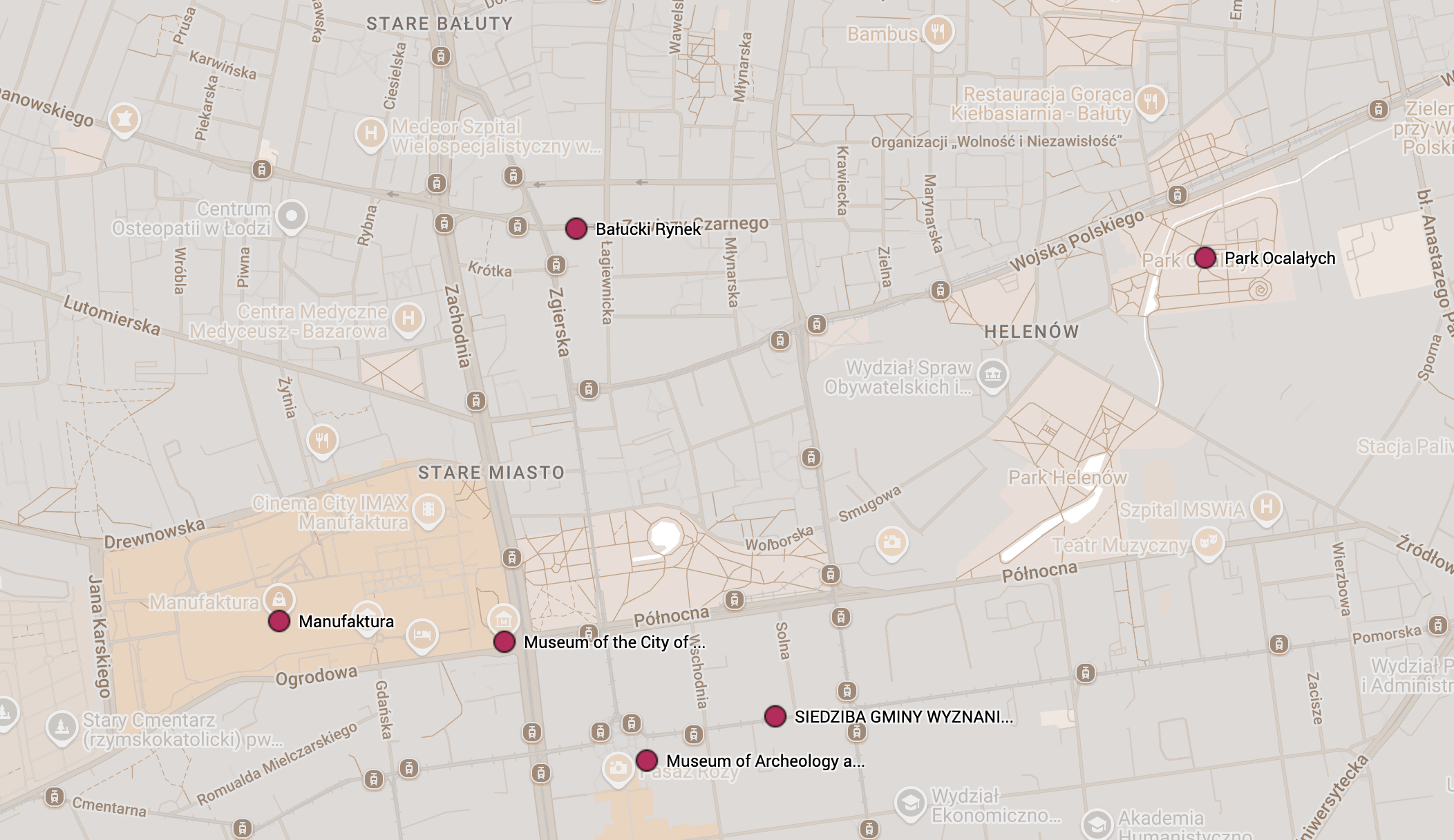
Map of northern Łódź
Sites
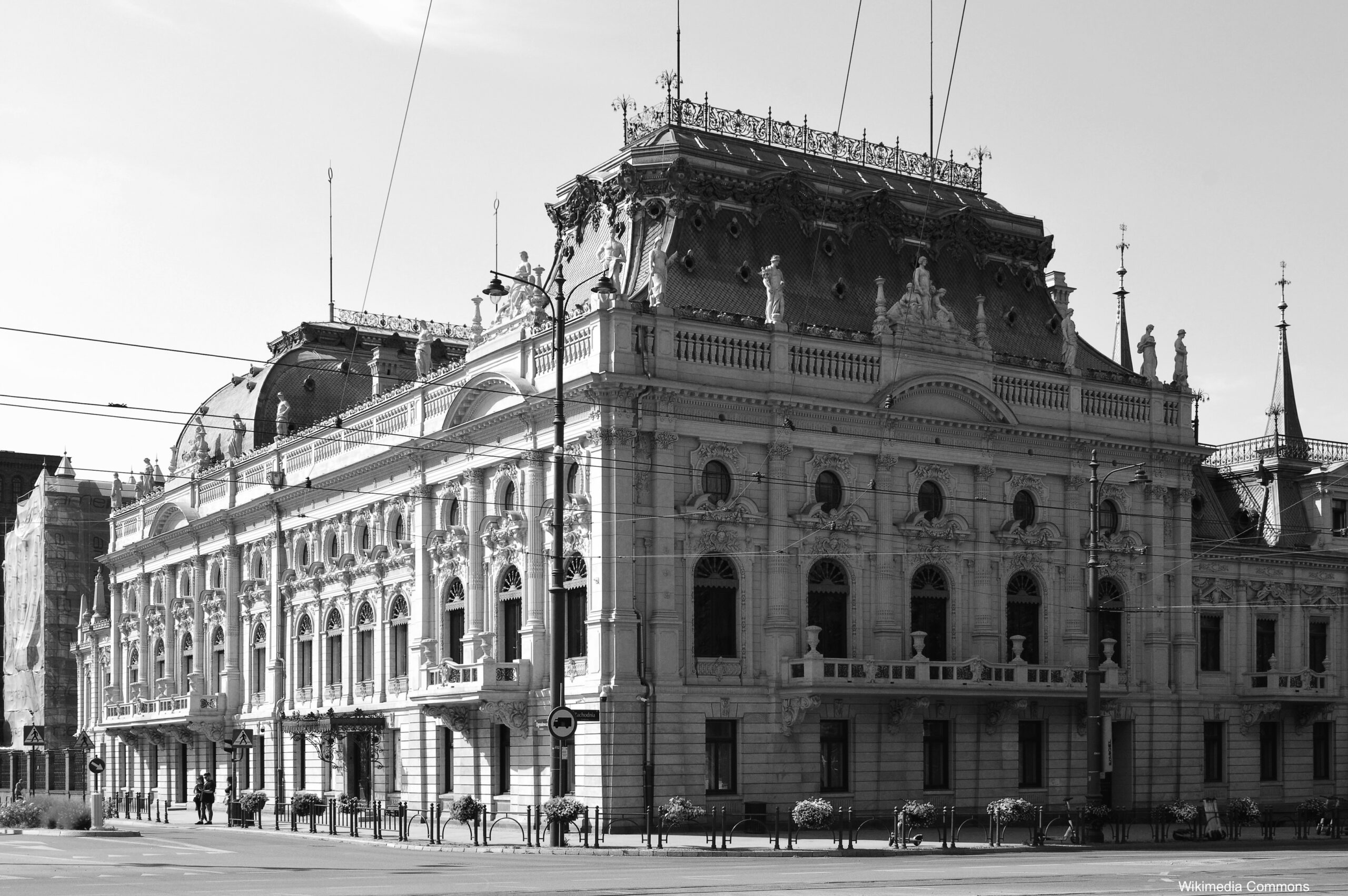
Manufaktura shopping centre The textile magnate Israel Poznański’s former factory is now a shopping centre. This is the location of the best hotels in Łódź. It is in the north of the city close to the former ghetto area.
Piotrkowska Street Similar grand houses and factories are located on Poland’s longest street at 4.2km in the city centre. Many of the factory and tenement buildings have been converted into bars and restaurants.
Museums
Museum of the City of Łódź (Muzeum Miasta Łodzi; Ogrodowa 15; w muzeum-lodz.pl; entry fee) is located in the former neo-Baroque-style palace of the textile magnate Izrael Poznański. This is the best place to get a feel for pre-war Łódź. The museum offers guided tours and thematic walks, and there is a small exhibition about Łódź-born Jan Karski, the courier for the Polish underground who brought news of the murder of the Jews to leaders in London and Washington. The former factory behind it is now the Manufaktura shopping centre
Archaeology and Ethnography Museum (Muzeum Archeologiczne i Etnograficzne w Łodzi; plac Wolności; w maie.lodz.pl; entry fee). The museum holds an extraordinary hidden treasure trove found in 2023 during restoration work on Północna 23. The street runs east from the Manufaktura complex and was just outside the ghetto limits. Hidden during World War II, it contained hundreds of Jewish-owned items, including Judaica and household utensils wrapped in newspapers.
Ghetto Location
Map of Łódź Ghetto.
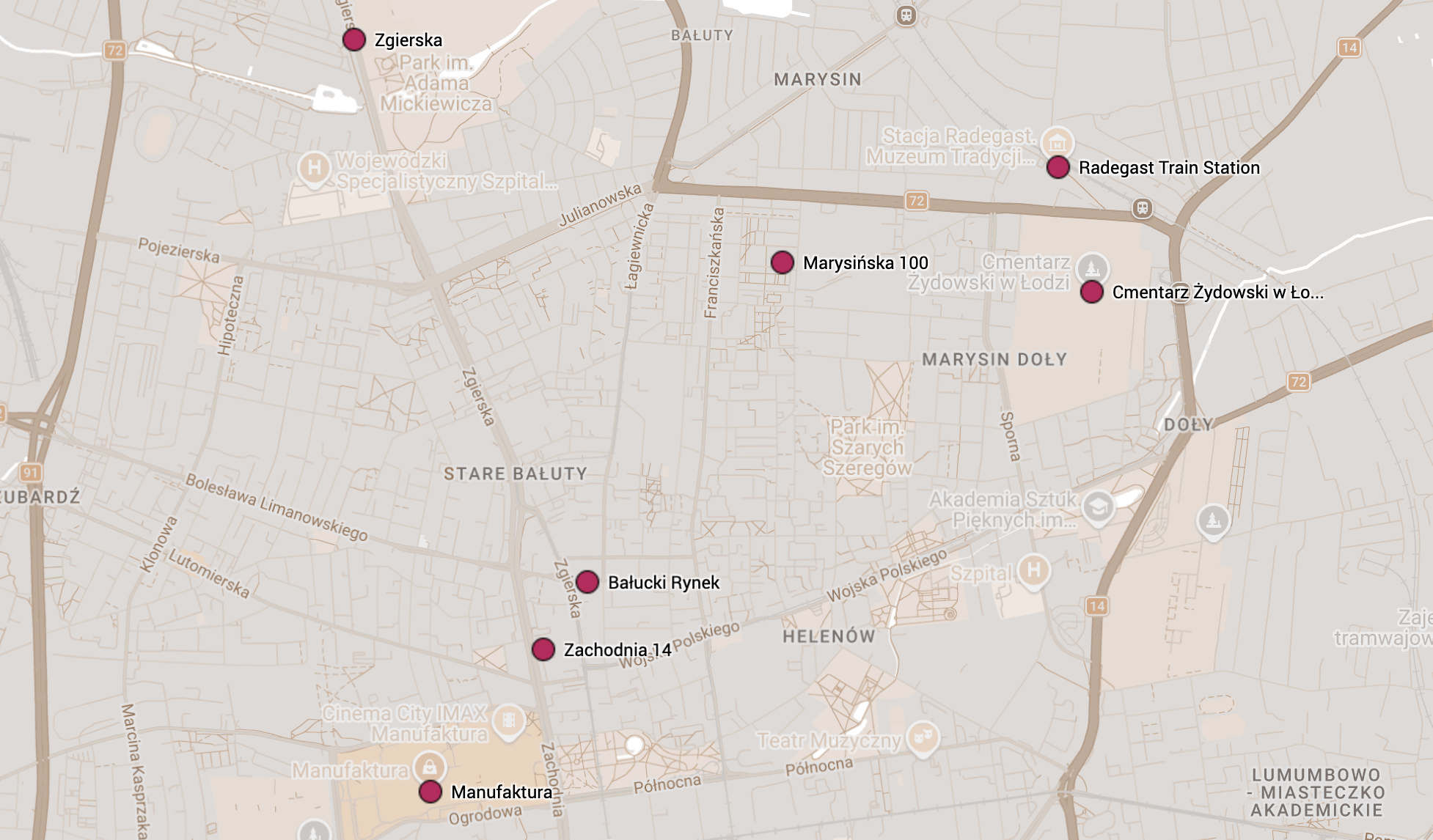
Łódź Ghetto began just north of the Manufaktura complex and extended to the Jewish cemetery in the east of the city. The ghetto area to the east and north was redeveloped under communism although the orphanage where Arek Hersch lived still stands at Marysińska 100.
Unlike in the former Warsaw Ghetto, some of the original buildings in Łódź still exist and have explanatory plaques attached which are also in English. To see all the sites of the ghetto, you need to follow the walking tour on w lodz-ghetto.com. The trail is roughly 10km long, so if you are looking for specific sites the tour is especially useful. A leaflet with a shorter tour is available at the Radegast memorial.
Bałucki Rynek The key highlights are around Bałucki Rynek, the main marketplace, where both the German and Jewish administrations were based. Food, raw materials and fuel were unloaded here. The area could only be entered with a special pass. Still standing, Łagiewnicka 25 housed several Jewish administrative offices. The Gestapo HQ was at Limanowskiego 1.
There were seven hospitals in the ghetto, from which the patients were deported in 1942. North of the market, Łagiewnicka 34–35 was Hospital No. 1.
Rumkowski had an apartment here until the deportations. It was then used as an assembly point. During the liquidation, the head of the ghetto, Hans Biebow, gathered a group of 600 Jews here and placed them on a special train destined for Stutthof. Some of the Boys were on this transport. The prisoners were taken to work as slave labourers in Dresden. Biebow was hoping that his rescue of the 600 from the gas chambers of Auschwitz would save him if he was captured by Allied forces. He was eventually caught and hanged in 1947.
South of the market in front of the fire station at Zachodnia 14, Rumkowski gave his infamous speech on 4 September 1942, calling upon the ghetto inhabitants to give up their children to save everyone else.
Zgierska just to the west of Bałucki Rynek cut through the ghetto. The buildings on either side of the thoroughfare were part of the ghetto, but trams and cars were free to pass along it. Many of the original buildings remain, but not the three wooden footbridges which were erected in the summer of 1940 allowing the people in the ghetto to move from one section to the other. One of those bridges stood next to the red-brick Church of the Assumption of the Blessed Virgin Mary on Plac Kościelny, which was used as a warehouse for stolen Jewish property. In 1942, the clothes of the people murdered at Chełmno extermination camp were brought here – the forced labourers tasked with sorting the clothes began to realise that mass murder was taking place. The Ghetto Chronicles which recorded life in the ghetto from January 1941 to July 1944 were written by Jewish journalists and intellectuals at Zgierska 4.
To find out more about the Łódź Ghetto click here.
Memorials
Radegast Station (al. Pamięci Ofiar; entry fee) Radegast railway station is one of the most moving and significant memorials in Łódź. From here deportations were carried out first to the Chełmno extermination camp and then in the summer of 1944 to Auschwitz. The tunnel that leads to the station is lined by original deportation lists. These lists are of people deported to Chełmno; there were no lists of those deported to Auschwitz.
The station was built in 1937 and before the deportations began was used to bring raw materials into the ghetto and to ship out goods that had been made in its factories. Transports of Jews, Roma and Sinti from other parts of occupied Europe also arrived here. There is a large model of the ghetto in the exhibition. This is the place to ask for help if you are looking for somewhere specific.
Three original freight cars stand on the tracks by the platform with their doors open, so that visitors can see what it was like inside. The outdoor exhibition tells the story of the Łódź Ghetto. There are also plaques commemorating the Jews of Vienna and Luxembourg, who were transported to the death camps after first passing through the ghetto. On the anniversary of the ghetto’s liquidation in August, the memorial service at the Jewish Cemetery is followed by a commemorative march to the station.
The Survivors Park (Park Ocalałych) in the eastern section of the former ghetto has a monument to those who survived and 594 trees planted by survivors, as well as memorials to Jan Karski and to Poles who helped save Jews. From the Mound of Memory, an artificial 8m hill, there is a view across the city. The park is also home to the Marek Edelman Dialogue Center (w centrumdialogu.com; free), founded in 2010, which promotes the multicultural and multi-ethnic heritage of Łódź and hosts temporary exhibitions.
Cemeteries
The Jewish Cemetery (public entrance on ul. Zmienna) The largest in Europe, the cemetery was in the eastern limits of the ghetto. The industrialist Izrael Poznański is buried here, but the most moving part of the cemetery, known as the Ghetto Field, is in the southern part of the complex. An estimated 45,000 Jews, who died in the ghetto, are buried here. The 700 Roma and Sinti who died in the ghetto are buried in section PV and PV1.
More than 5,000 Roma and Sinti, among them 2,689 children, were brought to Łódź from Burgenland in Austria in late autumn 1941. They were held in the nearby Zigeunerlager on Wojska Polskiego 84 at the junction with Głowackiego. The site is marked by a plaque and there is a small exhibition. In January 1942, the camp was liquidated and the people confined here were murdered in Chełmno extermination camp.
Jewish Community
The Jewish Community of Łódź (Gmina Wyznaniowa Żydowska w Łodzi, ul. Pomorska 18, t +48 42 633 51 56, w kehilalodz.com.) Housed in the historic Gebhardt Palace, it serves as the hub for Jewish religious and community life in Łódź. The site includes a small synagogue. The community supports the Reicher Synagogue (ul. Rewolucji 1905, 28) built 1895-1900, which is the only synagogue in the city that survived the Holocaust.
Visiting Chełmno Extermination Camp
>
Chełmno
The former Chełmno extermination camp, 77km northwest of Łódź, was the site of the first Nazi extermination camp on Polish soil and the first place where Jews were gassed.
Background Chełmno is one of the most sinister of the Nazi extermination camps as it was here that the Nazi teams experimented with ways to carry out mass murder and dispose of the bodies.
The first transport from the Łodz ghetto arrived in December 1941. Jews were choked to death as gas vans drove into the Rzuchów Forest along the road from Dabie to Kolo.
Tip Chełmno was the fifth most deadly extermination camp, yet it gets few visitors, so is never crowded. Do however book an English language tour in advance in order to understand the importance of the monuments in the nearby Rzuchów Forest.
What to see
The Kulmhof Museum in Chełmno on Ner (Muzeum Kulmhof w Chełmnie nad Nerem; Chełmno 59a; ( w chelmno-muzeum.eu; free) uses the German name for the village, Kulmhof, as the area around the camp was annexed by the Reich in 1940. The tour starts at the ruins of the country house, where in the cellar Jews from the neighbouring towns were stripped of their possessions and then loaded into mobile gas vans.
The Rzuchów Forest is 15 minutes away. There are a series of monuments and memorials. Visitors can also see the remains of the experimental crematorium.
What to watch & read
>
Films
Shoah (1985) Claude Lanzmann devoted a large part of his epic film to Chełmno, interviewing a former Nazi guard, Simon Srebnik, one of two people to survive the camp and a German settler who described the screams and yells she heard coming from the camp. Also revealing are his interviews with the villagers who remembered the camp.
Books
The Chronicle of the Lodz Ghetto, 1941-1944 (Edited by Lucjan Dobroszycki; Yale 1984): Day-by-day record of life in the ghetto compiled as by Jewish intellectuals imprisoned in the ghetto.
The Brothers Ashkenazi, Israel Joshua Singer (Other Press, 2010) Israel Joshua Singer was the older brother of Nobel Prize–winning Isaac Bashevis Singer. His epic novel of life in Łódź, originally written in Yiddish, was published in 1936.
 About
About History
 Education
 Quilts
 FIlms
FIlms Photos
 News Media & Events
 Publications
 Donate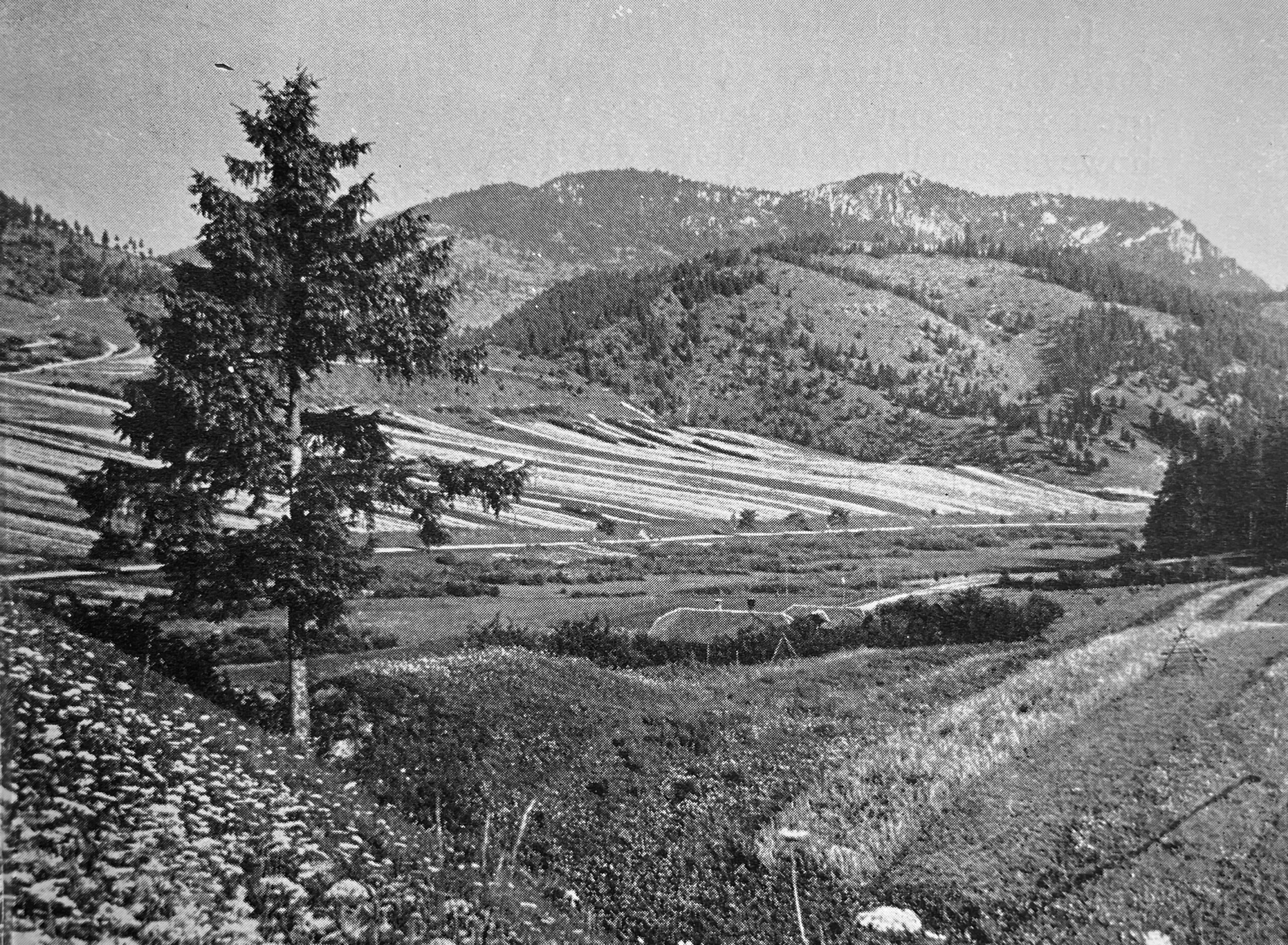
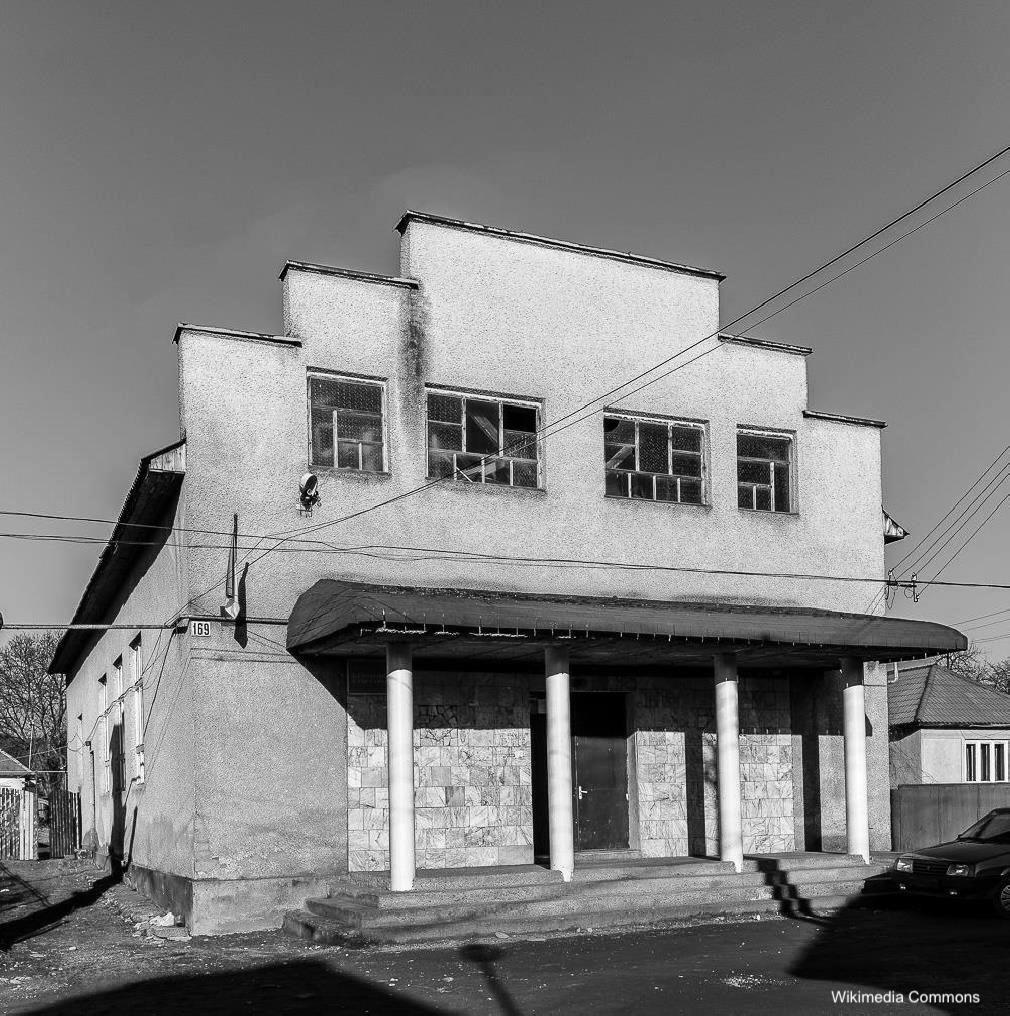
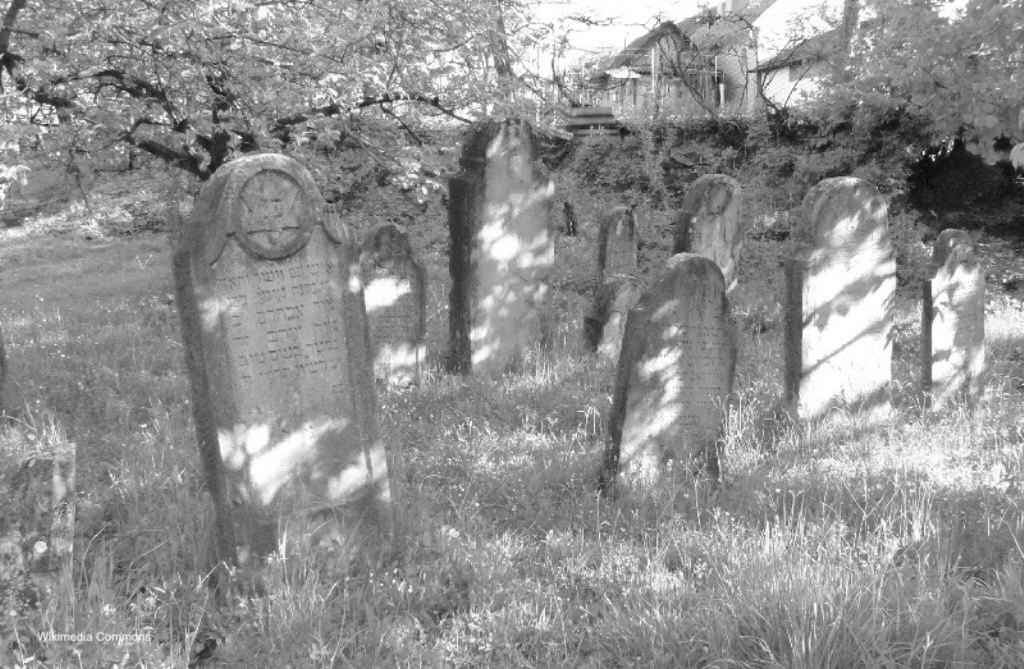
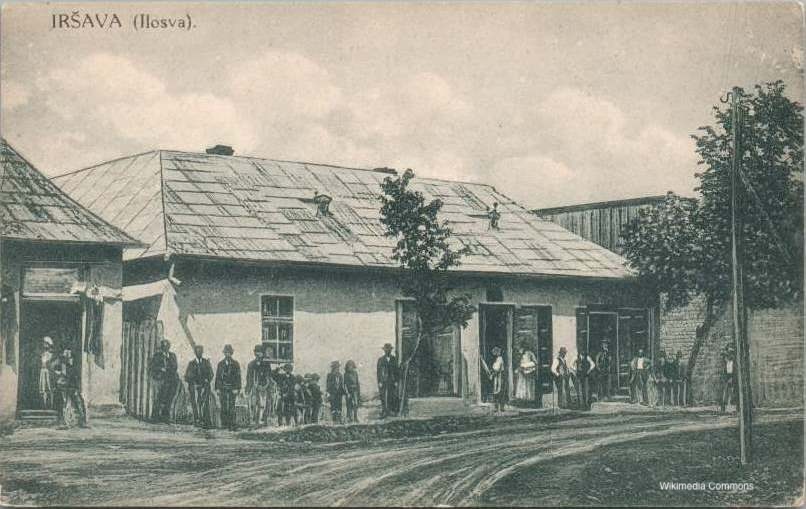
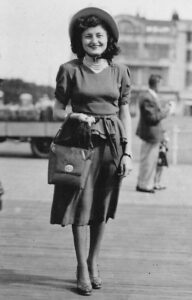
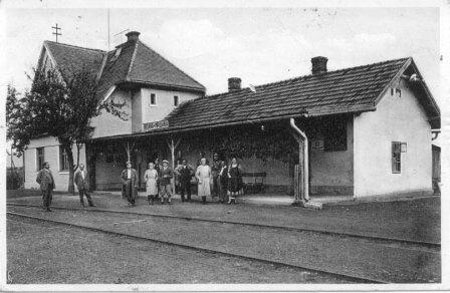
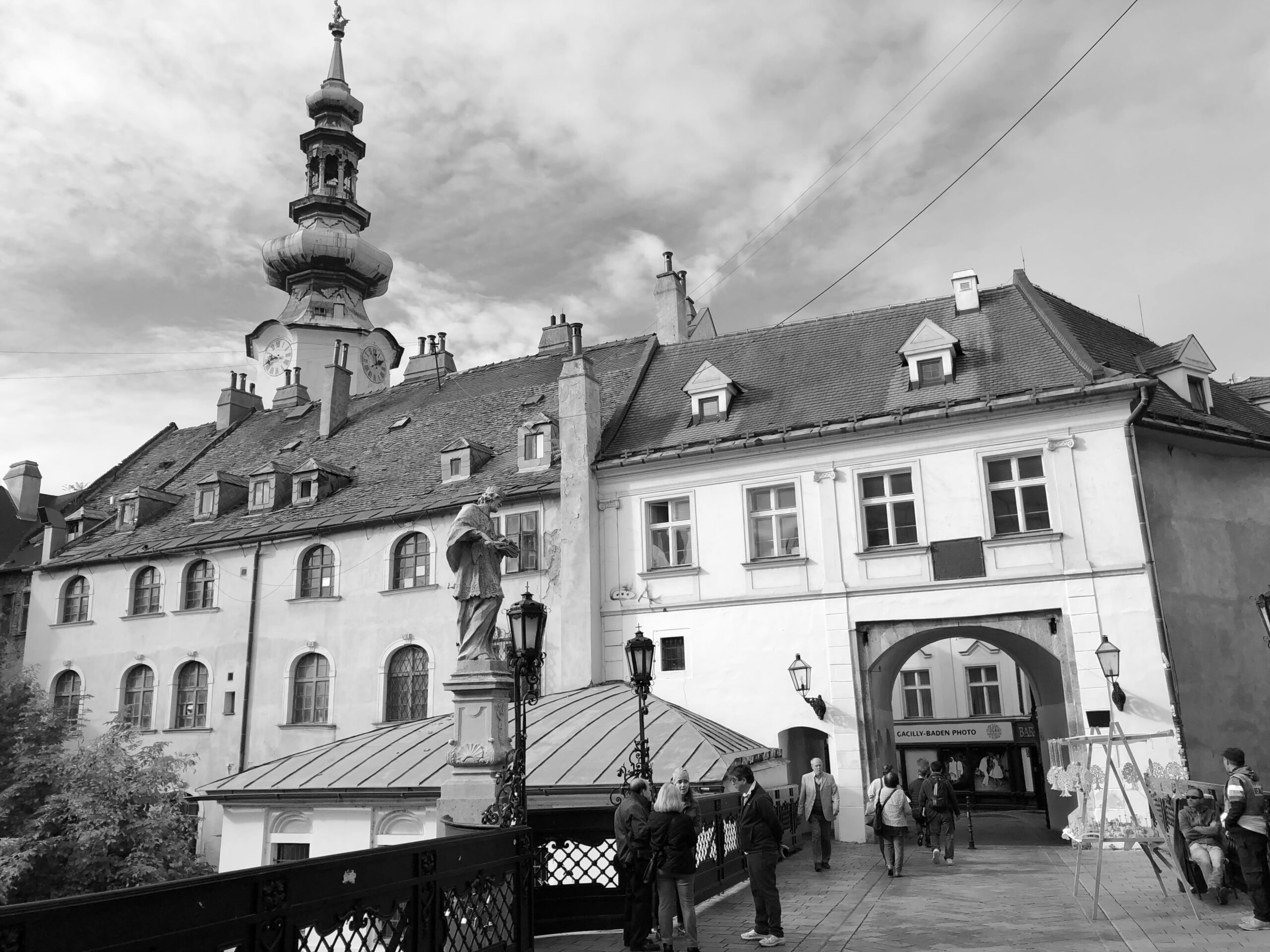
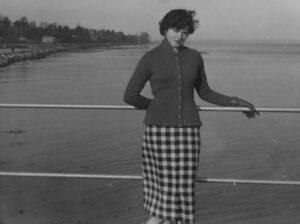
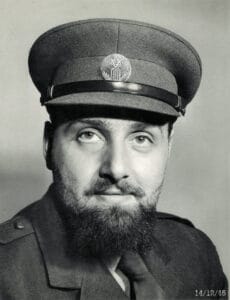
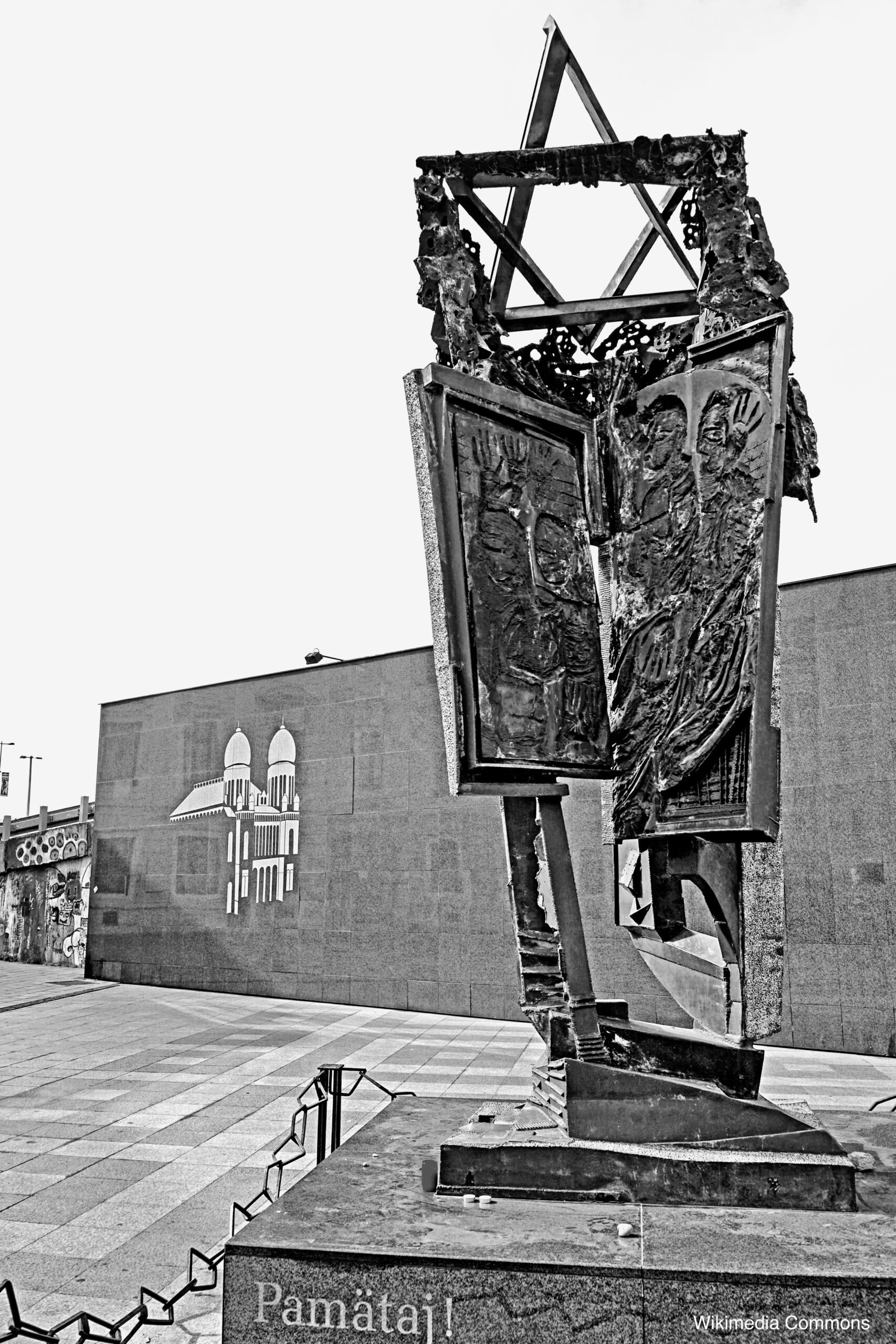
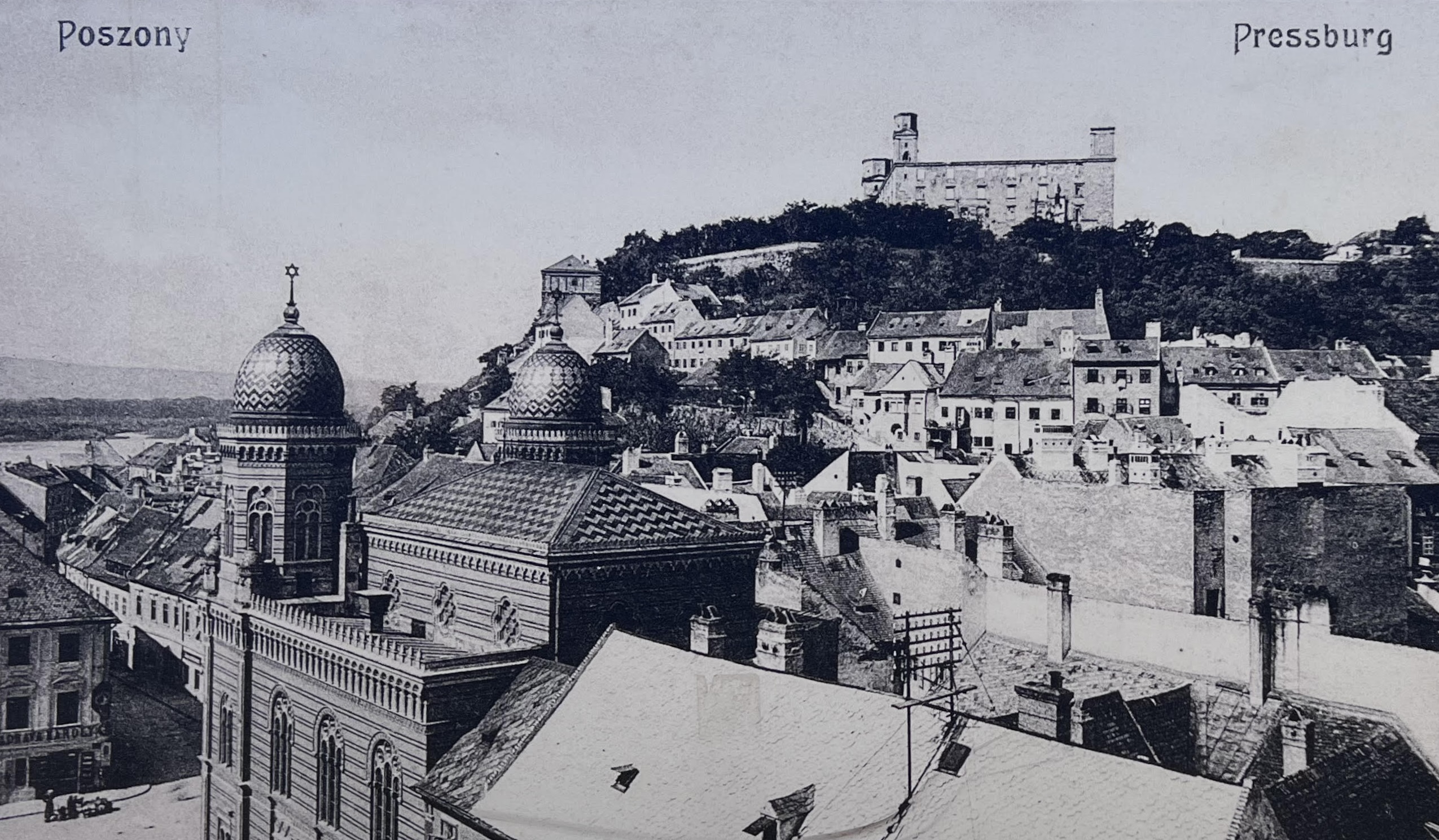
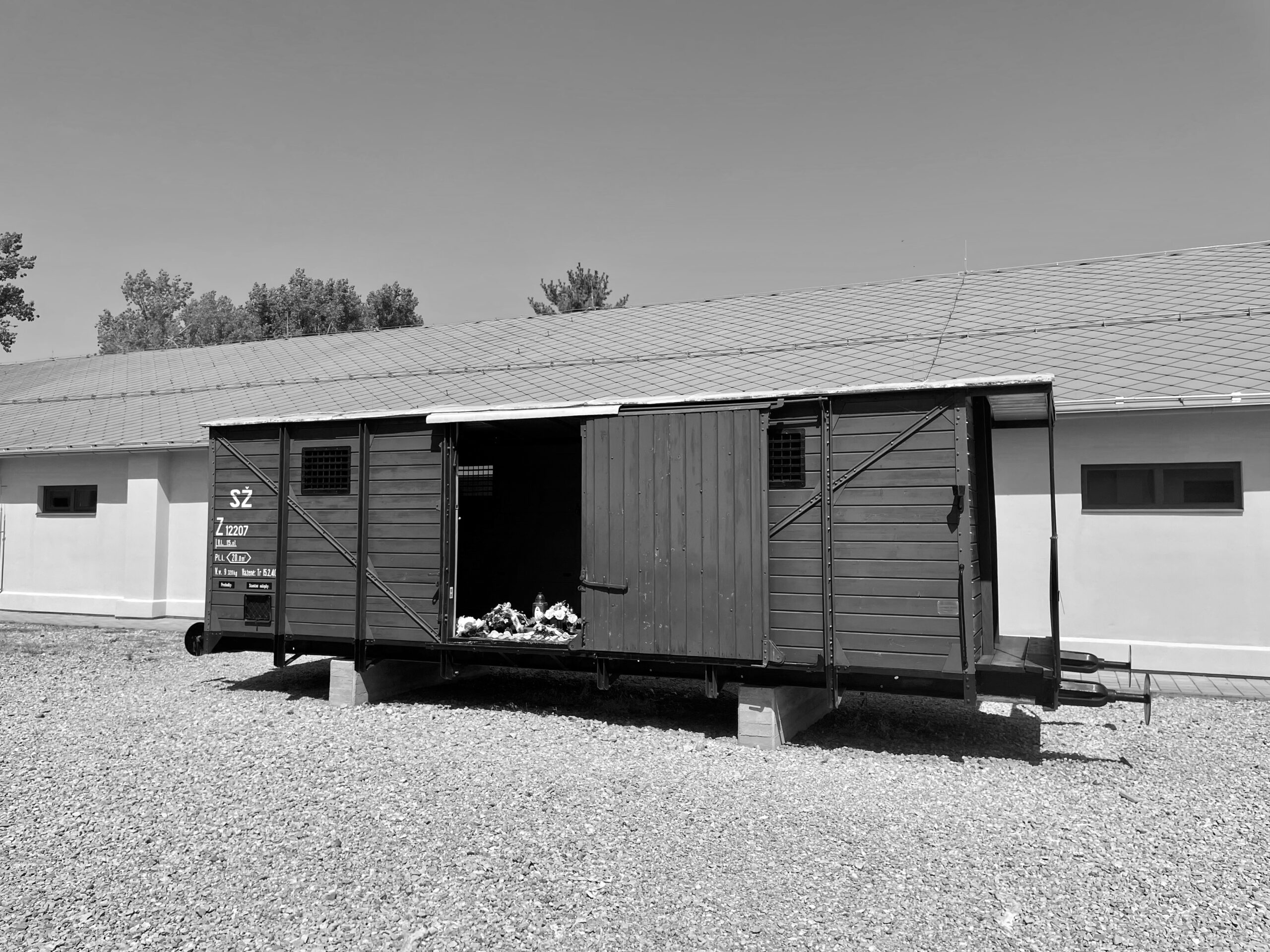
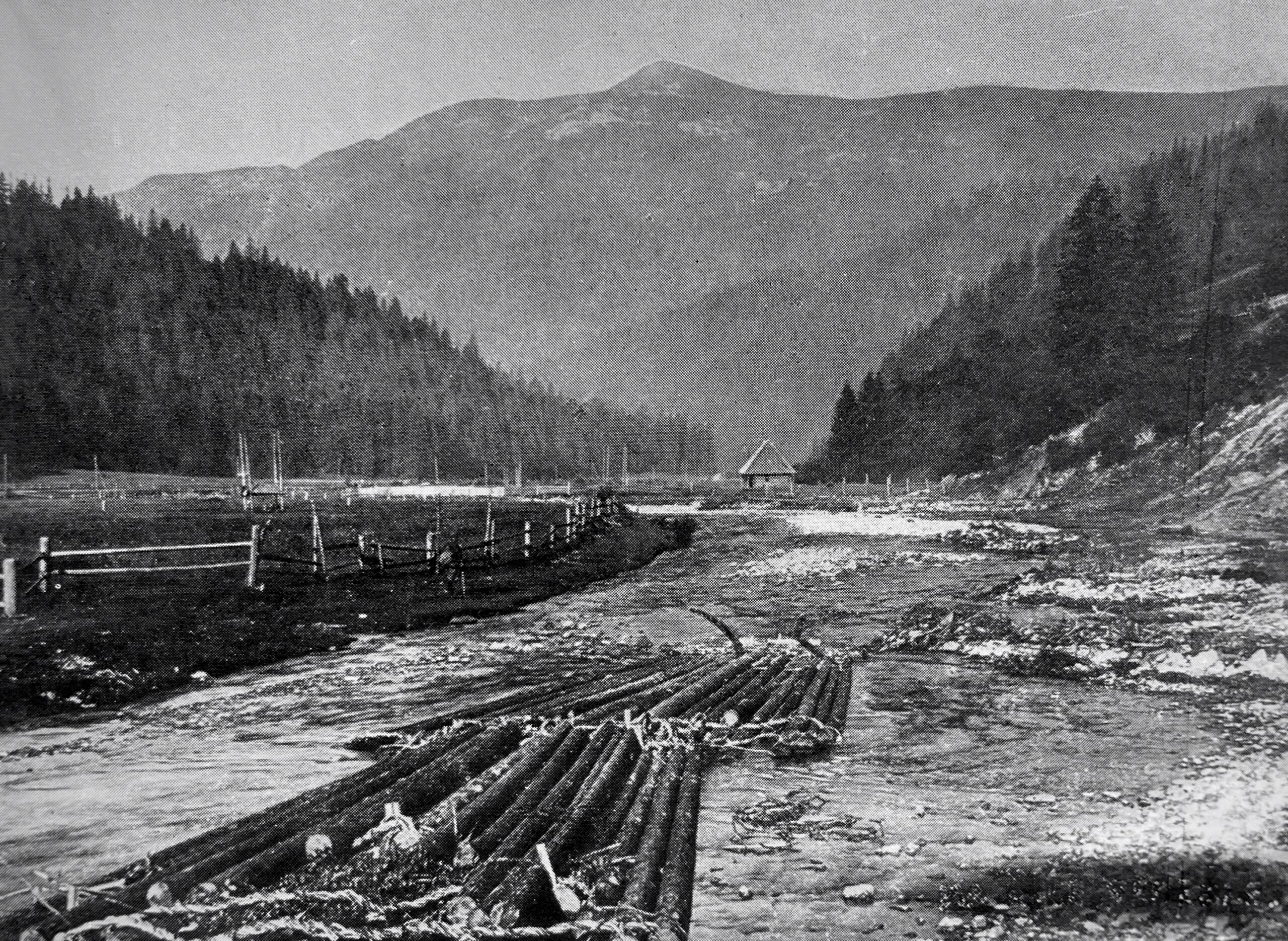
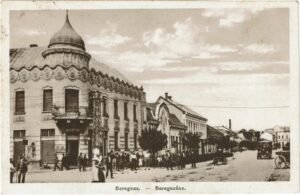 The city had a Jewish school as well as a number of small yeshivas. During the 1930s a Hebrew school was founded.