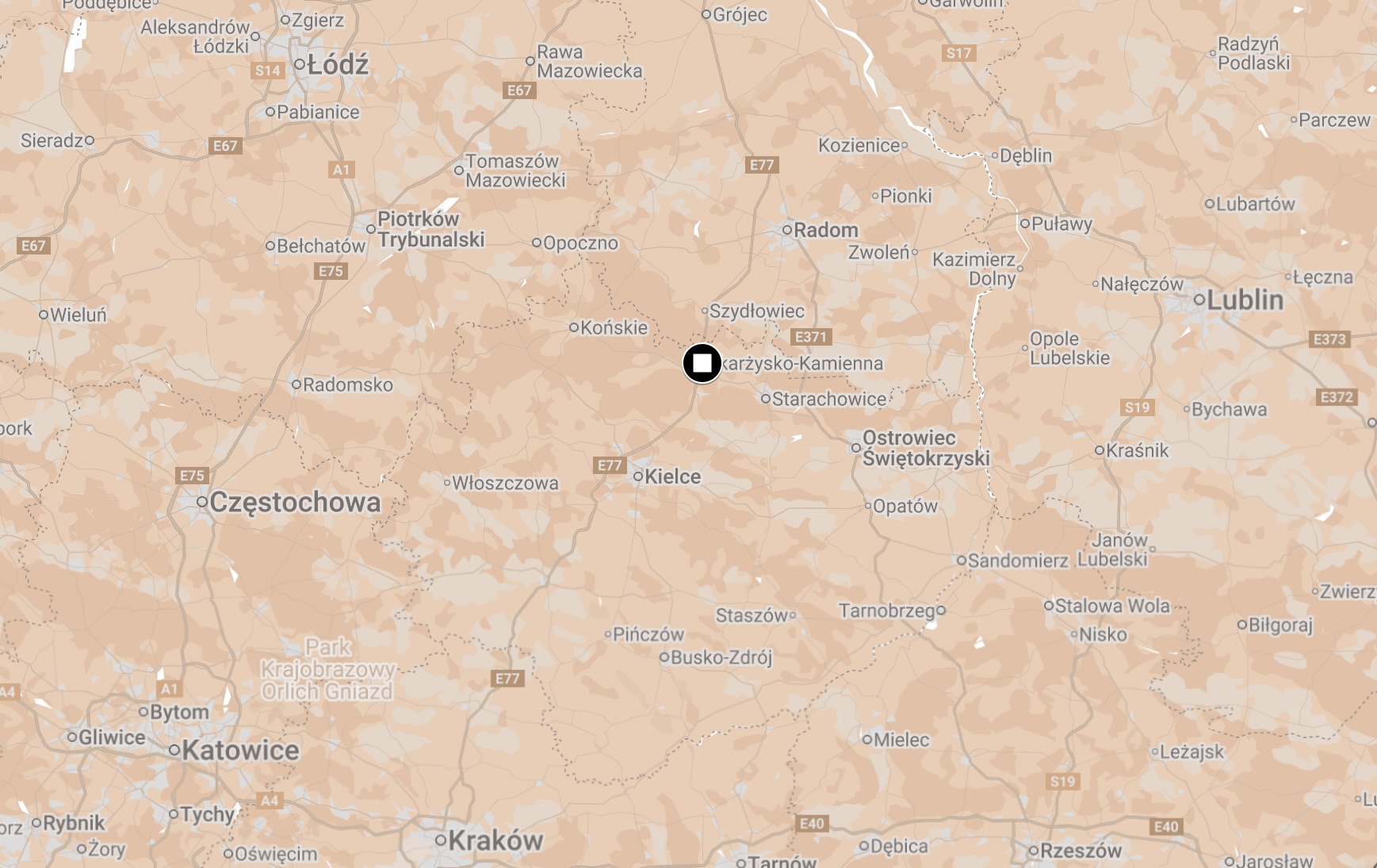
Members of the Boys were slave labourers in the Skarzysko-Kamienna labour camp in south-central Poland.
The Boys were teenagers and child-Holocaust survivors, who were brought to the UK after the war for rest and rehabilitation.
In the Third Reich, the German Leipzig based company HASAG, Hugo Schneider AG, became a Nazi arms-manufacturing conglomerate with dozens of factories across German occupied Europe. They used slave labour on a vast scale and tens of thousands of Jews from Poland died producing armaments in HASAG factories.
History
After the German invasion, the private German company HASAG took over the running of the Polish Państwowa Fabryka Amunicji (National Ammunition Factory). The company had been set up in 1924 in Skarżysko-Kamienna due to its strategic location in Poland’s “security triangle” which had excellent railway access. It soon became one of the most advanced munitions factories in Europe.
Skarżysko-Kamienna was a one business town and the company built many of the apartment blocks and public buildings. The factory buildings were located in the central and eastern districts.
The Germans used the plant to manufacture armaments for the war effort as did several other camps in the area. HASAG factories not only in Poland, but also in Germany employed a Polish forced labourers and concentration camp prisoners. In September 1942, Polish workers were replaced by Jewish ones and a forced labour camp was established.
Arrival
Skarżysko-Kamienna was for many of the Boys their first experience of a labour camp. Those members of the Boys who were taken to the camp were teenagers. Some had just been separated from their families in selections while other would lose their relatives in the camp. Menachem Silberstein was one of them. He also fell ill from typhoid and almost died.
“Shots were fired in the air and people rushed out their houses at once. In the main street, a dozen open lorries stood waiting and all the young men and boys were ordered to climb in. I was one of them … I looked around for my parents and caught the sight of my father standing gazing down in horror from the first floor window of the Jewish Council. His hat was off and both his hands were clasping his face in despair as the sight of his young son being driven away. That was the very last time I saw my father. I did not see my mother again either.”
Salek Orenstein quoted in Martin Gilbert, The Story of 732 Young Concentration Camp Survivors (Wiendenfeld & Nicholson, 1996).
Orenstein was 14 years old when he was held in the camp.
Others had already experienced the concentration camp system and had been transferred from the Kraków-Płaszów concentration camp, among them was 15 year old Chaim Olmer. They were shocked by what they saw, he later said, “The site that greeted us was like something out of hell. Yellow people, dressed in paper sacks, shuffled along as if in a dream.”
Structure
Conditions in Skarżysko-Kamienna made it one of the most notorious camps. The camp was filthy and overcrowded. Prisoners wore their own clothes, and KL was painted on the back of the garments that were soon rags.
The Skarżysko-Kamienna factory was divided into three separate camps, A, B, and C.
The Jewish prisoners of Werk A worked in one of the four departments of the factory: shell and grenade production, small ammunition production, automatic weapons production and instrument production. Production was carried out in a non-stop 12-hour two-shift mode. Werk B produced, among others ammunition for anti-aircraft guns and blank ammunition for small arms. The toughest in terms of working conditions in the camp was Werk C, where workers were forced to fill the projectiles’ shells and mines with TNT and picric acid.
Werk A & B were located near the central railway junction and main plant area. Werk C was further out in the Bzin/Rejów forested district. Typically, armament factories were located in forested areas for security reasons. Sections of the surrounding forests still contain traces of old infrastructure and the mass graves of the victims.
“I remember when I first came to Skarsżysko camp. I was put on thread machines and lots of oil was spraying on me. All my clothing got soaked with oil, and from that I got sores on my body which festered. After a while I was transferred to a capstan machine and was supposed to produce a hundred rounds of two centimetre bullets an hour. In one hour at the beginning I could not produce that amount. One of the German overseers, with a kapo, took me into the office, put me over a chair, and the two of them started to beat me. By the time they were finished I could not move.”
Sam Freiman quoted in Martin Gilbert, The Story of 732 Young Concentration Camp Survivors (Wiendenfeld & Nicholson, 1996).
Freiman was 16 years old when he was held in the camp.
In 1942 there were about 5,000 prisoners in the camp, but that figure rose after the defeat of the German army at Stalingrad in the winter of 1942-43 as munitions production became increasingly important. Of the 25,000-30,000 prisoners in the camp as estimated 18,000-23,000 died of exhaustion or starvation or were murdered by the guards.
The atmosphere was extremely violent. Sick prisoners were shot in the forest and there were also frequent hangings. Salek Orenstein also recalled that one day volunteers to go to Palestine were requested. Some men volunteered as there were rumours of prisoner exchanges. The next day he was ordered with a group of others to collect their clothes from the woods. He said, “The terrors imposed in the camp were horrendous.”
Resistence
The Polish and Jewish slave workers both sabotaged the production, despite severe penalties including numerous public executions of the culprits. The Polish resistance also smuggled ammunition and components out of the camp.
Despite horrific conditions, Jewish inmates engaged in clandestine cultural and religious life, famously including the crafting of a secret shofar (ram’s horn) for Rosh Hashanah (the Jewish New Year) in 1943, under the guidance of the Radoszyce Rebbe, a rabbi in the camp.
Dissolution
The camp was evacuated as the Red Army approached. The remaining prisoners were divided into three groups. The first group was transported by rail to the HASAG facility in Częstochowa. The second group, consisting exclusively of women, was sent to the camp at the factory in Leipzig. The third transport carried Jewish men to the Buchenwald concentration camp.
A large number of the Boys came together as a group in Skarżysko-Kamienna and they became skilled armaments producers. They would be used as slave labourers in other HASAG plants as the war went on.
Aftermath
After the end of World War II the factory continued to make some armaments but was known for household goods such as lawnmowers.
Today, it is operated by MESKO S.A., who produce advanced munitions and world-class missile systems like the PIORUN and SPIKE. The historic core of the Państwowa Fabryka Amunicji is still a heavily secured, active military defence site. The historic stone architectures of the original factories—such as the distinctive stone fire station building—can still be seen from the perimeter – but the facility itself is completely closed to the general public.
Memorialisation
There is a monument near the local Technical Scientific Institutes that commemorate the estimated 35,000 victims who perished in the camp.
The White Eagle Museum (Muzeum im. Orła Białego, Słoneczna 90) has a permanent exhibition on the camp.
 About
About History
 Education
 Quilts
 FIlms
FIlms Photos
 News Media & Events
 Publications
 Donate