Israel
Many of the Boys volunteered to fight as Machal volunteers in the 1948 Arab–Israeli War.
Many had been part of Zionist familes who had hoped to settle in Palestine before the war as they saw no future for themselves in Europe.
Many of the Boys had hoped to make their way to Palestine after the war – not to Britian – and had hoped accepting a visa for the UK would make that journey easier.
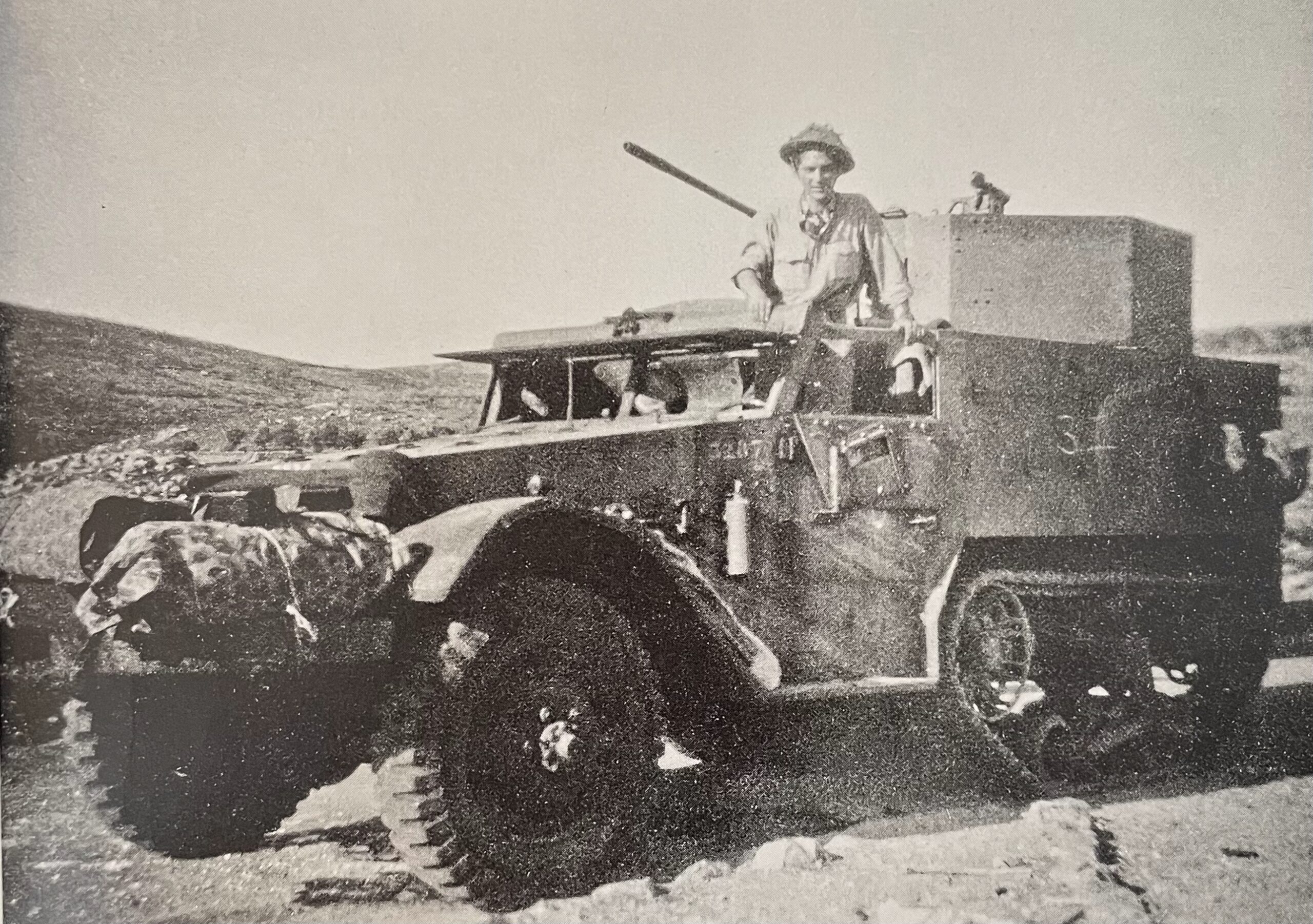
Some 4,000 volunteers, mostly Jews but also non-Jews, arrived from all over the world to fight alongside Israeli forces. Machal is an acronym of מתנדבי חוץ לארץ (Mitnadvei Hutz LaAretz, “volunteers from abroad”).
There were 600 volunteers from Britain but the emebrs of the Boys who volunteered to fight are not included in this figure as at the time they stateless.
The Machal volunteers were a small percentage of the Israeli fighting forces, but were assigned to virtually every unit in the Israeli army, navy and air force. Mahal was disbanded after the war and most of the volunteers went home, although some remained in the country as permanent residents.
The Boys and the 1948 War
It was illegal to volunteer to fight in the newly founded state of Israel so recruitment was carried out by the Jewish underground, the Haganah. They had a recruitment office behind a bookshop on Charing Cross Road run by a ‘Mr Gross’. They also visited the ORT training ship and recruited members of the Boys who had been trained as sailors as they were needed for the nascent Israeli navy.
Leaving the UK
The Boys who decided that they wanted to volunteer to fight had to obtain permits to take a holiday in France or Switzerland. They then went to Dover and crossed the Channel to Calais. There they were met by French members of the Jewish underground and given tickets to travel by train to Paris.
“I left England in August 1948, after I had volunteered to join the Israeli army. Earlier I was furnished with a travel permit, a titre de voyage, with a visa through France. I crossed the Channel from Dover to Calais. I remember the customs official in Dover asking whether the clothing I was taking wasn’t a bit light for Switzerland. It seems that although we attempted to disguise our true destination, the British knew where we were heading.”
“I was not alone on the trip. Travelling with me were a few of the ‘boys’ such as Menachem Silberstein, Sam ?Freiman, Jimmy (Zelig) Rosenblatt, Zvi Brand and David Turek. From Calais we took the train for Paris where we reported to an office in the Boulevard Haussmann. We spent only a few hours in Paris and went by train to Marseille where we arrived some twelve hours later. In Marseille we stayed in Camp St Jerome, which for some reason served as a transit camp for volunterrs for the Israeli forces. For some reason we had to stay there for nearly two months, when we were flown to Haifa. During our stay we had some sort of military service which lay ahead in Israe.”
Chaim Liss quoted in Martin Gilbert, The Boys: The Story of 732 Young Concentration Camp Survivors (Wiedenfeld and Nicholson, 1996).
In Paris they were told to report to an office on Boulevard Haussmann, which was the European headquarters of the Jewish underground. They were treated to dinner in a fancy restaurant before boarding the night train for Marseilles. Dotted around the Mediterranean port city were camps where the Jewish underground gave them basic weapons training before they sailed or flew to Haifa.
At the Tel Litvinsky camp, a former British military base, they joined the newly established 7th Brigade, which was made up of English-speaking volunteers. The unit had been set up after a senior American military advisor, who was the commander of the Jerusalem front, was accidentally shot dead by a Hebrew speaking soldier who had not understood when he gave the necessary password in English.
“When a cease-fire was arranged I decided to return to England as my travel document was expiring and I wanted to become a British subject. Looking back I am very proud to have participated in the War of Israeli Independence and to have belonged to the select group of what is known as Mahal. When I was shunted around for four weeks from Buchenwald to Theresienstadt, and was literally gasping for life, the last thought that would have been in my mind was that I would one day play my part in fighting for a Jewish State, an aspiration for which our ancestors had been striving for two thousand years.”
Krulik Wilder, written testament 1995.
After a brief stint in the trenches near Lydda airport, the volunteers were assigned to fight. Some went to the Negev, others were sent north to the Upper Galilee. The Upper Galilee had been designated to be part of an Arab state by the United Nations partition plan which had been rejected by the Arabs. After the third ceasefire of the war was broken by the Arab Liberation Army, a volunteer force made up of Palestinians and other Arab nationals, that had been set up by the Arab League, Ben Gurion the first Prime Minister of Israel, decided to drive the ALA out of the Upper Galilee and the Arab Palestinians with them. There were fierce battles here in which the Boys took part.
Bachad and the Boys
Among those who looked after the Boys in the UK was the religious Zionist movement Bachad. Members of Bachad, today Bnei Akiva, were involved in the Jewish underground in the UK.
Edi Maagan and her late husband, Shalom Marcowitz, one of Bahad’s leaders, ran a hostel for young survivors in London’s East End in Cazenove Rd. Her basement was a hub of activity for the London branch of the Haganah—the underground force that would later become the Israel Defense Forces. Those who had joined up spent their last night in the United Kingdom in Edi’s home and were given their final briefing.
One of the Bachad volunteers was 22 year old Esther Calingold who was killed fighting in the Old City of Jerusalem in in the summer of 1948.
One of the Boys, David Hirschfeld, volunteered without telling his brother Moniek, the only member of his family who had survived the Holocaust. “It was an illegal activity and I didn’t want to influence him to take a similar risk,” he wrote later. “It might be difficult to understand why people like us who were barely saved from extermination would volunteer,” he admitted, but felt it was “essential for the Jewish people to have a place of their own, where they can protect themselves and have their own armed forces.”
Sam Freiman was the sole survivor of not only his family but the entire Jewish community of Jeziorna in Poland. Before his death in December 2019, he proudly showed visitors to his apartment in southwest London a grainy picture of him in his first IDF uniform. “I felt I had an obligation to fight for a Jewish state as my father had been a staunch Zionist,” he recalled. “If he could have seen me fighting, he would have been so happy and gone straight to heaven!”
Many of the Boys who fought in the battles of 1948 remained in Israel but many returned back to the UK. Some because they felt their home and their future lay elsewhere or others because life in Israel was simply too hard and they were unable to find work.
UK
Some members of the Boys joined the British Army.
USA
Those male members of the Boys who decided to settle in the United States had to do their military service inorder to qualify for citizenship.
 About
About History
 Education
 Quilts
 FIlms
FIlms Photos
 News Media & Events
 Publications
 Donate